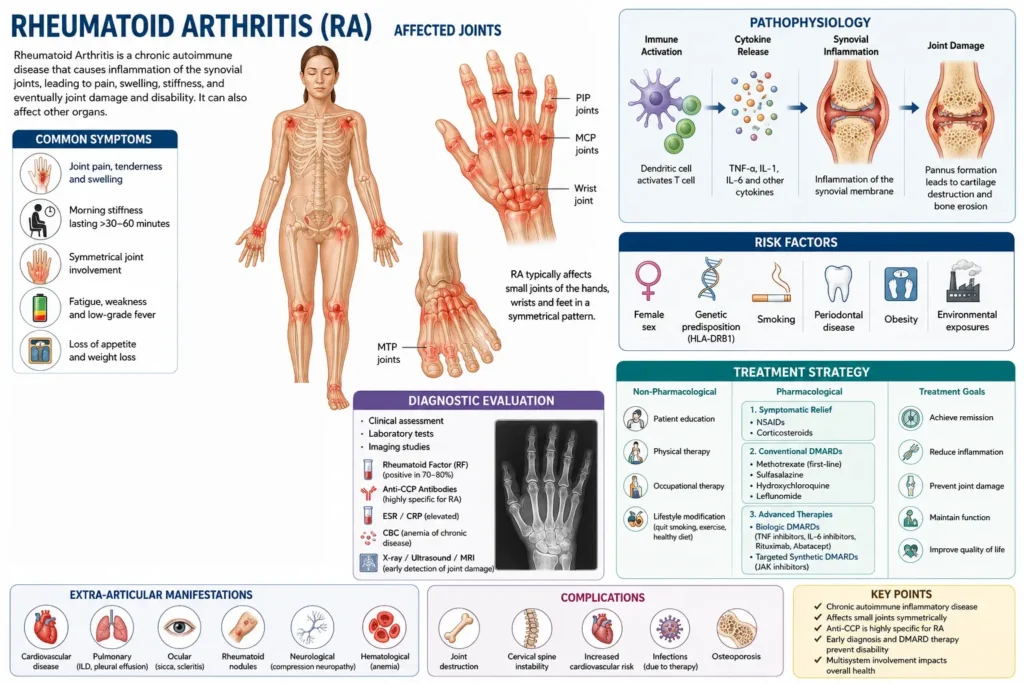
Rheumatoid Arthritis (RA) is a chronic, systemic autoimmune disease characterized by persistent inflammation of the synovial joints. Unlike osteoarthritis, which primarily results from mechanical wear and tear, RA is driven by immune-mediated inflammation that can lead to progressive joint destruction, disability, and systemic complications.
RA primarily affects small joints in a symmetrical pattern, especially those of the hands, wrists, and feet. However, it is a multisystem disease that can involve the cardiovascular, pulmonary, ocular, neurological, and hematological systems.
The prevalence of RA is approximately 0.5%–1% worldwide, with women affected two to three times more frequently than men.
Epidemiology of Rheumatoid Arthritis
Global Prevalence
Rheumatoid Arthritis affects approximately 1% of the global population and represents one of the most common chronic inflammatory arthritides.
Age and Gender Distribution
- Most commonly develops between 30 and 60 years of age
- Women are affected 2–3 times more often than men
- Can occur at any age, including childhood and older adulthood
Risk Factors
Major risk factors include:
- Female sex
- Family history of RA
- Cigarette smoking
- Obesity
- Periodontal disease
- Environmental exposures
- Certain genetic factors, particularly HLA-DRB1 alleles
Causes and Pathogenesis of Rheumatoid Arthritis
Autoimmune Mechanisms
RA develops when the immune system mistakenly attacks the synovial membrane lining the joints.
This immune response triggers:
- Synovial inflammation
- Cytokine release
- Cartilage destruction
- Bone erosion
- Joint deformity
Genetic Factors
Genetic susceptibility contributes significantly to disease development.
Important genetic associations include:
- HLA-DR4
- HLA-DRB1 shared epitope
- PTPN22 gene variants
Individuals with these genetic markers have an increased risk of developing RA.
Environmental Triggers
Potential environmental triggers include:
- Smoking
- Air pollution
- Occupational silica exposure
- Periodontal infections
- Microbiome alterations
These factors may initiate autoimmune reactions in genetically susceptible individuals.
See Also: Juvenile Rheumatoid Arthritis: Symptoms, Treatment & Prognosis
Pathophysiology of Rheumatoid Arthritis
Synovial Inflammation
The hallmark of RA is chronic synovitis.
Activated immune cells infiltrate the synovium, including:
- T lymphocytes
- B lymphocytes
- Macrophages
- Plasma cells
Cytokine-Mediated Damage
Inflammatory cytokines play a crucial role:
Tumor Necrosis Factor-Alpha (TNF-α)
Promotes:
- Synovial inflammation
- Cartilage degradation
- Bone erosion
Interleukin-1 (IL-1)
Contributes to:
- Joint destruction
- Osteoclast activation
Interleukin-6 (IL-6)
Associated with:
- Systemic inflammation
- Fatigue
- Elevated acute phase reactants
Pannus Formation
Persistent inflammation produces pannus, an invasive granulation tissue that:
- Covers articular cartilage
- Erodes bone
- Causes irreversible joint damage
Symptoms & Signs of Rheumatoid Arthritis
Early Symptoms
Patients commonly present with:
- Fatigue
- Malaise
- Low-grade fever
- Weight loss
- Generalized weakness
Articular Manifestations
Characteristic joint symptoms include:
Symmetrical Polyarthritis
Typically affects:
- Metacarpophalangeal (MCP) joints
- Proximal interphalangeal (PIP) joints
- Wrists
- Feet
Morning Stiffness
Morning stiffness lasting more than 30–60 minutes is highly suggestive of inflammatory arthritis.
Joint Swelling and Pain
Inflamed joints become:
- Tender
- Warm
- Swollen
- Restricted in movement
Common Joint Deformities in Rheumatoid Arthritis
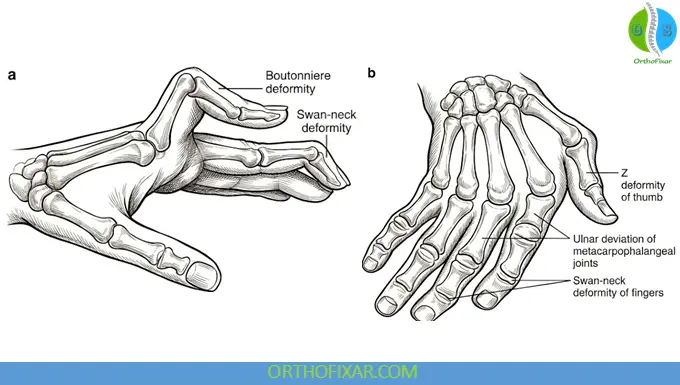
Advanced disease may produce characteristic deformities:
Swan-Neck Deformity
- Hyperextension of the PIP joint
- Flexion of the DIP joint
Boutonnière Deformity
- Flexion of the PIP joint
- Hyperextension of the DIP joint
Ulnar Deviation
Lateral deviation of fingers at the MCP joints.
Z-Deformity of the Thumb
Common in longstanding RA due to joint instability.
Extra-Articular Manifestations
RA is a systemic disease with multiple organ involvement.
Rheumatoid Nodules
Firm subcutaneous nodules typically found over:
- Elbows
- Forearms
- Pressure points
Cardiovascular Disease
Patients have increased risk of:
- Coronary artery disease
- Myocardial infarction
- Heart failure
Cardiovascular disease remains a major cause of mortality in RA.
Pulmonary Manifestations
Possible complications include:
- Interstitial lung disease
- Pleural effusion
- Pulmonary nodules
Ocular Manifestations
Eye involvement may cause:
- Dry eyes
- Episcleritis
- Scleritis
Neurological Complications
Examples include:
- Carpal tunnel syndrome
- Peripheral neuropathy
- Cervical spine instability
Diagnosis of Rheumatoid Arthritis
Clinical Assessment
Diagnosis relies on:
- Clinical history
- Physical examination
- Laboratory investigations
- Imaging studies
Laboratory Findings
Rheumatoid Factor (RF)
Positive in approximately 70–80% of patients.
Anti-Cyclic Citrullinated Peptide (Anti-CCP) Antibodies
Features:
- High specificity for RA
- Predictive of severe disease
- Useful in early diagnosis
Inflammatory Markers
Common findings include:
- Elevated ESR
- Elevated CRP
Complete Blood Count
May reveal:
- Normocytic anemia
- Thrombocytosis
- Chronic inflammatory changes
Imaging in Rheumatoid Arthritis
Conventional Radiography
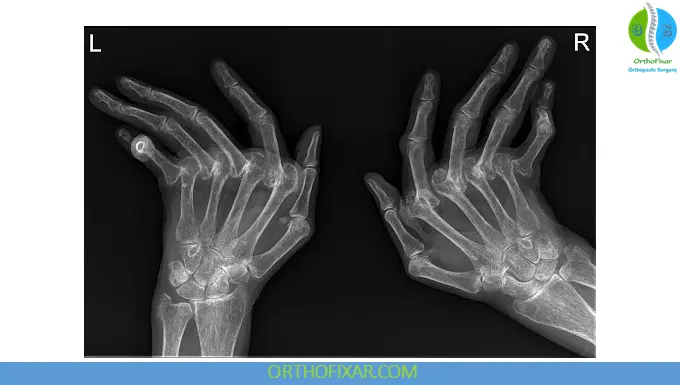
Typical findings:
- Periarticular osteopenia
- Joint space narrowing
- Marginal erosions
Ultrasound
Useful for:
- Detecting synovitis
- Identifying early erosions
- Monitoring disease activity
Magnetic Resonance Imaging (MRI)
MRI can identify:
- Early inflammatory changes
- Bone marrow edema
- Synovial hypertrophy
Before irreversible radiographic damage occurs.
Classification Criteria for Rheumatoid Arthritis
The 2010 ACR/EULAR classification criteria consider:
- Joint involvement
- Serology
- Acute phase reactants
- Duration of symptoms
A score of 6 or more supports the diagnosis of RA.
Rheumatoid Arthritis Treatment
Early treatment is essential to prevent irreversible joint damage.
Treatment Goals
- Achieve remission
- Reduce inflammation
- Prevent joint destruction
- Preserve function
- Improve quality of life
Non-Pharmacological Management
Patient Education
Patients should understand:
- Disease progression
- Medication adherence
- Lifestyle modifications
Physical Therapy
Benefits include:
- Improved mobility
- Muscle strengthening
- Joint protection
Occupational Therapy
Helps patients maintain independence in daily activities.
Smoking Cessation
Smoking cessation significantly improves outcomes.
Pharmacological Treatment
Nonsteroidal Anti-Inflammatory Drugs (NSAIDs)
Provide symptomatic relief but do not prevent disease progression.
Examples:
- Ibuprofen
- Naproxen
- Diclofenac
Corticosteroids
Used for rapid control of inflammation.
Examples:
- Prednisone
- Methylprednisolone
Long-term use should be minimized due to adverse effects.
Disease-Modifying Antirheumatic Drugs (DMARDs)
DMARDs for rheumatoid arthritis are the cornerstone of treatment.
Conventional Synthetic DMARDs
Methotrexate
First-line therapy for most patients.
Benefits include:
- Disease control
- Reduced radiographic progression
- Improved long-term outcomes
Sulfasalazine
Often used in combination therapy.
Hydroxychloroquine
Useful in mild disease.
Leflunomide
Alternative for patients intolerant to methotrexate.
Biologic DMARDs
Biologic therapies target specific inflammatory pathways.
TNF Inhibitors
Examples:
- Adalimumab
- Etanercept
- Infliximab
- Certolizumab
- Golimumab
IL-6 Inhibitors
Example:
- Tocilizumab
B-Cell Depletion Therapy
Example:
- Rituximab
T-Cell Costimulation Blockade
Example:
- Abatacept
Targeted Synthetic DMARDs
Janus Kinase (JAK) Inhibitors
Examples:
- Tofacitinib
- Baricitinib
- Upadacitinib
These agents provide effective oral treatment options for selected patients.
Surgical Management
Surgery may be required in advanced disease.
Common procedures include:
- Synovectomy
- Tendon reconstruction
- Arthroplasty
- Arthrodesis
Joint replacement can significantly improve function and quality of life.
Complications of Rheumatoid Arthritis
Potential complications include:
Musculoskeletal
- Joint destruction
- Tendon rupture
- Osteoporosis
Cardiovascular
- Accelerated atherosclerosis
- Heart failure
Infectious
Increased infection risk due to:
- Immune dysfunction
- Immunosuppressive medications
Cervical Spine Disease
Atlantoaxial instability may cause spinal cord compression.
Prognosis
The prognosis of RA has improved substantially due to:
- Early diagnosis
- Treat-to-target strategies
- Modern DMARD therapy
- Biologic agents
Poor prognostic indicators include:
- High anti-CCP titers
- Positive rheumatoid factor
- Early erosive disease
- Smoking
- High disease activity
Without adequate treatment, RA can lead to severe disability and reduced life expectancy.
Prevention Strategies
Although RA cannot be completely prevented, risk reduction strategies include:
- Smoking cessation
- Maintaining healthy body weight
- Good oral hygiene
- Early recognition of symptoms
- Prompt rheumatology referral
Key Takeaways
- Rheumatoid Arthritis is a chronic autoimmune inflammatory disease.
- Symmetrical polyarthritis and prolonged morning stiffness are hallmark features.
- Anti-CCP antibodies provide high diagnostic specificity.
- Early initiation of DMARD therapy is critical.
- Biologic and targeted therapies have dramatically improved outcomes.
- RA is a systemic disease with significant cardiovascular and extra-articular complications.
- Early diagnosis and aggressive treatment help prevent disability and improve survival.
References & More
- Chauhan K, Jandu JS, Brent LH, et al. Rheumatoid Arthritis. [Updated 2023 May 25]. In: StatPearls [Internet]. Treasure Island (FL): StatPearls Publishing; 2026 Jan-. Available from: https://www.ncbi.nlm.nih.gov/books/NBK441999/
- Radu AF, Bungau SG. Management of Rheumatoid Arthritis: An Overview. Cells. 2021 Oct 23;10(11):2857. doi: 10.3390/cells10112857. PMID: 34831081; PMCID: PMC8616326. Link
- InformedHealth.org [Internet]. Cologne, Germany: Institute for Quality and Efficiency in Health Care (IQWiG); 2006-. Overview: Rheumatoid arthritis. [Updated 2024 Jan 11]. Available from: https://www.ncbi.nlm.nih.gov/books/NBK384455/
- Jahid M, Khan KU, Rehan-Ul-Haq, Ahmed RS. Overview of Rheumatoid Arthritis and Scientific Understanding of the Disease. Mediterr J Rheumatol. 2023 Aug 1;34(3):284-291. doi: 10.31138/mjr.20230801.oo. PMID: 37941854; PMCID: PMC10628871. Link
- Blom, A., Warwick, D., & Whitehouse, M. R. (2018). Apley & Solomon’s system of orthopaedics and trauma (10th ed.). CRC Press