What Is Multiple Epiphyseal Dysplasia?
Multiple epiphyseal dysplasia (MED) is a rare inherited skeletal disorder that affects the growth and development of the epiphyses, which are the rounded ends of long bones. The condition primarily involves abnormal cartilage and bone formation, leading to joint pain, stiffness, gait abnormalities, and early-onset osteoarthritis.
MED belongs to a group of disorders known as skeletal dysplasias. Symptoms usually begin in early childhood, although severity varies significantly among affected individuals.
The disorder may be inherited in either an autosomal dominant or autosomal recessive pattern depending on the causative genetic mutation.
Epidemiology of Multiple Epiphyseal Dysplasia
Autosomal dominant MED is estimated to affect approximately 1 in 10,000 individuals. However, the true prevalence may be underestimated because mild cases are frequently misdiagnosed or remain undetected.
Both males and females are equally affected.
Causes and Genetics of Multiple Epiphyseal Dysplasia
Multiple epiphyseal dysplasia is caused by mutations in genes involved in cartilage structure and skeletal development.
Genes Associated With Autosomal Dominant MED
The dominant form is commonly associated with mutations in:
- COMP
- MATN3
- COL9A1
- COL9A2
- COL9A3
Among these, mutations in the COMP gene are the most common.
Gene Associated With Recessive MED
The recessive form is caused by mutations in the:
- SLC26A2 gene
These genetic abnormalities disrupt normal cartilage formation and impair endochondral ossification, resulting in abnormal epiphyseal development.
See Also: Hereditary Multiple Exostoses (HME): Causes, Symptoms & Treatment
Pathophysiology
In MED, defective cartilage matrix proteins impair normal skeletal growth. The abnormal cartilage weakens joint surfaces and affects ossification centers within the epiphyses.
Over time, progressive degeneration of the affected joints occurs, increasing the risk of:
- Premature osteoarthritis
- Joint deformities
- Chronic pain
- Reduced mobility
The hips and knees are most commonly involved.
Clinical Features of Multiple Epiphyseal Dysplasia
Symptoms generally appear during childhood after weight-bearing activities increase.
Common Symptoms
- Hip pain
- Knee pain
- Joint stiffness
- Fatigue after walking
- Waddling gait
- Limited range of motion
- Mild short stature
- Joint deformities
Musculoskeletal Findings
Patients may develop:
- Genu valgum (knock knees)
- Genu varum (bow legs)
- Coxa vara
- Hypermobile finger joints
- Restricted elbow movement
Recessive MED Features
Individuals with recessive MED may also present with:
- Clubfoot
- Scoliosis
- Cleft palate
- Double-layered patella
- Hand and foot abnormalities
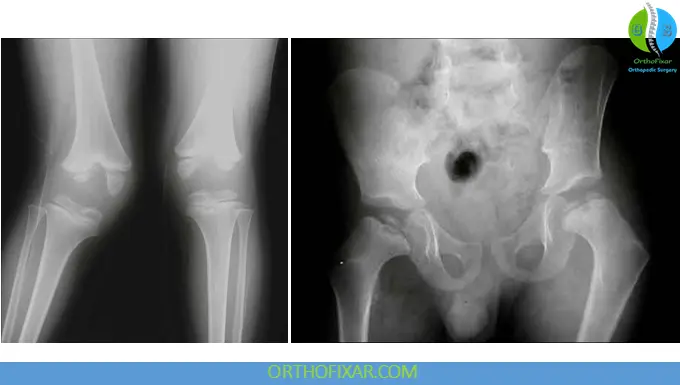
Radiographic Findings in MED
Radiographic evaluation is essential for diagnosis.
Typical Imaging Features
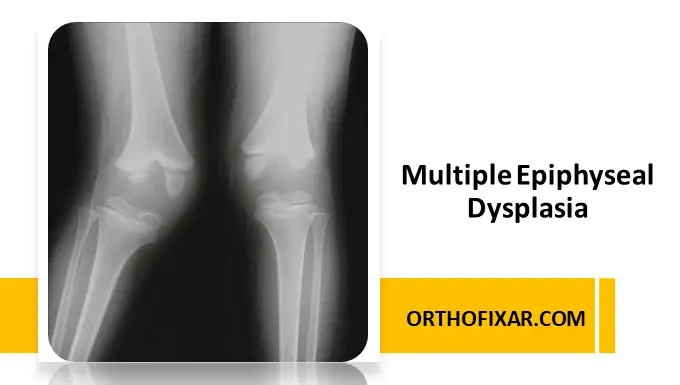
X-rays may reveal:
- Delayed ossification of epiphyses
- Small and irregular epiphyseal ossification centers
- Flattened femoral heads
- Hip dysplasia
- Irregular knee epiphyses
- Early degenerative joint disease
In adults, imaging often demonstrates severe osteoarthritic changes.
MRI may help evaluate cartilage damage and avascular necrosis in complicated cases.
Diagnosis of Multiple Epiphyseal Dysplasia
Diagnosis is based on clinical presentation, radiographic findings, and genetic testing.
Diagnostic Evaluation
Clinical Assessment
Physicians evaluate:
- Growth patterns
- Gait abnormalities
- Joint symptoms
- Family history
Imaging Studies
Recommended imaging includes:
- Plain radiographs
- MRI when indicated
Genetic Testing
Molecular genetic testing confirms pathogenic variants in MED-associated genes.
Genetic testing also helps distinguish MED from related skeletal dysplasias.
Differential Diagnosis
Several disorders may resemble multiple epiphyseal dysplasia.
Important Differential Diagnoses
- Legg-Calvé-Perthes disease
- Pseudoachondroplasia
- Spondyloepiphyseal dysplasia
- Early-onset osteoarthritis
- Juvenile idiopathic arthritis
Accurate diagnosis requires correlation of clinical, radiologic, and genetic findings.
Complications of Multiple Epiphyseal Dysplasia
Untreated or severe disease may result in long-term complications.
Common Complications
- Early osteoarthritis
- Chronic joint pain
- Hip deformities
- Mobility limitations
- Functional disability
- Avascular necrosis of the femoral head
Many patients eventually require orthopedic surgery in adulthood.
Treatment of Multiple Epiphyseal Dysplasia
There is currently no cure for MED. Management focuses on symptom control, preservation of joint function, and prevention of complications.
Conservative Management
Physical Therapy
Physical therapy helps improve:
- Muscle strength
- Joint mobility
- Functional capacity
Hydrotherapy may reduce joint stress during exercise.
Pain Management
Pain control may include:
- Acetaminophen
- NSAIDs
- Referral to pain specialists when necessary
Lifestyle Modifications
Patients are advised to:
- Avoid obesity
- Reduce repetitive joint stress
- Maintain low-impact physical activity
Surgical Treatment
Orthopedic procedures may be necessary in advanced disease.
Surgical Options
- Corrective osteotomy
- Acetabular osteotomy
- Joint-preserving procedures
- Total hip replacement
- Knee arthroplasty
Joint replacement is commonly required because of early degenerative arthritis.
Prognosis
The prognosis varies according to genetic subtype and disease severity.
Many individuals maintain near-normal life expectancy and cognitive function. However, chronic pain and progressive osteoarthritis can significantly affect quality of life.
Early diagnosis and multidisciplinary management improve long-term outcomes.
Genetic Counseling
Genetic counseling is recommended for affected individuals and families.
Inheritance Patterns
Autosomal Dominant MED
- One mutated gene copy is sufficient
- Each child has a 50% inheritance risk
Autosomal Recessive MED
- Both gene copies must be mutated
- Parents are typically asymptomatic carriers
Prenatal and preimplantation genetic testing may be available for families with known pathogenic variants.
Living With Multiple Epiphyseal Dysplasia
Long-term care often involves collaboration among:
- Orthopedic surgeons
- Geneticists
- Physical therapists
- Rheumatologists
- Pain specialists
Psychological and social support may also benefit patients coping with chronic pain and mobility limitations.
Key Takeaways
- Multiple epiphyseal dysplasia is a rare inherited skeletal dysplasia affecting the epiphyses.
- Common symptoms include joint pain, waddling gait, and early osteoarthritis.
- MED is associated with mutations in COMP, MATN3, COL9A genes, and SLC26A2.
- Diagnosis relies on imaging and genetic testing.
- Treatment focuses on symptom management and orthopedic care.
- Early intervention can improve mobility and quality of life.
Frequently Asked Questions (FAQs)
Is multiple epiphyseal dysplasia rare?
Yes. MED is considered a rare genetic skeletal disorder, although mild cases may be underdiagnosed.
Can multiple epiphyseal dysplasia be cured?
No cure currently exists. Treatment aims to reduce symptoms and preserve joint function.
Is MED inherited?
Yes. MED can be inherited in autosomal dominant or autosomal recessive patterns.
Does MED affect intelligence?
No. Intelligence is typically normal in individuals with MED.
Can adults with MED need joint replacement surgery?
Yes. Early-onset osteoarthritis commonly leads to hip or knee replacement in adulthood.
References & More
- Briggs MD, Wright MJ, Mortier GR. Multiple Epiphyseal Dysplasia, Autosomal Dominant. 2003 Jan 8 [Updated 2024 Jul 4]. In: Adam MP, Bick S, Mirzaa GM, et al., editors. GeneReviews® [Internet]. Seattle (WA): University of Washington, Seattle; 1993-2026. Available from: https://www.ncbi.nlm.nih.gov/books/NBK1123/
- Lachman RS, Krakow D, Cohn DH, Rimoin DL. MED, COMP, multilayered and NEIN: an overview of multiple epiphyseal dysplasia. Pediatr Radiol. 2005 Feb;35(2):116-23. doi: 10.1007/s00247-004-1323-4. Epub 2004 Oct 21. PMID: 15503005. Pubmed
- Anthony S, Munk R, Skakun W, Masini M. Multiple epiphyseal dysplasia. J Am Acad Orthop Surg. 2015 Mar;23(3):164-72. doi: 10.5435/JAAOS-D-13-00173. Epub 2015 Feb 9. Erratum in: J Am Acad Orthop Surg. 2015 Apr;23(4):266. doi: 10.5435/JAAOS-D-15-00122. PMID: 25667404. Pubmed