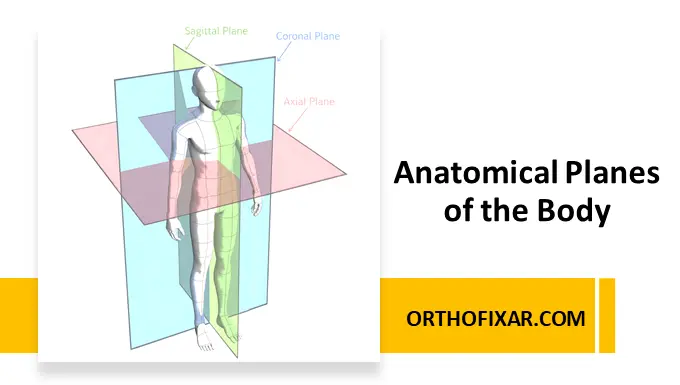
Understanding the anatomical planes of the body is fundamental in anatomy, radiology, surgery, orthopedics, physical therapy, and medical education. These imaginary flat surfaces divide the human body into sections and help healthcare professionals accurately describe locations, movements, injuries, and imaging findings.
This guide explains the three major body planes and sections — the sagittal plane, coronal plane, and transverse plane — with clinical relevance and educational examples.
What Are Anatomical Body Planes?
An anatomical body plane is an imaginary two-dimensional surface passing through the human body. These planes are used to describe:
- Direction of movement
- Orientation of organs
- Medical imaging views
- Surgical approaches
- Anatomical relationships
The three primary planes of body anatomy are:
- Sagittal Plane
- Coronal Plane
- Transverse Plane
Together, they form the basis of anatomical terminology and are essential for interpreting CT scans, MRI images, ultrasound, and physical examination findings.

1. Sagittal Plane
The sagittal plane divides the body into right and left portions.
If the division occurs exactly in the midline, it is called the: Median (midsagittal) plane
If the cut is off-center, it is called: Parasagittal plane
Structures and Movements in the Sagittal Plane
Movements occurring in the sagittal plane include:
- Flexion
- Extension
- Dorsiflexion
- Plantarflexion
Examples
- Bending the elbow
- Nodding the head
- Squatting
- Walking
Clinical Importance of the Sagittal Plane
The sagittal plane is frequently used in:
- MRI and CT imaging
- Neurosurgery
- Spinal surgery
- Orthopedic assessment
- Gait analysis
Example
A lumbar MRI sagittal view helps evaluate:
- Disc herniation
- Spinal stenosis
- Vertebral alignment

2. Coronal Plane
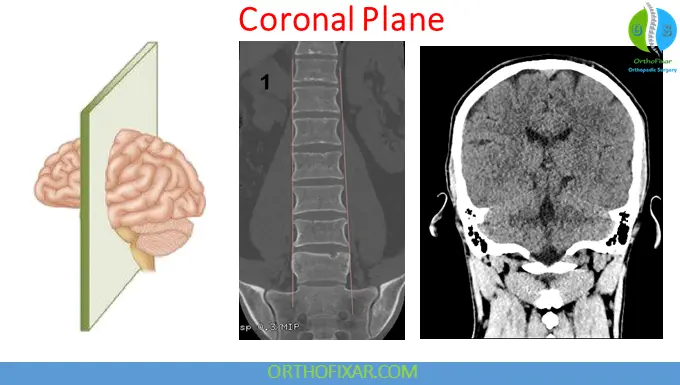
The coronal plane (also called the frontal plane) divides the body into:
- Anterior (front)
- Posterior (back)
Movements in the Coronal Plane
Movements commonly occurring in the coronal plane include:
- Abduction
- Adduction
- Lateral flexion
Examples
- Raising the arms sideways
- Side bending of the trunk
- Hip abduction exercises
Clinical Importance of the Coronal Plane
The coronal plane is important for evaluating:
- Scoliosis
- Limb alignment
- Shoulder motion
- Hip deformities
Imaging Applications
Coronal CT and MRI images help visualize:
- Kidney anatomy
- Sinus disease
- Hip joint pathology
- Knee meniscal injuries
3. Transverse Plane
The transverse plane (also called the axial or horizontal plane) divides the body into:
- Superior (upper)
- Inferior (lower) sections
Movements in the Transverse Plane
Movements occurring in the transverse plane include:
- Rotation
- Internal rotation
- External rotation
Examples
- Turning the head
- Twisting the trunk
- Rotating the shoulder
Clinical Importance of the Transverse Plane
The transverse plane is especially important in:
- CT imaging
- Cross-sectional anatomy
- Trauma evaluation
- Neurological imaging
Example
Axial CT scans are widely used to assess:
- Brain hemorrhage
- Abdominal trauma
- Pulmonary disease

Body Planes and Sections Summary Table
| Anatomical Plane | Divides the Body Into | Other Names | Common Movements |
|---|---|---|---|
| Sagittal Plane | Right and left | Median, parasagittal | Flexion and extension |
| Coronal Plane | Front and back | Frontal plane | Abduction and adduction |
| Transverse Plane | Upper and lower | Axial, horizontal plane | Rotation |
Sections of the Body in Anatomy
The terms sections of body and body planes and sections refer to how the body is cut or viewed for anatomical study and medical imaging.
Common section types include:
- Longitudinal sections
- Cross-sections
- Oblique sections
Oblique Plane
An oblique plane passes through the body at an angle that is not parallel to the three major anatomical planes.
Clinical Examples
- Oblique X-rays
- Cardiac imaging
- Dental radiographs
Importance of Anatomical Planes in Medical Education
Knowledge of planes of body anatomy is essential for:
- Anatomy students
- Radiologists
- Surgeons
- Orthopedic specialists
- Physiotherapists
- Emergency medicine physicians
Understanding the anatomical body plane system improves communication between healthcare professionals and enhances interpretation of diagnostic imaging.
Anatomical Planes in Radiology
Modern imaging modalities rely heavily on anatomical planes:
CT Scan Views
- Axial (transverse)
- Coronal reconstruction
- Sagittal reconstruction
MRI Views
MRI studies are routinely interpreted in all three planes for accurate diagnosis.

Common Mistakes Students Make
Confusing Coronal and Sagittal Planes
A simple memory aid:
- Sagittal = Side split
- Coronal = Crown/front view
- Transverse = Top and bottom
Frequently Asked Questions (FAQ)
What is the sagittal plane?
The sagittal plane divides the body into right and left portions.
What is the coronal plane?
The coronal plane divides the body into anterior and posterior sections.
What is the transverse plane?
The transverse plane divides the body into superior and inferior portions.
Why are anatomical planes important?
They provide a standardized method for describing anatomy, movement, and medical imaging.
Conclusion
The three primary anatomical planes of the body — the sagittal plane, coronal plane, and transverse plane — are essential concepts in anatomy and clinical medicine. Understanding these body planes and sections improves interpretation of movement, pathology, surgical orientation, and radiologic imaging.
Mastery of the planes of body anatomy forms a critical foundation for all healthcare professionals and medical students.
References & More
- Purves D, Augustine GJ, Fitzpatrick D, et al., editors. Neuroscience. 2nd edition. Sunderland (MA): Sinauer Associates; 2001. Some Anatomical Terminology. Available from: Pubmed
- Anatomical plane – Wikipedia
- Moore, Keith L.; Dalley, Arthur F.; Agur, Anne M. R. (2018). Clinically oriented anatomy (Eighth ed.). Philadelphia Baltimore New York London Buenos Aires Hong Kong Sydney Tokyo: Wolters Kluwer. pp. 5–8. ISBN 9781496347213.
- Saladin, Kenneth S. (2011). Human anatomy (3rd ed.). New York: McGraw-Hill.
- Tafti, Amin; Byerly, Doug W. (2025). “X-ray Radiographic Patient Positioning”. StatPearls. StatPearls Publishing. Retrieved 8 August 2025.