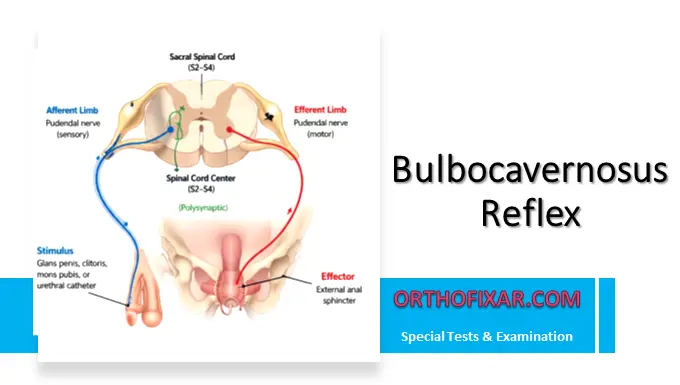
The bulbocavernosus reflex (BCR) is a key neurological reflex used in the assessment of integrity of the sacral spinal cord segments S2–S4, particularly in acute spinal cord injuries. It plays a crucial role in determining the presence and resolution of spinal shock, making it highly relevant in emergency, neurology, and orthopedic settings.
What is the Bulbocavernosus Reflex?
The bulbocavernosus reflex refers to the contraction of the external anal sphincter in response to stimulation of the genital or perineal region.
See Also: Cremasteric Reflex
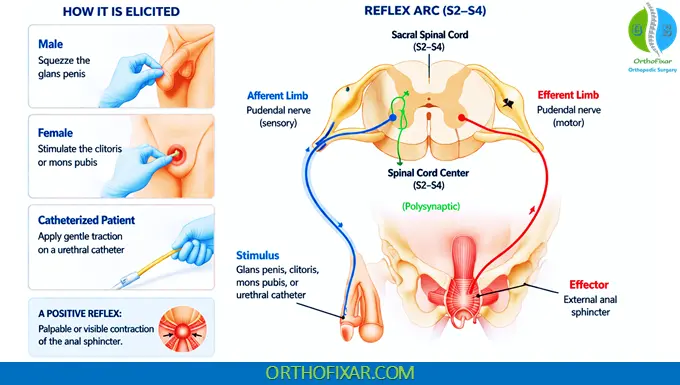
How it is elicited:
- In males: Squeezing the glans penis
- In females: Stimulation of the clitoris or mons pubis
- In catheterized patients: Gentle traction on a Foley catheter
A positive Bulbocavernosus Reflex is observed as a palpable or visible contraction of the anal sphincter.
Neuroanatomy of the Reflex
The Bulbocavernosus Reflex is a polysynaptic reflex mediated through the sacral spinal cord segments S2–S4.
Reflex arc components:
- Afferent limb: Pudendal nerve
- Spinal cord center: S2–S4 segments
- Efferent limb: Pudendal nerve
- Effector: External anal sphincter
Because of this pathway, the BCR is an important marker of sacral cord function.
How to Perform the Test (Step-by-Step)
- Position the patient appropriately (usually supine).
- Ensure privacy and explain the procedure.
- Apply stimulus:
- Squeeze glans penis / clitoris, or
- Gently pull on urinary catheter.
- Observe or palpate for anal sphincter contraction.
Clinical Interpretation Summary
| Finding | Interpretation |
|---|---|
| Absent BCR (acute phase) | Suggests spinal shock |
| Return of BCR | Indicates end of spinal shock |
| Present BCR + no motor/sensory function | Suggests complete spinal cord injury |
| Absent BCR after shock phase | Possible severe sacral cord injury |
Clinical Importance
1. Indicator of Spinal Shock
- Absent Bulbocavernosus Reflex is a hallmark of Spinal shock, a transient physiological loss of spinal cord function following acute injury.
- During this phase, all reflexes below the level of injury are suppressed.
2. Marker of Resolution of Spinal Shock
- The return of the Bulbocavernosus Reflex is one of the earliest signs that spinal shock has ended.
- This typically occurs within 24–48 hours after the initial injury (though it may vary).
3. Prognostic Value
- After spinal shock resolves:
- Absence of motor or sensory function + presence of Bulbocavernosus Reflex suggests a complete spinal cord injury.
- This carries a very poor prognosis for neurological recovery.
4. Limitations
- The BCR is not reliable for prognostic evaluation in:
- Lesions involving the Conus medullaris
- Lesions involving the Cauda equina
Key Takeaways
- The bulbocavernosus reflex is a critical bedside tool in spinal cord injury assessment.
- It helps differentiate spinal shock from permanent injury.
- Its early return marks neurological stabilization, not recovery.
- Interpretation must always be combined with a full neurological exam.
References & More
- Previnaire JG. The importance of the bulbocavernosus reflex. Spinal Cord Ser Cases. 2018 Jan 10;4:2. doi: 10.1038/s41394-017-0012-0. PMID: 29423307; PMCID: PMC5798690. Pubmed
- Lavoisier P, Proulx J, Courtois F, De Carufel F. Bulbocavernosus reflex: its validity as a diagnostic test of neurogenic impotence. J Urol. 1989 Feb;141(2):311-4. doi: 10.1016/s0022-5347(17)40749-x. PMID: 2913351. Pubmed
- Ertekin C, Reel F. Bulbocavernosus reflex in normal men and in patients with neurogenic bladder and/or impotence. J Neurol Sci. 1976 May;28(1):1-15. doi: 10.1016/0022-510x(76)90044-7. PMID: 180261. Pubmed
- Kirshblum S, Eren F. Anal reflex versus bulbocavernosus reflex in evaluation of patients with spinal cord injury. Spinal Cord Ser Cases. 2020 Jan 7;6:2. doi: 10.1038/s41394-019-0251-3. PMID: 31934354; PMCID: PMC6946655. Pubmed
- Egol KA. Handbook of fractures. 6th ed. Philadelphia: Lippincott Williams & Wilkins; 2019.