The Revised Trauma Score (RTS) is a widely used physiological scoring system designed to assess the severity of trauma and predict patient outcomes. It plays a crucial role in prehospital triage, emergency department evaluation, and trauma research.
Originally developed as a refinement of the Trauma Score, the RTS improves reliability and practicality by focusing on key physiological parameters that are rapidly measurable in emergency settings.
Components of the Revised Trauma Score
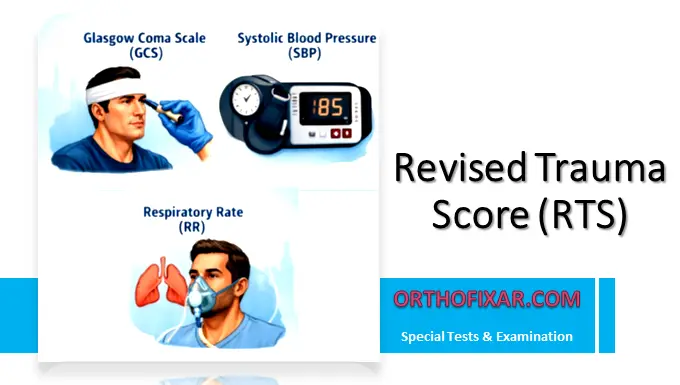
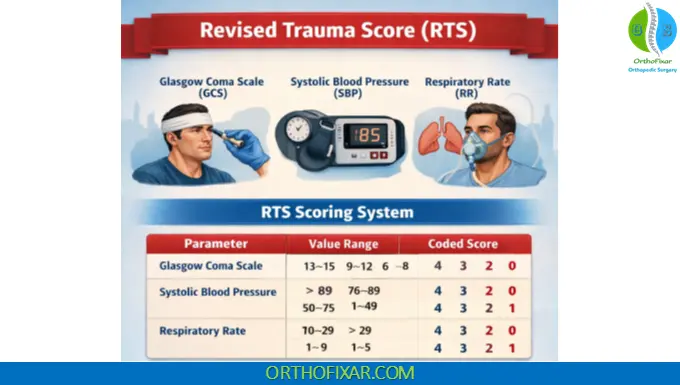
The RTS is based on three core physiological variables:
- Glasgow Coma Scale (GCS)
- Systolic Blood Pressure (SBP)
- Respiratory Rate (RR)
These parameters reflect the neurological, circulatory, and respiratory status of the patient, respectively.
Each variable is converted into a coded value (0–4) depending on predefined ranges.
See Also: Glasgow Coma Scale (GCS)
RTS Coding System
| Parameter | Value Range | Coded Score |
|---|---|---|
| GCS | 13–15 | 4 |
| 9–12 | 3 | |
| 6–8 | 2 | |
| 4–5 | 1 | |
| 3 | 0 | |
| SBP (mmHg) | >89 | 4 |
| 76–89 | 3 | |
| 50–75 | 2 | |
| 1–49 | 1 | |
| 0 | 0 | |
| RR (breaths/min) | 10–29 | 4 |
| >29 | 3 | |
| 6–9 | 2 | |
| 1–5 | 1 | |
| 0 | 0 |
RTS Calculation
There are two main forms of RTS:
1. Triage RTS (T-RTS)
- Simple sum of coded values:
T-RTS = GCS code + SBP code + RR code
- Maximum score = 12
- Used in prehospital triage
2. Weighted RTS (for outcome prediction)
The weighted formula is:
RTS = (0.9368 × GCS) + (0.7326 × SBP) + (0.2908 × RR)
- Maximum score ≈ 7.8408
- Used in trauma registries and research
This weighted system improves mortality prediction accuracy compared to the original Trauma Score.
Clinical Interpretation
- Higher RTS → Better prognosis
- Lower RTS → Increased mortality risk
Key thresholds:
- RTS < 8 (T-RTS) → Severe trauma, high risk of mortality
- RTS near maximum → Mild injury
The RTS is highly effective in identifying patients who require trauma center care, correctly detecting over 97% of non-survivors in early studies.
Clinical Applications
1. Prehospital Triage
- Rapid identification of critically injured patients
- Helps determine transport to Level I trauma centers
2. Emergency Department Assessment
- Provides objective physiological assessment
- Supports early decision-making
3. Trauma Research and Quality Control
- Standardized scoring system for:
- Outcome prediction
- Trauma registry data
- Comparative studies
The RTS remains a standard physiologic severity score in trauma systems worldwide.
Advantages of RTS
- Simple and rapid to calculate
- Uses readily available clinical data
- Reliable predictor of mortality
- Applicable in both prehospital and hospital settings
Limitations
- Less accurate in isolated severe injuries (e.g., single-region trauma)
- Does not account for:
- Anatomical injury severity
- Patient comorbidities
- Requires accurate measurement of vital signs, which may be difficult in chaotic environments
Comparison with Other Trauma Scores
| Score | Type | Key Use |
|---|---|---|
| RTS | Physiological | Triage & prognosis |
| Injury Severity Score (ISS) | Anatomical | Injury burden |
| Trauma Score (TS) | Older physiological | Replaced by RTS |
The RTS complements anatomical scores like ISS for comprehensive trauma assessment.
Summary
The Revised Trauma Score (RTS) is a cornerstone tool in trauma care, integrating neurological status (GCS), blood pressure, and respiratory rate into a rapid, reproducible scoring system.
- Essential for triage and early management
- Strong predictor of mortality
- Widely validated in trauma systems
Despite some limitations, RTS remains a fundamental component of modern trauma assessment protocols.
Revised Trauma Score Online Calculator
Revised Trauma Score (RTS) Calculator
Triage RTS: –
Weighted RTS: –
Severity: –
References & More
- Champion HR et al. A revision of the Trauma Score. Journal of Trauma. (PubMed)
- Moran ME, Nash JE. Revised Trauma Score. NCBI/StatPearls. (ncbi.nlm.nih.gov)
- Moore L et al. Unification of the Revised Trauma Score. (PubMed)
- Alvarez BD et al. Analysis of RTS in trauma patients. (PubMed)
- Jeong JH et al. New Trauma Score vs RTS. (PMC)
- Clinical evaluation studies on RTS prognostic value (PubMed)
- Egol KA. Handbook of fractures. 6th ed. Philadelphia: Lippincott Williams & Wilkins; 2019.