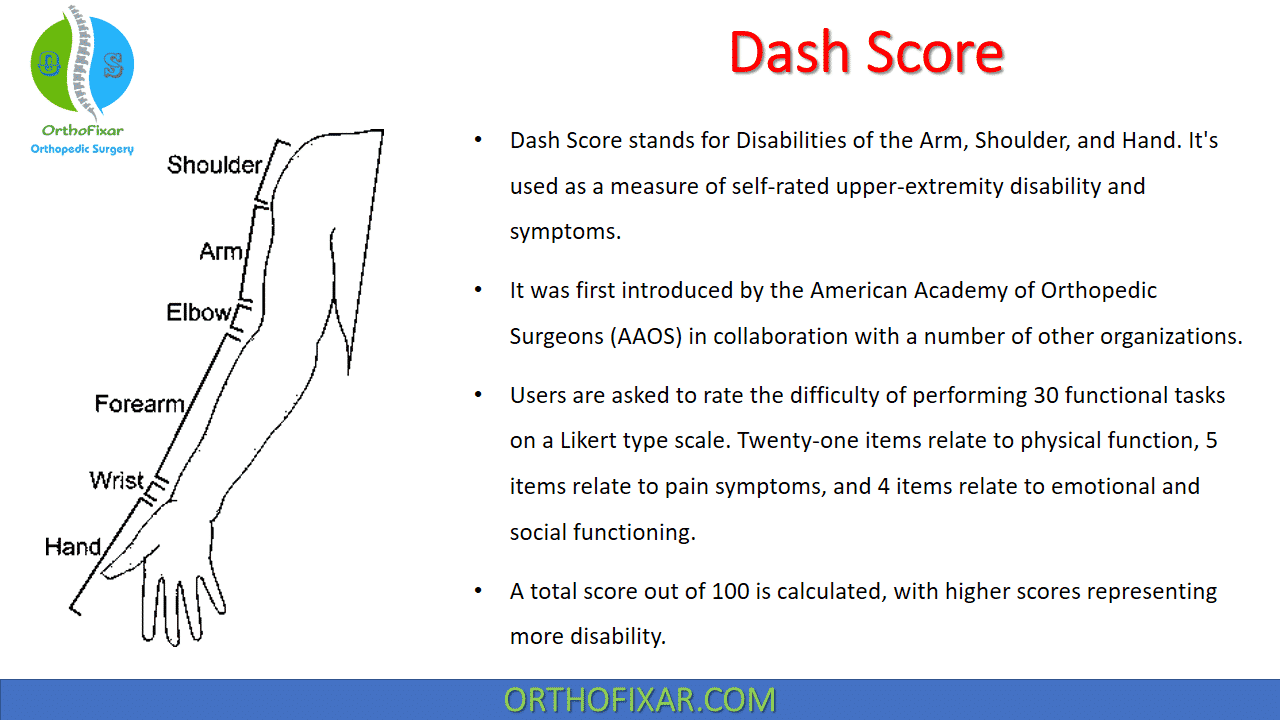
Dash Score stands for Disabilities of the Arm, Shoulder and Hand. It’s used as a measure of self-rated upper-extremity disability and symptoms.
It was first introduced by the American Academy of Orthopedic Surgeons (AAOS) in collaboration with a number of other organizations.
Users are asked to rate the difficulty of performing 30 functional tasks on a Likert type scale. Twenty-one items relate to physical function, 5 items relate to pain symptoms, and 4 items relate to emotional and social functioning.
A total dash score out of 100 is calculated, with higher scores representing more disability.
See Also: Upper Extremity Functional Index
The 30 functional tasks of DASH Score are:
The patient is asked to rate the ability to do the Following Activities in the Last week:
- Open a tight or new jar
- Write
- Turn a key
- prepare a meal
- Push open a heavy door
- Place an object on a shelf above your head
- Do heavy household chores (e.g., wash walls, wash floors)
- Garden or do yard work
- Make a bed
- Carry a shopping hag or briefcase
- Carry a heavy object (over 10 lbs)
- Change a light bulb overhead
- Wash or blow dry your hair
- Wash your hack
- put on a pullover sweater
- Use a knife to cut food
- Recreational activities which require little effort (e.g., card playing, knitting, etc.)
- Recreational activities in which you take some force or impact through your arm, shoulder or hand (e.g., golf, hammering, tennis, etc.)
- Recreational activities in which you move your arm freely (e.g., playing frisbee, badminton, etc.)
- Manage transportation needs (getting from one place to another)
- Sexual activities
- During the past week, to what extent has your arm, shoulder or hand problem interfered with your normal social activities with family, friends, neighbors or groups?
- During the past week, were you limited in your work or other regular daily activities as a result of your arm, shoulder or hand problem ?
- Arm, shoulder or hand pain
- Arm, shoulder or hand pain when you performed any specific activity
- Tingling (pins and needles) in your arm, shoulder or hand
- Weakness in your arm, shoulder or hand
- Stiffness in your arm, shoulder or hand.
- During the past week, how much difficulty have you had sleeping because of the pain in your arm, shoulder or hand?
- I feel less capable, less confident or less useful because of my arm, shoulder or hand problem.
The score is recorded as the following based on the difficulty of performing the task:
- 1: No difficulty.
- 2: Mild difficulty
- 3: Moderate difficulty
- 4: Severe difficulty
- 5: Unable to do the task.
The DASH Score can detect and differentiate small and large changes in disability over time after surgery in patients with upper extremity musculoskeletal disorders. A 10-point difference in mean DASH score might be considered as a minimal important change.

DASH Score Interpretation
Score Range
- 0 → 100 scale
- 0 = No disability
- 100 = Most severe disability
The score reflects functional limitation + symptom burden, not just pain.
General Interpretation Bands
Although the DASH scale was not originally designed with strict cutoffs, the following ranges are widely used in clinical practice:
| Dash Score Range | Interpretation | Clinical Meaning |
|---|---|---|
| 0 – 10 | Normal / Asymptomatic | No meaningful impairment |
| 11 – 20 | Minimal disability | Mild symptoms, little functional impact |
| 21 – 40 | Mild disability | Noticeable limitation in some activities |
| 41 – 60 | Moderate disability | Clear functional restriction |
| 61 – 80 | Severe disability | Major difficulty in daily tasks |
| 81 – 100 | Very severe disability | Near-complete functional loss |
How to Interpret Clinically
1. Focus on Functional Impact
The DASH score reflects:
- Activities of daily living (ADLs)
- Fine motor tasks
- Strength-dependent activities
- Social/work participation
👉 Example:
- A score of 45 suggests moderate limitation, likely affecting work and self-care tasks.
2. Track Change Over Time (More Important Than Single Score)
The DASH score is most powerful for monitoring progress.
- Minimal Clinically Important Difference (MCID):
- ≈ 10–15 points
👉 Example:
- Pre-op: 65
- Post-op: 40
✔️ Clinically meaningful improvement
3. Consider Patient Context
DASH score interpretation must be adjusted for:
- Age
- Occupation (manual vs desk work)
- Dominant hand involvement
- Baseline function
👉 A DASH Score of 30:
- May be acceptable in elderly patients
- But problematic in athletes or manual workers
4. Pain vs Function
Some patients:
- Have high pain but preserved function
- Others have low pain but major stiffness/weakness
DASH Score integrates both → always correlate with:
- Physical exam
- Imaging (if needed)
5. Use with Specific Conditions
Common in:
- Fractures (e.g., humerus, radius)
- Tendon injuries
- Rotator cuff disease
- Nerve compression (e.g., carpal tunnel)
👉 Higher scores often correlate with:
- Reduced ROM
- Weakness
- Chronic pain syndromes
Important Limitations
- Not disease-specific
- Subjective (patient perception)
- Cultural/language differences may affect responses
- Ceiling/floor effects in very mild or very severe cases
🧾 Practical Clinical Summary
- <20 → minimal concern
- 20–40 → monitor / conservative treatment
- 40–60 → active treatment often required
- >60 → significant disability, consider advanced intervention
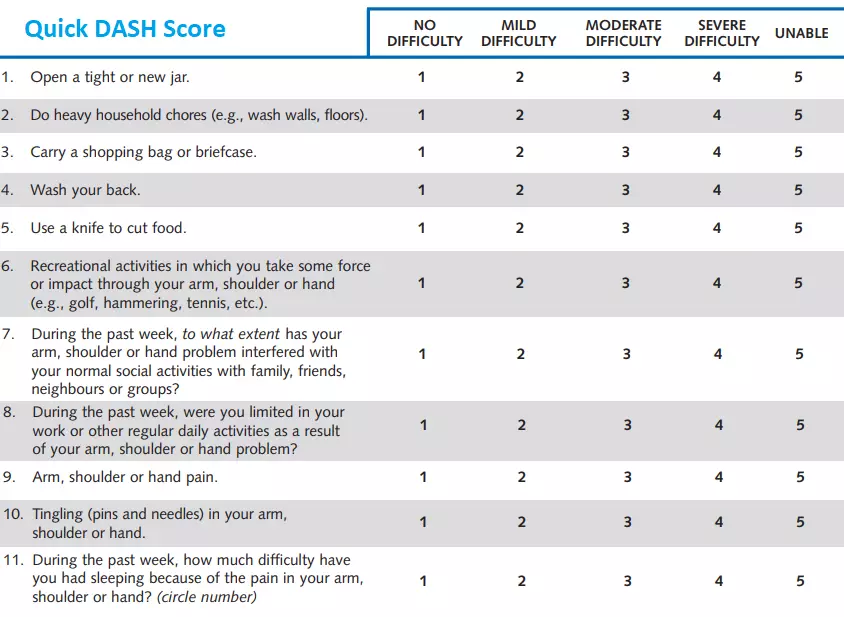
Quick DASH Score
Quick DASH score is a shortened Version of Disabilities of the Arm, Shoulder, and Hand score.
Users are asked to rate questions on an 11-item questionnaire that addresses symptoms and physical function. A total score out of 100 is calculated, with higher scores representing more disability.
The 11 questions of Quick DASH Score are:
- Open a tight or new jar.
- Do heavy household chores (e.g., wash walls, floors).
- CarWash your back.
- Wash your back.
- Use a knife to cut food
- Recreational activities in which you take some force or impact through your arm, shoulder or hand (e.g., golf, hammering, tennis, etc.).
- During the past week, to what extent has your arm, shoulder or hand problem interfered with your normal social activities with family, friends, neighbours or groups?
- During the past week, were you limited in your work or other regular daily activities as a result of your arm, shoulder or hand problem?
- Arm, shoulder or hand pain.
- Tingling (pins and needles) in your arm, shoulder or hand.
- During the past week, how much difficulty have you had sleeping because of the pain in your arm, shoulder or hand?
Quick DASH Score DISABILITY/SYMPTOM SCORE = (sum of n responses)/n – 1 x 25, where n is equal to the number of completed responses.
References
- Hudak PL, Amadio PC, Bombardier C. Development of an upper extremity outcome measure: the DASH (disabilities of the arm, shoulder and hand) [corrected]. The Upper Extremity Collaborative Group (UECG). Am J Ind Med. 1996 Jun;29(6):602-8. doi: 10.1002/(SICI)1097-0274(199606)29:6<602::AID-AJIM4>3.0.CO;2-L. Erratum in: Am J Ind Med 1996 Sep;30(3):372. PMID: 8773720. Pubmed
- Roy JS, MacDermid JC, Woodhouse LJ. Measuring shoulder function: a systematic review of four questionnaires. Arthritis Rheum. 2009 May 15;61(5):623-32. doi: 10.1002/art.24396. PMID: 19405008. Pubmed
- Gummesson C, Atroshi I, Ekdahl C. The disabilities of the arm, shoulder and hand (DASH) outcome questionnaire: longitudinal construct validity and measuring self-rated health change after surgery. BMC Musculoskelet Disord. 2003 Jun 16;4:11. doi: 10.1186/1471-2474-4-11. Epub 2003 Jun 16. PMID: 12809562; PMCID: PMC165599.
- Mintken PE, Glynn P, Cleland JA. Psychometric properties of the shortened disabilities of the Arm, Shoulder, and Hand Questionnaire (QuickDASH) and Numeric Pain Rating Scale in patients with shoulder pain. J Shoulder Elbow Surg. 2009 Nov-Dec;18(6):920-6. doi: 10.1016/j.jse.2008.12.015. Epub 2009 Mar 17. PMID: 19297202.
- Netter’s Orthopaedic Clinical Examination An Evidence-Based Approach 3rd Edition Book.