Trousseau sign is an important bedside clinical sign used to detect latent hypocalcemia. It is commonly assessed during a physical examination when disorders affecting calcium metabolism are suspected. The sign reflects increased neuromuscular excitability caused by low serum calcium levels and is widely referenced in clinical literature.
This guide explains the definition, physiology, examination technique, clinical significance, and interpretation of Trousseau sign based on peer-reviewed medical literature.
What Is Trousseau Sign?
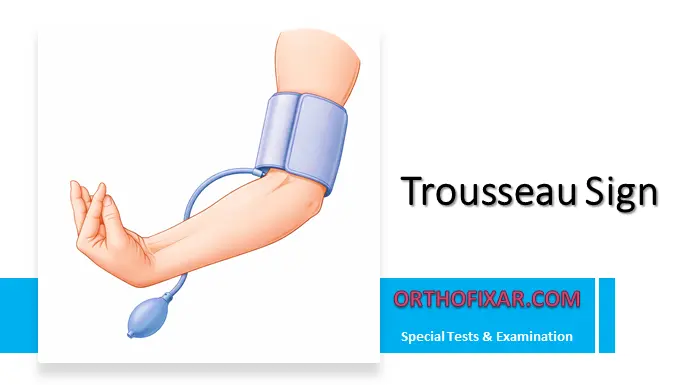
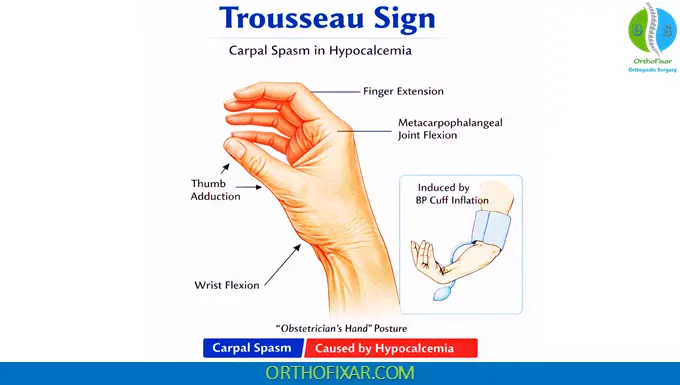
Trousseau sign refers to a carpal spasm induced by ischemia after inflating a blood pressure cuff above systolic pressure for several minutes. The resulting spasm is caused by increased neuromuscular irritability associated with hypocalcemia.
The sign was first described by Armand Trousseau, a 19th-century French physician known for his contributions to clinical medicine.
A positive Trousseau sign produces a characteristic carpopedal spasm, including:
- Flexion of the wrist
- Flexion at the metacarpophalangeal joints
- Extension of the fingers
- Adduction of the thumb (often called the “obstetrician’s hand”)
Studies indicate that Trousseau sign may be present in up to 94% of patients with hypocalcemia, making it a sensitive clinical indicator.
Pathophysiology of Trousseau Sign
Trousseau sign occurs due to increased neuronal membrane excitability when serum calcium levels fall.
Calcium normally stabilizes sodium channels in nerve membranes. When calcium levels decrease:
- Sodium channel permeability increases
- Nerves depolarize more easily
- Spontaneous muscle contractions occur
Temporary ischemia from the blood pressure cuff further enhances this neuromuscular excitability, leading to carpal spasm.
How to Perform the Trousseau Sign Test (Step-by-Step)
The test is simple and performed during routine clinical examination.
Procedure
- Place a blood pressure cuff around the patient’s upper arm.
- Inflate the cuff 20 mmHg above the patient’s systolic blood pressure.
- Maintain inflation for 3 minutes.
- Observe the patient’s hand for carpal spasm.
Positive Sign
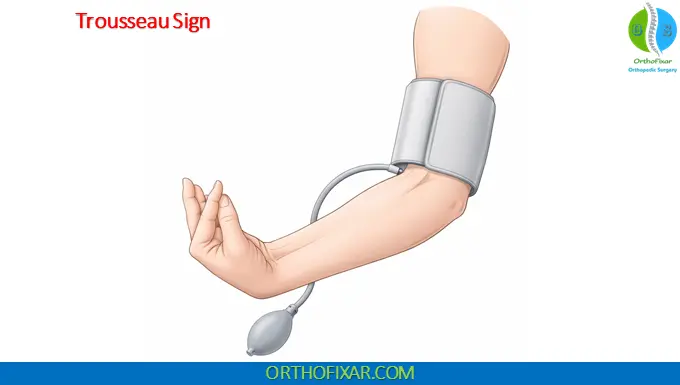
A positive Trousseau sign results in:
- Wrist flexion
- Metacarpophalangeal joint flexion
- Interphalangeal extension
- Thumb adduction
The hand assumes a posture resembling an obstetrician’s hand.
Conditions Associated with a Positive Trousseau Sign
Trousseau sign most commonly occurs in hypocalcemic states, but several conditions can lead to low calcium levels.
Common Causes
- Hypocalcemia
- Hypoparathyroidism
- Vitamin D Deficiency
- Chronic Kidney Disease
- Acute Pancreatitis
- Alkalosis
It may also be seen after thyroid or parathyroid surgery, where parathyroid gland injury can reduce calcium regulation.
Trousseau Sign vs Chvostek Sign
Both signs are used to detect neuromuscular irritability caused by hypocalcemia, but they differ in technique and reliability.
| Feature | Trousseau Sign | Chvostek Sign |
|---|---|---|
| Test method | BP cuff inflation | Facial nerve tapping |
| Location | Hand and wrist | Facial muscles |
| Sensitivity | Higher | Lower |
| Specificity | More reliable | Can be positive in healthy individuals |
Because of its higher sensitivity, many clinicians consider Trousseau sign the more reliable indicator of latent hypocalcemia.
See Also: Chvostek Sign
Clinical Importance
Trousseau sign remains an important bedside diagnostic clue in modern clinical medicine.
Why It Matters
- Helps detect early hypocalcemia before severe symptoms develop
- Useful in post-thyroidectomy monitoring
- Can guide urgent laboratory testing
- Assists clinicians when laboratory results are not immediately available
Recognizing this sign early can help prevent serious complications such as:
- Tetany
- Seizures
- Cardiac arrhythmias
Key Clinical Tips
- Perform the test when neuromuscular irritability or electrolyte imbalance is suspected.
- Ensure the cuff remains inflated for the full 3 minutes.
- Compare findings with serum calcium levels.
- Use in combination with other clinical signs such as Chvostek sign.
Frequently Asked Questions (FAQ)
What does a positive Trousseau sign indicate?
A positive Trousseau sign usually indicates latent hypocalcemia, meaning calcium levels are low enough to increase neuromuscular excitability.
How long should the blood pressure cuff remain inflated?
The cuff should remain inflated about 3 minutes above systolic pressure to provoke carpal spasm if hypocalcemia is present.
Is Trousseau sign specific for hypocalcemia?
It is highly suggestive but not completely specific. Other metabolic disturbances affecting nerve excitability may rarely produce similar findings.
Which is more reliable: Trousseau sign or Chvostek sign?
Clinical literature suggests Trousseau sign is more sensitive and reliable for detecting hypocalcemia.
Summary
Trousseau sign is a classic bedside test used to detect latent hypocalcemia by inducing carpal spasm through ischemia with a blood pressure cuff. The sign reflects increased neuromuscular excitability due to low calcium levels and remains an important clinical tool in endocrine and emergency medicine.
References & More
- Patel M, McMahon K, Hu EW. Trousseau Sign. [Updated 2025 Jun 23]. In: StatPearls [Internet]. Treasure Island (FL): StatPearls Publishing; 2026 Jan-. Available from: Pubmed
- Patel M, McMahon K, Hu EW. Trousseau Sign. 2025 Jun 23. In: StatPearls [Internet]. Treasure Island (FL): StatPearls Publishing; 2025 Jan–. PMID: 32491764. Pubmed
- Rehman HU, Wunder S. Trousseau sign in hypocalcemia. CMAJ. 2011 May 17;183(8):E498. doi: 10.1503/cmaj.100613. Epub 2011 Feb 28. PMID: 21398222; PMCID: PMC3091937. Pubmed