What Is the Drehmann Sign?
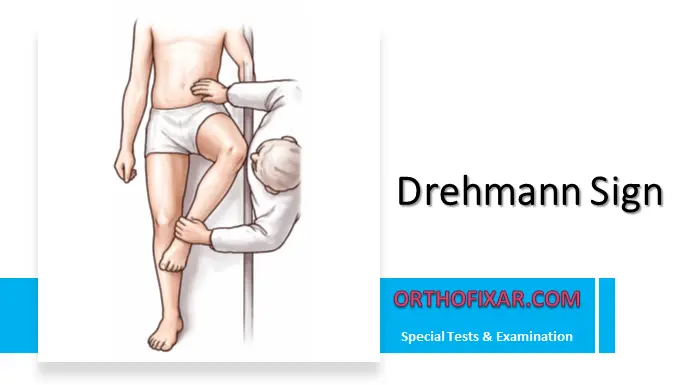
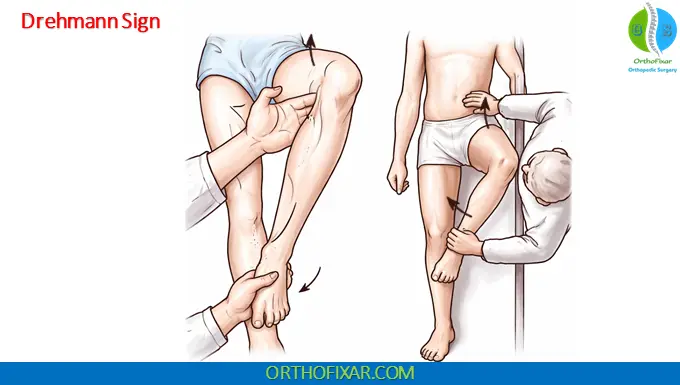
The Drehmann sign is an important orthopedic clinical finding observed during hip examination. It is considered positive when passive hip flexion causes unavoidable external rotation and often abduction of the hip, with limited or painful internal rotation.
This sign reflects mechanical deformity of the proximal femur or femoroacetabular relationship and is most classically associated with slipped capital femoral epiphysis (SCFE).
Historical Background
The sign is named after the German surgeon Gustav Drehmann, who described it in the early 20th century as a clinical indicator of epiphyseal disorders of the hip.
How to Perform the Drehmann Test
Patient Position
- Patient lies supine on the examination table
- Hip and knee relaxed
Examination Steps
- Passively flex the hip to about 90°.
- Observe the limb alignment during flexion.
- Attempt gentle internal rotation.
Positive Result
- Hip automatically rotates externally during flexion
- Internal rotation is restricted or painful
This obligatory external rotation reflects deformity at the femoral head–neck junction or physis.
Clinical Significance
1. Slipped Capital Femoral Epiphysis (Most Important Association)
In SCFE, the femoral head slips posteriorly and inferiorly relative to the neck, causing mechanical malalignment.
As a result:
- Internal rotation becomes limited
- Flexion induces external rotation
- The Drehmann sign becomes a classic physical finding
It is often present alongside:
- Limp or antalgic gait
- Hip, thigh, or knee pain
- Reduced hip motion
These features are key clues for early diagnosis in adolescents.
See Also: Slipped Capital Femoral Epiphysis (SCFE)
2. Other Conditions Where It May Occur
Although strongly linked to SCFE, the sign may also appear in:
- Femoroacetabular impingement
- Advanced hip osteoarthritis
- Perthes disease
- Structural deformities of the femoral head
These conditions similarly alter femoral head mechanics and hip rotation.
Pathophysiological Explanation
The sign results from abnormal femoral head–neck geometry.
When the hip flexes:
- The deformed femoral head impinges against the acetabulum
- To avoid impingement, the hip rotates externally
- This produces the characteristic obligatory movement
Thus, Drehmann sign reflects a mechanical block rather than muscular restriction.
Diagnostic Value
While not pathognomonic, the Drehmann sign is:
- Highly suggestive of SCFE in adolescents
- A useful screening tool in patients with unexplained knee or thigh pain
- An indication for urgent imaging
Radiographs (AP pelvis and frog-leg lateral views) are required to confirm the diagnosis.
Early recognition is essential because untreated SCFE can lead to:
- Avascular necrosis
- Early hip osteoarthritis
- Permanent deformity
Clinical Pearls for Practice
- Always examine hip rotation in adolescents with knee pain
- Loss of internal rotation is often the first sign
- Drehmann sign should prompt immediate radiographic evaluation
- Early diagnosis significantly improves outcomes
References & More
- Wikipedia – Drehmann sign
- Kamegaya M, Saisu T, Nakamura J, Murakami R, Segawa Y, Wakou M. Drehmann sign and femoro-acetabular impingement in SCFE. J Pediatr Orthop. 2011;31:853–857. Pubmed