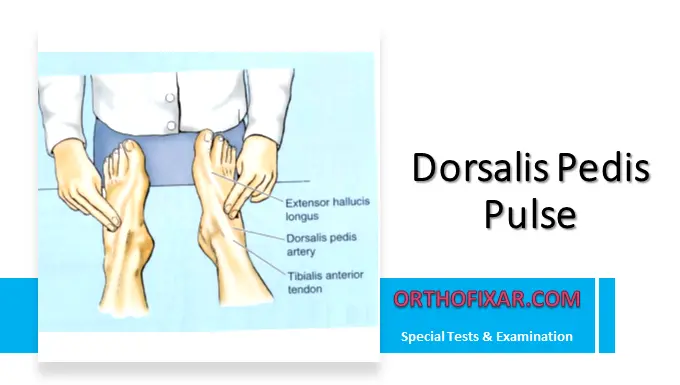
The dorsalis pedis pulse is a crucial component of lower limb vascular assessment. Palpating this pulse helps clinicians evaluate peripheral circulation and screen for peripheral arterial disease (PAD) — a common condition that impairs blood flow to the feet and legs.
What Is the Dorsalis Pedis Pulse?
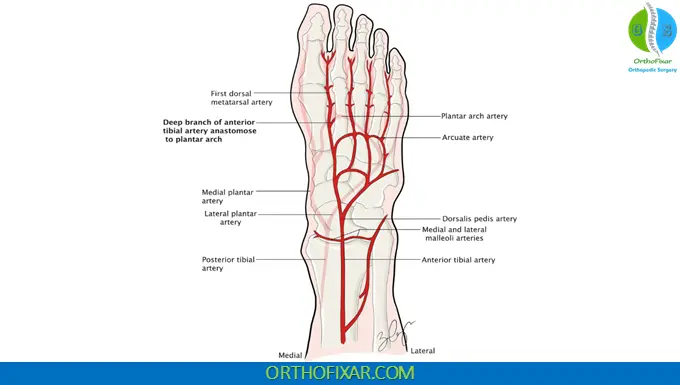
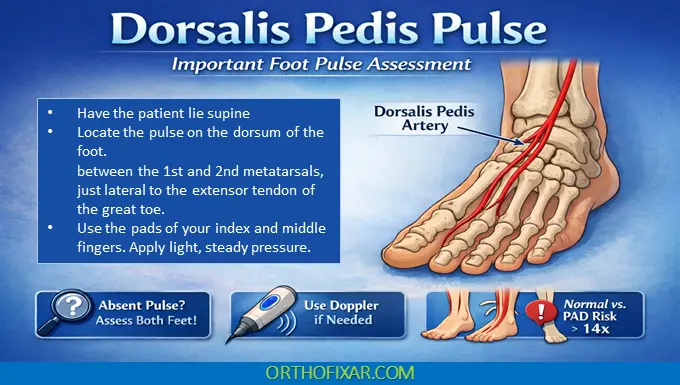
The dorsalis pedis artery is the continuation of the anterior tibial artery across the ankle and runs superficially over the dorsum (top) of the foot. It supplies oxygen-rich blood to the bones, muscles, and soft tissues of the dorsal foot. Because it lies close to the skin’s surface, it is one of the main sites to palpate a foot pulse during a vascular exam.
See Also: Ankle Anatomy
How to Palpate the Dorsalis Pedis Pulse (Step-by-Step)
Performing an accurate dorsalis pedis pulse assessment requires precision and anatomical landmarks:
- Patient Positioning
Have the patient lying supine or seated with the foot relaxed. Slight dorsiflexion of the foot often makes the pulse easier to feel. - Anatomical Landmarks
Place the pads of your fingers on the dorsum of the foot, just lateral to the extensor tendon of the great toe (the tendon of the extensor hallucis longus). - Technique
Apply gentle pressure — pressing too firmly can obliterate the pulse. If the pulse is not immediately palpable, adjust your finger position slightly laterally on the dorsum. - Alternate Detection
If palpation remains inconclusive, use a handheld Doppler device to detect arterial flow.
See Also: Popliteal Artery Pulse: Location, Palpation & Clinical Signs

Grading the Dorsalis Pedis Pulse
Clinicians often use a standardized pulse scale:
| Grade | Description |
|---|---|
| 0 | Absent |
| 1+ | Diminished |
| 2+ | Normal |
| 3+ | Full |
| 4+ | Bounding |
This scale assists with documentation and clinical comparisons over time.
See Also: Ankle Brachial Index (ABI)
Clinical Considerations and Variations
- Anatomical variation: The dorsalis pedis artery may be congenitally absent in ~8–15% of healthy individuals.
→ If the dorsalis pedis pulse is not present, palpate more laterally on the dorsum, or assess the posterior tibial pulse as well. - Peripheral occlusive disease: A weak or absent dorsalis pedis pulse — especially when femoral and popliteal pulses are normal — significantly raises the likelihood of peripheral arterial disease (PAD). In practical terms, this elevates the likelihood ratio for PAD to >14, indicating strong diagnostic relevance when other pulses are intact.
- Clinical symptoms matter: Absent pedal pulses are more meaningful when combined with symptoms like claudication, non-healing ulcers, or cool extremities.
Why the Dorsalis Pedis Pulse Matters in Practice
Assessing the dorsalis pedis pulse is a simple yet powerful physical exam tool:
- It provides immediate clues about distal perfusion and vascular integrity.
- In patients with diabetes or cardiovascular risk factors, absent pedal pulses correlate with higher risk of major vascular events (e.g., myocardial infarction, stroke, or limb ischemia).
- Combined with other pulses and clinical context, it helps guide decisions about further vascular testing — such as ankle-brachial index (ABI), Doppler studies, or imaging.
Key Takeaways
✅ The dorsalis pedis pulse is palpated on the top of the foot, lateral to the extensor tendon of the great toe.
✅ Use gentle fingertip pressure and adjust position if the pulse is not immediately felt.
✅ Anatomical absence is common — always assess both feet and other pedal pulses.
✅ Absent or diminished dorsalis pedis pulses raise clinical suspicion for PAD, particularly when proximal pulses are normal.
Final Clinical Tip
Incorporate dorsalis pedis pulse assessment as part of a routine vascular exam for patients with limb symptoms, diabetes, or cardiovascular risk factors. Detecting abnormalities early can guide appropriate referrals and interventions that may improve patient outcomes.
References & More
- Bickley, L. S., Szilagyi, P. G., Hoffman, R. M., & Soriano, R. P. (2021). Bates’ guide to physical examination and history taking, 12e.
- Zimmerman B, Williams D. Peripheral Pulse. [Updated 2025 Jul 6]. In: StatPearls [Internet]. Treasure Island (FL): StatPearls Publishing; 2025 Jan-. Available from: Pubmed
- Garg E. At Your Fingertips: The Critical Role of Dorsalis Pedis Pulse Palpation in Early Detection of Peripheral Arterial Disease. Spartan Med Res J. 2025 Sep 30;10(2):10. doi: 10.51894/001c.144459. PMCID: PMC12450396. Pubmed
- Mowlavi A, Whiteman J, Wilhelmi BJ, Neumeister MW, McLafferty R. Dorsalis pedis arterial pulse: palpation using a bony landmark. Postgrad Med J. 2002 Dec;78(926):746-7. doi: 10.1136/pmj.78.926.746. PMID: 12509693; PMCID: PMC1757948. Pubmed