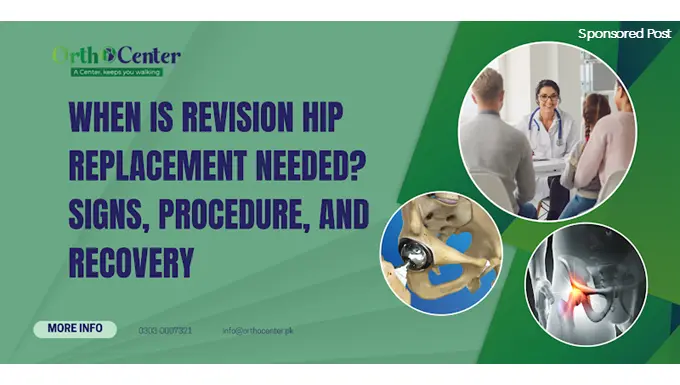
People with constant hip joint pain often find its replacement a life-altering procedure. It specializes in bringing immense relief from pain in addition to facilitating the ability to do day-to-day tasks. Though it has been observed that the current implants have a life of more than two decades, they are not meant to be a lifetime solution. Hence, in some cases, revised surgery becomes necessary. A revised hip replacement surgery can be termed as a secondary surgery involving the replacement or correction of a failed implant.
It is crucial to understand when the need for revision of hip replacement arises, especially for patients who have previously undergone hip replacement. This awareness plays an essential role in maintaining hip joint health and preventing further deterioration. This comprehensive guide will walk you through everything you need to know, from the signs that indicate the need for revision hip replacement to the surgical procedure and recovery options.
What is a revision Hip replacement?
The revision hip replacement is a type of surgical procedure wherein the previously implanted joint is replaced, repaired, or both. Revision of a hip joint is a comparatively more complicated procedure in relation to the original surgery.
Revision hip replacement usually becomes necessary in cases where the first hip replacement does not work properly, results in considerable pain, or hinders movement. The overall objective of undergoing the procedure is to regain joint functionality. The main steps involved in revision are as follows:
1. Preoperative planning
The surgeon will carefully assess the existing implant as well as the bone and tissues. Imaging technology and customized instruments are the main tools that help with precise evaluation.
2. Removing an Old Implant
The damaged parts are removed with caution. Experts use the newest methods in order to maintain as much bone as possible.
3. Bone & Tissue repair
The damaged bone or soft tissue can be repaired or reinforced. In certain situations, bone grafts are of great help.
4. Placement of New Implant
Surgeons insert and attach a new artificial joint, usually larger or more complex than the previous one.
5. Closure and Postoperative
The operation wound is closed, sometimes with the use of drainage tubes. Pain control, antibiotics if infection was present, and the prevention of blood clots are critical.
Signs indicating the need for a revision Hip replacement
It would be difficult to accept if one went through a hip surgery and realized that a second procedure is necessary now. That is why individuals often seem to attempt to relieve pain or other issues through medication or therapies. However, ignoring the facts and the need for operation can create even greater problems. Below are the signs that show it’s time to go for a revision hip replacement.
Persistent or Increasing Pain
Occasionally, problems in the hip joint may recur even if replacement surgery has been successful. In some cases, less invasive options such as arthroscopic surgery in Lahore may be considered before proceeding to revision surgery. Persistent or increasing pain in a replaced hip can indicate the need for further intervention. Such pain is different from normal or temporary discomfort and may worsen over time due to loosening, infection, or implant wear. Seeking timely and appropriate treatment is therefore essential.
Swelling and Stiffness:
With an already replaced hip, if stiffness or swelling is not subsiding or, in fact, progressing, it may also point towards the requirement for revision Hip replacement surgery. Even in traditional Hip replacement surgery, if the symptoms are not dissipating with time, then these may indicate some problem of loosening, infection, or wear. An accomplished orthopedic specialist would help identify the issue and declare the need for another operation.
Instability or Giving Way:
Hip instability or the feeling of “giving way” following a hip replacement is a major warning sign for the necessity of a revision replacement. The feeling of instability or wobbly signals a lack of adequate support being provided for the hip from the implant. This implant instability may occur due to the loosening of the artificial joint or wear and tear of the components. Due to this reason, the ligaments of the Hip or the misalignment of the hip may occur. Yet, the final decision is in the disposal of the orthopedic surgeon.
Deformity or Misalignment:
Visible changes in the shape of the hip, such as bowing or shifting of the joint, are a sign of mechanical problems with the implant. These become observable and more prominent over time. Thus clearly describing its time to go for a revision hip replacement.
Difficulty Performing Daily Activities:
Problems with everyday tasks, like walking, using the stairs, standing up from a chair, or bending the Hip, are another signal. These problems can be an indicator that the replacement may not be functioning as it should. If this occurs, a visit to a specialist for a revision replacement is the primary need.
Signs of Infection:
The infection signs and symptoms may include redness, warmth, swelling, pain, drainage of fluid from the affected wound, or fever. All can be a very serious warning sign of an impending revision of the replacement surgery. An infection can weaken an implant and the surrounding tissue, causing damage and diminished functionality within the replaced joint. Approaching an orthopedic specialist for early assessment can determine whether a revision surgery is the ultimate option or not.
Wrapping Up
In the end, hip replacement surgery is a high-impact operation that specializes in relieving pain and discomfort of a dysfunctional hip joint. It is highly effective in restoring mobility and supporting an active life for many patients. However, in certain cases, other treatment options such as arthroscopic surgery may be considered before or after joint replacement. Sometimes, things may go wrong due to inappropriate surgery, low-quality implants, or other factors, and a previously replaced hip may stop functioning well.
In all such situations, the ultimate decision is, it’s time to go for a revision Hip replacement. Persistent pain, swelling, stiffness, instability, deformity, difficulty in daily activities, or symptoms of infection after a Hip replacement are important warning signs that a revision surgery may be necessary. Early recognition of these symptoms and timely evaluation by an orthopedic specialist can help prevent further joint damage, improve function, and ensure the best possible outcome.
References & More
- Revision Total Hip Replacement – AAOS
- Sabah SA, Knight R, Nicolson PJA, Taylor A, Kendrick B, Alvand A, Petrou S, Beard DJ, Price AJ, Palmer AJR. Epidemiology of revision hip replacement surgery in the UK over the past 15 years-an analysis from the National Joint Registry. BMJ Open. 2023 Oct 17;13(10):e072462. doi: 10.1136/bmjopen-2023-072462. PMID: 37848303; PMCID: PMC10583040. Pubmed
- Deere K, Whitehouse MR, Kunutsor SK, Sayers A, Mason J, Blom AW. How long do revised and multiply revised hip replacements last? A retrospective observational study of the National Joint Registry. Lancet Rheumatol. 2022 Jun 23;4(7):e468-e479. doi: 10.1016/S2665-9913(22)00097-2. PMID: 36394063; PMCID: PMC9647039. Pubmed