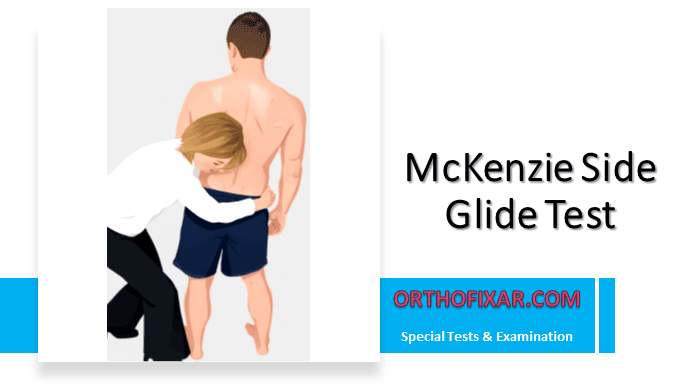
The McKenzie Side Glide Test is a clinical assessment used to help determine the presence of a lateral shift deformity (scoliosis) and to assess whether symptoms related to lumbar disc pathology can be mechanically influenced or centralized through lateral movements. It’s also called Lateral Shift Correction Test.
The main goal of the McKenzie Side Glide Test is to:
- Identify a lateral shift (asymmetrical posture of the trunk relative to the pelvis).
- Assess whether mechanical loading in the frontal plane (side gliding) alters the patient’s neurological or radicular symptoms.
- Help determine if the patient’s pain is discogenic in nature and if it can be centralized through corrective movement.
How to Perform the McKenzie Side Glide Test?
- The patient is standing upright with the feet shoulder-width apart.
- The examiner stands to one side of the patient — typically starting on the side opposite the trunk shift unless scoliosis or deformity dictates otherwise.
- The examiner grasps the patient’s pelvis firmly with both hands.
- The examiner then places one shoulder against the patient’s lower thorax to act as a stabilizing block.
- Using the shoulder as a fulcrum, the examiner pulls the patient’s pelvis toward their own body, thereby gliding the patient’s pelvis laterally relative to the thorax. This side glide position is held for 10–15 seconds.
- The test is then repeated on the opposite side. If the patient has an evident scoliosis or lateral shift, the side toward which the curve points should be tested first.
When an evident scoliosis is present, testing protocol is modified:
- Test the convex side first (the side toward which the scoliosis curves)
- This sequence helps determine if the lateral deviation is symptom-producing
- The test can reveal whether correcting the shift reduces or eliminates symptoms.
See Also: Cobb Angle for Scoliosis

What does a Positive McKenzie Side Glide Test Mean?
The test is considered positive if:
- The patient experiences increased neurological symptoms (e.g., pain, tingling, numbness) on the affected side, or
- The side glide movement alters or centralizes the symptoms.
A positive McKenzie Side Glide Test may indicate that the scoliosis or lateral shift is secondary to pain or discogenic irritation rather than a fixed structural deformity.
If the side glide reduces or centralizes symptoms, it suggests that the symptoms are mechanical and may respond to McKenzie-based exercises or lateral shift correction techniques. If symptoms worsen, the direction of loading should be avoided, and further assessment is warranted.
The test helps to distinguish between a true structural scoliosis and a functional lateral shift caused by pain-avoidance mechanisms.
If the test reproduces symptoms, lateral shift correction exercises may be beneficial. McKenzie method techniques focus on self-correction of the lateral deviation where patients are taught to perform repeated side glide movements toward the painful side to centralize symptoms
Summary Table
| Aspect | Description |
|---|---|
| Test Name | McKenzie Side Glide Test |
| Purpose | Identify lateral shift and assess discogenic pain |
| Patient Position | Standing |
| Examiner Action | Applies lateral glide to pelvis using shoulder as block |
| Positive Sign | Increased or centralized neurological symptoms |
| Indicates | Functional lateral shift; mechanical disc derangement |
References & More
- McKenzie RA. The Lumbar Spine: Mechanical Diagnosis and Therapy. Waikanae, New Zealand: Spinal Publications; 1981.
- Santolin SM. McKenzie diagnosis and therapy in the evaluation and management of a lumbar disc derangement syndrome: A case study. J Chiropr Med. 2003 Spring;2(2):60-5. doi: 10.1016/S0899-3467(07)60044-5. PMID: 19674597; PMCID: PMC2646960. PubMed
- Palmer ML, Epler M. Clinical Assessment Procedures In Physical Therapy. Philadelphia: JB Lippincott; 1990.
- Orthopedic Physical Assessment by David J. Magee, 7th Edition.