The Prone Instability Test is a widely used orthopaedic special test used to assess lumbar spine instability in patients presenting with chronic low back pain. This test helps identify whether segmental instability of the lumbar vertebrae is contributing to the patient’s symptoms.
Lumbar spine instability can result from various factors, including degenerative disc disease, ligamentous injury, or muscular dysfunction. It’s a common source of mechanical back pain.
How to Perform the Prone Instability Test?
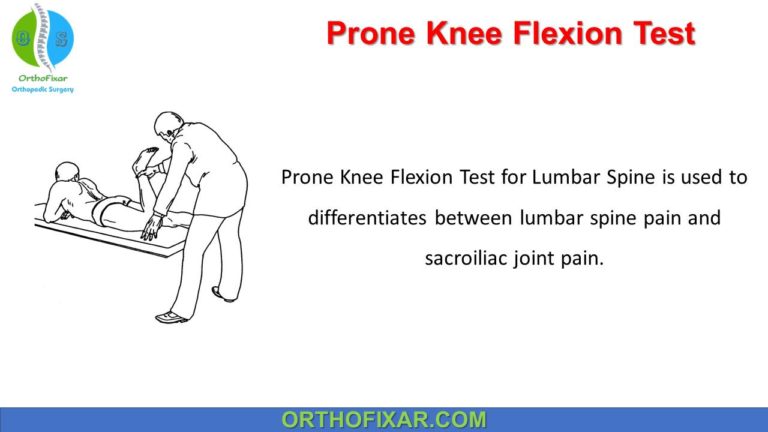
The patient lies prone on the examination table, the upper body (torso and hips) rests comfortably on the table and the legs hang freely over the edge, with the feet resting on the floor.
The examiner applies gentle pressure over the posterior aspect of the lumbar spine (spinous processes) while the patient’s legs remain relaxed on the floor. The patient reports any pain or discomfort felt during this pressure. Next, the patient lifts both legs off the floor, activating the lumbar extensor muscles. The examiner again applies pressure to the same lumbar area. The response is compared between the relaxed and active muscle conditions.
See Also: Spine Examination

What does a Positive Lumbar Spine Instability Mean?
The test is positive when pain is present only in the resting position (when the legs are supported on the floor) and subsides when the legs are lifted. This indicates segmental lumbar instability, as the active contraction of spinal muscles temporarily stabilizes the vertebral segments and reduces pain.
The test is negative when the pain persists or does not change with muscle activation, suggesting that the source of pain is not due to instability, but may be related to another lumbar pathology.
A positive Prone Instability Test is a strong indicator of lumbar segmental instability, often seen in patients with:
- Chronic mechanical low back pain
- Poor lumbar muscular control
- History of repeated lumbar strain
- Postural or degenerative changes
This test helps clinicians identify patients who may benefit from core stabilization exercises, lumbar strengthening, and motor control retraining programs rather than purely passive therapies.
See Also: Slump Test for Diagnosing Lumbar Disc Herniation
Summary Table
| Feature | Description |
|---|---|
| Test Name | Prone Instability Test |
| Patient Position | Prone, torso on table, legs off edge |
| Examiner Action | Applies posterior pressure to lumbar spine |
| Positive Result | Pain only in resting position, not during leg lift |
| Indicates | Lumbar segmental instability |
References & More
- Hicks GE, Fritz JM, Delitto A, et al. Interrater reliability of clinical examination measures for identification of lumbar segmental instability. Arch Phys Med Rehabil. 2003;84:1858–1864. PubMed
- Hicks GE, Fritz JM, Delitto A, McGill SM. Preliminary development of a clinical prediction rule for determining which patients with low back pain will respond to a stabilization exercise program. Arch Phys Med Rehabil. 2005;86(9):1753–1762. PubMed
- Wadsworth CT, DeFabio RF, Johnson D. The spine. In: Wadsworth CT, ed. Manual Examination and Treatment of the Spine and Extremities. Baltimore: Williams & Wilkins; 1988.
- Ravenna MM, Hoffman SL, Van Dillen LR. Low interrater reliability of examiners performing the prone instability test: a clinical test for lumbar shear instability. Arch Phys Med Rehabil. 2011;92(6):913–919. PubMed