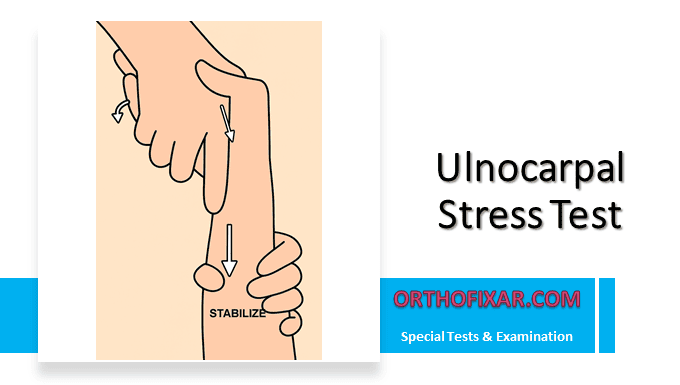
The Ulnocarpal Stress Test, also known as Nakamura’s Ulnar Stress Test, is a provocative clinical examination technique used to assess ulnar-sided wrist pathology. This test proves particularly valuable for identifying conditions affecting the ulnocarpal joint and related structures on the ulnar aspect of the wrist.
How to Perform the Ulnocarpal Stress Test?
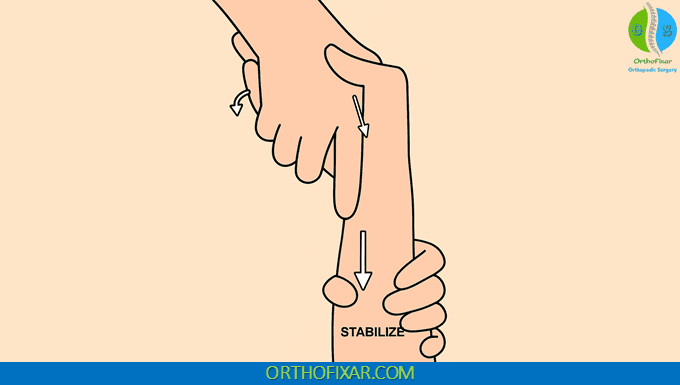
The patient sits comfortably with the affected arm accessible to the examiner. The test elbow should be positioned at 90 degrees of flexion with the forearm maintained in neutral rotation, meaning neither pronated nor supinated. The wrist is then placed in maximum ulnar deviation and held in this position throughout the examination.
The examiner begins by stabilizing the patient’s elbow and forearm, then applies axial compression by directing downward pressure along the long axis of the forearm. While maintaining this axial load, the examiner passively rotates the forearm through both supination and pronation movements. The critical aspect is maintaining the wrist in ulnar deviation throughout the entire maneuver while observing for pain reproduction and noting the patient’s response.
See Also: Wrist Anatomy: Bones, Ligaments & Joints
What is a Positive Ulnocarpal Stress Test?
A positive Ulnocarpal Stress Test is indicated by reproduction of the patient’s familiar pain, particularly when localized to the ulnar side of the wrist, with increased discomfort during the loading and rotation phases. The Ulnocarpal Stress Test will typically be positive in patients with various ulnar-sided wrist pathologies.
Ulnocarpal abutment syndrome, also known as ulnar impaction syndrome, represents a degenerative condition where the ulnar head impinges against the triangular fibrocartilage complex and ulnar carpus. This condition is often associated with positive ulnar variance and creates characteristic pain patterns during the stress test.
Triangular fibrocartilage complex injuries, whether traumatic or degenerative in nature, frequently produce positive test results. These injuries involve tears or degeneration of the TFCC and represent a common source of ulnar-sided wrist pain in both athletes and the general population.
Lunotriquetral ligament injuries, including instability or tears of the lunotriquetral interosseous ligament, may present with ulnar-sided wrist pain and clicking sensations that are reproduced during the stress test. Arthritis affecting the ulnocarpal joint, whether primary or secondary to other conditions, can also produce positive test results due to the mechanical stress placed on degenerative joint surfaces.
See Also: Wrist Pain Causes
Clinical Considerations
While this test provides useful screening information for ulnar-sided wrist pathology, it should always be interpreted within the broader clinical context. The test may produce false positives in patients with generalized wrist hypermobility or other concurrent conditions, making clinical correlation essential.
A positive test should prompt further investigation to differentiate between the various ulnar-sided pathologies, as the treatment approaches can vary significantly. Additional imaging studies such as MRI or wrist arthroscopy may be necessary for definitive diagnosis and treatment planning.
The Ulnocarpal Stress Test should be performed as part of a comprehensive wrist examination that includes other provocative tests such as the TFCC compression test and lunotriquetral ballottement test. Assessment of ulnar variance through radiographic evaluation often provides valuable complementary information.
References & More
- Orthopedic Physical Assessment by David J. Magee, 7th Edition.
- Sachar K. Ulnar-sided wrist pain: evaluation and treatment of triangular fibrocartilage complex tears, ulnocarpal impaction syndrome, and lunotriquetral ligament tears. J Hand Surg Am. 2008;33(9):1669–1679. PubMed
- Rhee PC, Sauve PS, Lindau T, Shin AY. Examination of the wrist: ulnar-sided wrist pain due to ligamentous injury. J Hand Surg Am. 2014;39(9):1859–1862. PubMed
- Newton AW, Hawkes DH, Bhalaik V. Clinical examination of the wrist. Orthop Trauma. 2017;31(4): 237–247.