The Traction-Shift Test is a clinical examination technique used to assess the first carpometacarpal (CMC) joint for signs of arthritis, particularly osteoarthritis at the base of the thumb.
The first carpometacarpal joint is formed between the trapezium bone of the wrist and the base of the first metacarpal bone. This saddle-shaped joint is highly mobile, allowing for the complex movements of thumb opposition, but this mobility also makes it susceptible to degenerative changes over time. CMC arthritis is particularly common in postmenopausal women and individuals who perform repetitive gripping activities.
How to Perform the Traction-Shift Test?
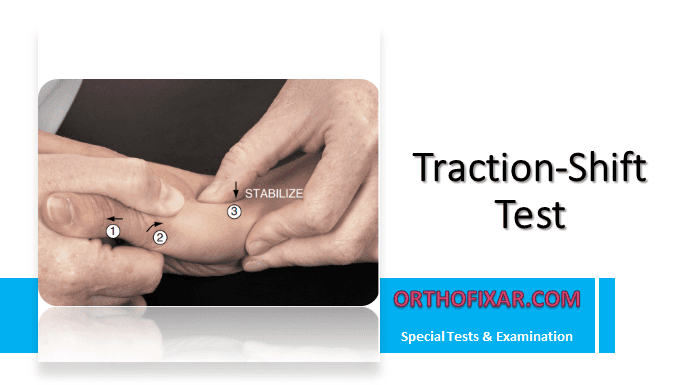
The patient should be seated comfortably with their arm relaxed and the affected hand positioned for easy access by the examiner. The examiner begins by using one hand to support and stabilize the patient’s forearm and wrist, ensuring the patient remains relaxed throughout the test.
With the other hand, the examiner grasps the head (distal end) of the patient’s first metacarpal bone using a firm but gentle grip. The examiner then applies longitudinal traction (pulling force) along the axis of the first metacarpal while simultaneously extending the patient’s thumb. Concurrently, the examiner uses their thumb to apply direct pressure to the dorsal (back) aspect of the base of the first metacarpal, directly over the CMC joint. The examiner may also incorporate a slight grinding or rotational movement while maintaining the traction and pressure.
See Also: Thumb CMC Grind Test
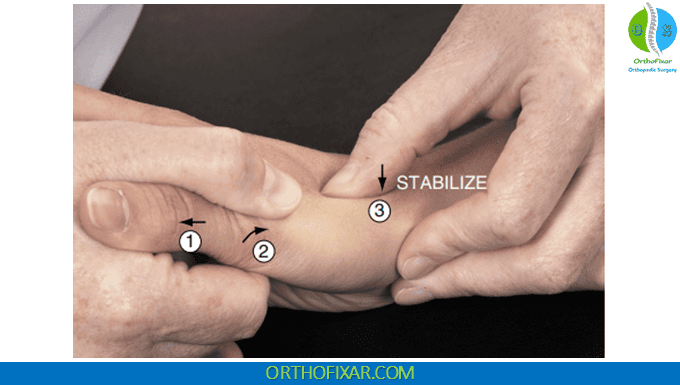
What is the Positive Traction-Shift Test?
A positive Traction-Shift Test is indicated by the presence of crepitus, which manifests as a grating, crackling, or grinding sensation felt by the examiner during the maneuver. Additionally, the patient will report pain at the base of the thumb, specifically over the CMC joint, and the test typically reproduces the patient’s typical thumb pain complaints.
The clinical significance of a positive Traction-Shift Test suggests degenerative changes within the first CMC joint and indicates probable osteoarthritis of the thumb base. These findings may correlate with joint space narrowing, osteophyte formation, and cartilage deterioration that would be visible on radiographic imaging.
Test Reliability
In prospective case-control study to compare the sensitivity and specificity of the thumb CMC grind test and traction-shift test in osteoarthritis of the thumb carpometacarpal joint, they were compared in 30 patients and 30 unaffected controls. The traction-shift test had greater sensitivity (66.7%) and specificity (100%) than the grind test (30% and 96.7%, respectively), whilst also demonstrating superior positive (100%) and negative (75%) predictive value than the grind test (90% and 58%, respectively).
Relationship to Joint Play Assessment
The traction component of this test utilizes the same longitudinal force applied during joint play assessment of the CMC joint. However, the Traction-Shift Test specifically combines this traction with compressive forces and thumb extension to stress the joint surfaces and elicit symptoms related to arthritic changes.
Clinical Considerations
While a positive Traction-Shift Test strongly suggests CMC arthritis, clinicians should consider other potential causes of thumb base pain, including De Quervain’s tenosynovitis, scaphoid fracture or pathology, intersection syndrome, and carpal tunnel syndrome with thenar involvement. The test demonstrates good clinical utility when combined with patient history and other physical examination findings, though it should not be used in isolation for diagnosis, and imaging studies may be necessary for definitive confirmation.
When performing this test, it’s important to explain the procedure to the patient beforehand and warn them that some discomfort may occur. The examiner should stop immediately if severe pain is elicited and correlate findings with the patient’s functional complaints and daily activities.
References & More
- Orthopedic Physical Assessment by David J. Magee, 7th Edition.
- Choa RM, Parvizi N, Giele HP. A prospective case-control study to compare the sensitivity and specificity of the grind and traction-shift (subluxation-relocation) clinical tests in osteoarthritis of the thumb carpometacarpal joint. J Hand Surg Eur Vol. 2014 Mar;39(3):282-5. doi: 10.1177/1753193413508714. Epub 2013 Oct 14. PMID: 24127463. PubMed
- Sauve PS, Rhee PC, Shin AY, Lindau T. Examination of the wrist: radial–sided wrist pain. J Hand Surg Am. 2014;39(10):2089–2092. PubMed
- Newton AW, Hawkes DH, Bhalaik V. Clinical examination of the wrist. Orthop Trauma. 2017;31(4): 237–247