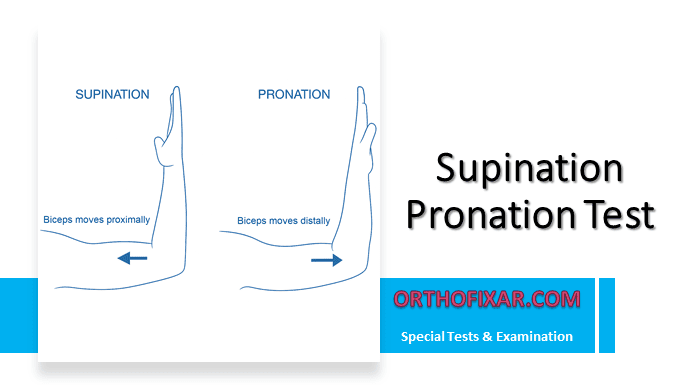
The supination pronation test is used to assess the integrity of the distal biceps tendon at the elbow joint. This test leverages the anatomical relationship between forearm rotation and biceps muscle position to detect potential tendon ruptures.
When the biceps brachii contracts during supination, it not only flexes the elbow but also rotates the radius, causing the muscle belly to move proximally. Conversely, during pronation, the muscle relaxes and moves distally. This normal anatomical movement forms the basis of the supination pronation test.
How to perform the Supination Pronation Test?
The patient stands with both shoulders abducted to 90 degrees and elbows flexed to 60-70 degrees. The examiner stands directly in front of the patient to observe both biceps simultaneously, enabling bilateral comparison of muscle movement patterns.
The patient actively supinates and pronates both forearms while the examiner observes the biceps muscle contour bilaterally. The examiner should pay particular attention to the proximal-distal movement of the muscle belly during these rotational movements.

What is the positive test?
In patients with intact distal biceps tendons, the Supination Pronation Test reveals characteristic muscle movement patterns:
During Supination: The biceps muscle belly moves proximally (rises), creating a noticeable change in the muscle’s contour and position.
During Pronation: The biceps muscle belly moves distally (falls), again producing visible changes in muscle shape and position.
This migration pattern occurs because the intact tendon maintains its connection to the radial tuberosity, allowing the muscle to follow the normal biomechanical patterns associated with forearm rotation.
A positive supination pronation test indicates potential distal biceps tendon rupture and is characterized by:
Lack of Migration: The biceps muscle fails to demonstrate the normal proximal-distal movement during forearm rotation. The muscle contour remains relatively static throughout supination and pronation.
Bilateral Comparison: The affected side shows markedly different movement patterns compared to the uninjured side, making bilateral testing essential for accurate interpretation.
See Also: Distal Biceps Tendon Tear
Passive Variation
Research has demonstrated that the Supination Pronation Test maintains its diagnostic value when performed passively. The passive forearm pronation test involves the examiner moving the patient’s forearm through supination and pronation while observing biceps muscle movement. This variation can be particularly useful when:
- Patients experience pain with active movement
- There are concerns about patient cooperation or understanding
- The examiner wants to eliminate the influence of active muscle contraction
The passive version shows the same diagnostic principle: intact tendons allow normal muscle migration, while ruptured tendons result in minimal muscle movement during forearm rotation.
Supination Pronation Test Reliability
While specific sensitivity and specificity values for this test alone aren’t readily available in the provided search results, the supination pronation test has been found to be a reliable, pain-free test that should be incorporated in the physical examination to evaluate patients for distal biceps injury.
Limitations and Considerations
While valuable, the supination pronation test should be interpreted within the broader clinical context:
Partial Tears: The test may be less reliable in cases of partial tendon ruptures where some fibers remain intact.
Patient Factors: Pain, swelling, or patient anxiety may affect test performance and interpretation.
Examiner Experience: Proper technique and experience in recognizing subtle movement patterns are essential for accurate interpretation.
Integration with Clinical Assessment
The supination pronation test should be combined with other clinical findings including patient history, mechanism of injury, physical examination findings, and potentially imaging studies for comprehensive evaluation. A positive test, combined with appropriate clinical presentation, strongly suggests distal biceps tendon rupture and warrants further evaluation and potential surgical consultation.
References & More
- Metzman LS, Tivener KA. The supination–pronation test for distal biceps tendon rupture. Am J Orthop (Belle Mead NJ). 2015;44(10):E361–E364. Pubmed
- Vishwanathan K, Soni K. Distal biceps rupture: Evaluation and management. J Clin Orthop Trauma. 2021 May 20;19:132-138. doi: 10.1016/j.jcot.2021.05.012. PMID: 34099972; PMCID: PMC8167284. Pubmed
- Hausman MR, Lang P. Examination of the elbow: current concepts. J Hand Surg Am. 2014;39:2534–2541.
- Zwerus EL, Somford MP, Maissan F, et al. Physical examination of the elbow, what is the evidence? A systematic literature review. Br J Sports Med. 2017;51:1–9.
- Orthopedic Physical Assessment by David J. Magee, 7th Edition.