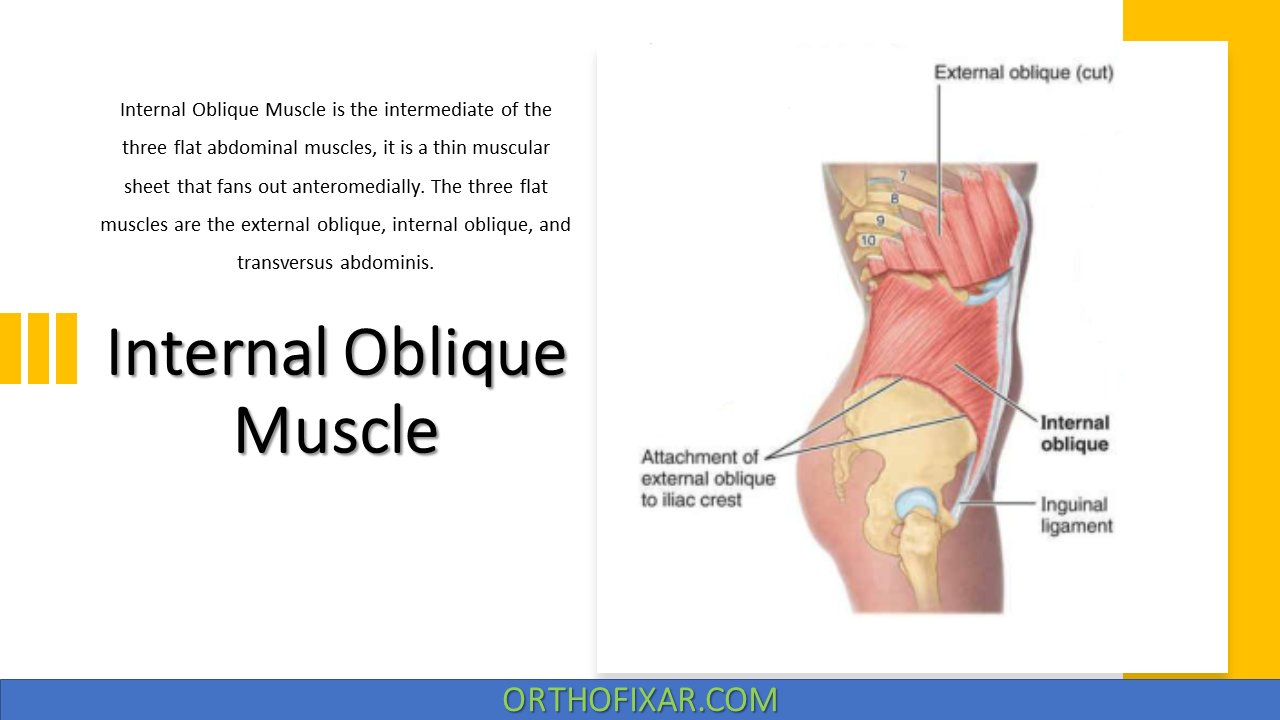
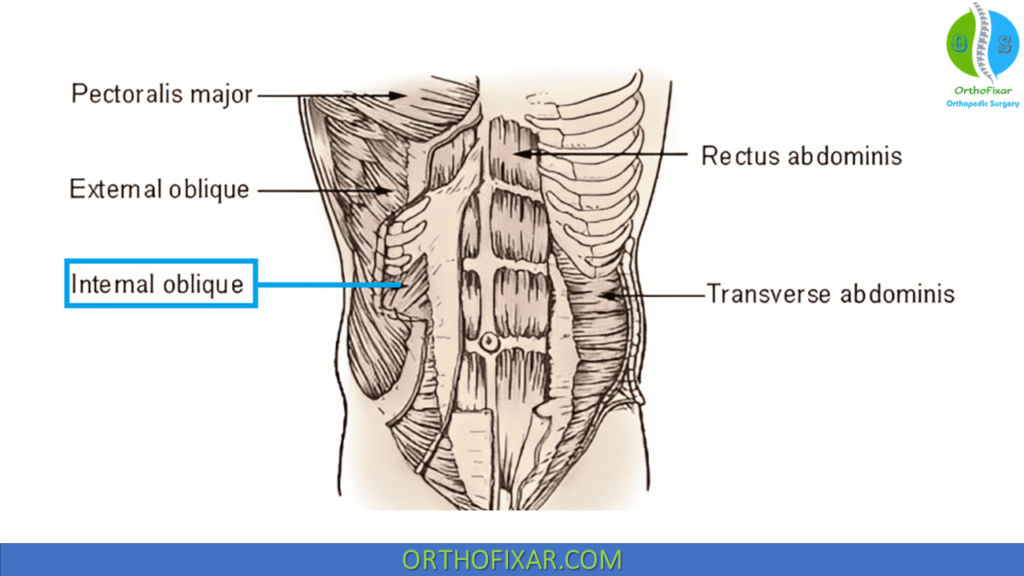
Internal Oblique Muscle is the intermediate of the three flat abdominal muscles, it is a thin muscular sheet that fans out anteromedially. The three flat muscles are the external oblique, internal oblique, and transversus abdominis.
Internal Oblique Muscle Anatomy
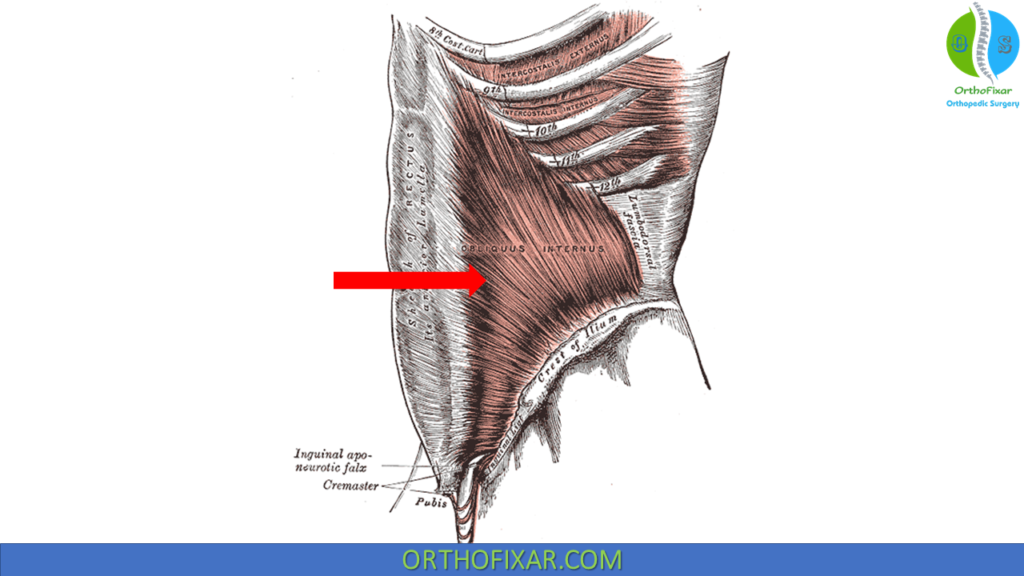
Except for its lowermost fibers, which arise from the lateral half of the inguinal ligament, its fleshy fibers run perpendicular to those of the external oblique, running superomedially (like your fingers when the hand is placed over your chest). Its fibers also become aponeurotic at the MCL and participate in the formation of the rectus sheath.
The superior two thirds of the internal oblique aponeurosis splits into two layers (laminae) at the lateral border of the rectus abdominis; one lamina passing anterior to the muscle and the other passing posterior to it. The anterior lamina joins the aponeurosis of the external oblique to form the anterior layer of the rectus sheath. The posterior lamina joins the aponeurosis of the transversus abdominis to form the posterior layer of the rectus sheath.
See Also: Transverse Abdominal Muscle
Origin
- Anterior two-thirds of iliac crest,
- Iliopectineal arch,
- Thoracolumbar fascia
Insertion
- Inferior borders of ribs 10-12,
- Linea alba,
- Pubic crest & pectin pubis (via conjoint tendon)
In males, the cremaster muscle is also attached to the internal oblique.
Innervation
- Intercostal nerves (T7-T11),
- Subcostal nerve (T12),
- Iliohypogastric nerve (L1),
- Ilioinguinal nerve (L1)
Blood Supply
- Lower posterior intercostal and subcostal arteries,
- Superior and inferior epigastric arteries,
- Superficial and deep circumflex arteries,posterior lumbar arteries
Action
- Bilateral contraction: Trunk flexion, compresses abdominal viscera, expiration
- Unilateral contraction: Trunk lateral flexio
n (ipsilateral), trunk rotation (ipsilateral)
| Origin | Anterior two-thirds of iliac crest, iliopectineal arch, thoracolumbar fascia |
| Insertion | Inferior borders of ribs 10-12, linea alba, pubic crest & pectin pubis (via conjoint tendon) |
| Innervation | Intercostal nerves (T7-T11), subcostal nerve (T12), iliohypogastric nerve (L1), ilioinguinal nerve (L1) |
| Blood Supply | Lower posterior intercostal and subcostal arteries, superior and inferior epigastric arteries, superficial and deep circumflex arteries,posterior lumbar arteries |
| Action | Bilateral contraction: Trunk flexion, compresses abdominal viscera, expiration Unilateral contraction: Trunk lateral flexio |
References & More
- Clinically Oriented Anatomy – 8th Edition
- Seeras K, Qasawa RN, Ju R, et al. Anatomy, Abdomen and Pelvis: Anterolateral Abdominal Wall. [Updated 2023 Jul 24]. In: StatPearls [Internet]. Treasure Island (FL): StatPearls Publishing; 2023 Jan-. Available from: https://www.ncbi.nlm.nih.gov/books/NBK525975/
- Ramasastry SS, Granick MS, Futrell JW. Clinical anatomy of the internal oblique muscle. J Reconstr Microsurg. 1986 Jan;2(2):117-22. doi: 10.1055/s-2007-1007012. PMID: 2935630. Pubmed