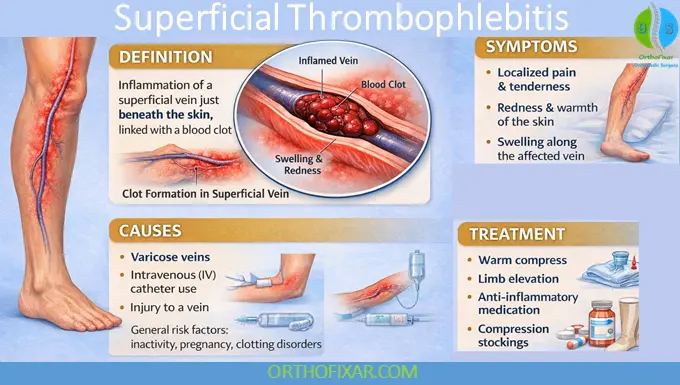
Superficial thrombophlebitis – commonly referred to as phlebitis – is an inflammatory condition of a superficial vein associated with the formation of a blood clot. It most commonly affects veins in the legs or arms and usually occurs in veins located just beneath the skin. Although generally considered less dangerous than deep vein thrombosis (DVT), it still requires proper medical evaluation because it can occasionally progress to more serious venous thromboembolism.
This article provides a medically accurate overview of superficial thrombophlebitis, including its causes, clinical features, diagnosis, and management based on peer-reviewed medical literature and trusted medical sources such as PubMed and academic medical institutions.
See Also: Deep Vein Thrombosis (DVT)
What is Phlebitis?
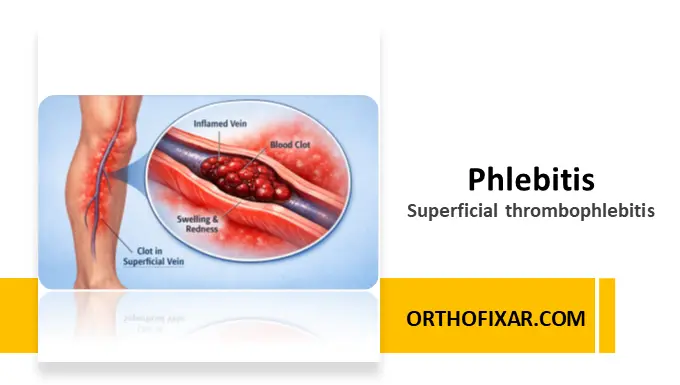
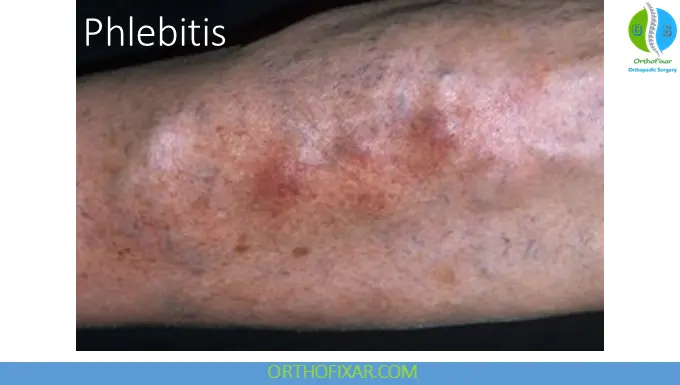
Phlebitis or Superficial thrombophlebitis is defined as inflammation and thrombosis of a superficial vein, typically presenting with localized pain, redness, and a palpable cord-like vein beneath the skin.
The condition results from the combination of two pathological processes:
- Venous inflammation (phlebitis)
- Formation of a thrombus (blood clot) within the superficial vein
Unlike deep vein thrombosis, which occurs in deeper veins and carries a higher risk of pulmonary embolism, superficial thrombophlebitis typically affects veins closer to the skin surface.
However, recent clinical studies emphasize that superficial venous thrombosis can be associated with deep venous thrombosis or pulmonary embolism, highlighting the importance of careful assessment.
Epidemiology
Superficial thrombophlebitis is relatively common and frequently occurs in patients with varicose veins. It may also develop after intravenous catheter placement, trauma, or prolonged immobility.
Risk increases in individuals with underlying conditions that promote venous stasis or hypercoagulability.
Causes and Risk Factors
Several factors can contribute to the development of superficial thrombophlebitis. These factors generally correspond to Virchow’s triad: endothelial injury, venous stasis, and hypercoagulability.
Common Causes
- Trauma or injury to a vein
- Intravenous catheter or IV infusion
- Varicose veins
- Local infection or irritation of the vein
- Injection drug use
Risk Factors
- Prolonged immobilization or bed rest
- Pregnancy or postpartum state
- Oral contraceptives or hormone therapy
- Malignancy
- Obesity
- Previous thromboembolic disease
- Inherited clotting disorders
Varicose veins represent the most frequent predisposing factor, especially in lower-limb superficial thrombophlebitis.
Phlebitis Signs & Symptoms
Symptoms usually occur along the affected superficial vein and develop gradually.
Typical Symptoms
- Localized pain and tenderness
- Redness (erythema) over the vein
- Warmth of the skin
- Swelling in the surrounding area
- A palpable, hard cord-like vein under the skin
In many patients, the inflamed vein becomes firm and thickened, producing a rope-like structure visible or palpable beneath the skin.
Diagnosis
Diagnosis is usually clinical, based on the typical physical findings.
Clinical Evaluation
Physicians assess:
- Local inflammation and tenderness
- A palpable thrombosed superficial vein
- Skin erythema along the venous course
Imaging
If there is concern for deeper venous involvement, duplex ultrasound is recommended to evaluate:
- Presence of superficial venous thrombosis
- Extension into deep veins
- Associated deep vein thrombosis (DVT)
Ultrasound is particularly important when thrombophlebitis occurs near major venous junctions such as the saphenofemoral junction.
Phlebitis Treatment
Management depends on the severity, location, and risk of progression.
Conservative Treatment
For uncomplicated cases:
- Warm compresses
- Elevation of the affected limb
- Nonsteroidal anti-inflammatory drugs (NSAIDs) for pain and inflammation
- Compression stockings to improve venous circulation
Anticoagulation Therapy
Anticoagulant therapy may be recommended when:
- The clot is extensive
- It is located near the deep venous system
- There are risk factors for thromboembolism
Low-molecular-weight heparin (LMWH) is frequently used in selected cases.
Surgical Treatment
In rare cases, surgical management such as ligation or removal of the affected vein may be considered, especially when associated with severe varicose veins or recurrent thrombophlebitis.
Complications
Although often self-limited, Phlebitis may occasionally lead to complications:
- Extension of the clot into the deep venous system
- Deep vein thrombosis (DVT)
- Pulmonary embolism (rare)
- Recurrent thrombophlebitis
- Chronic venous insufficiency
Additionally, migratory thrombophlebitis (Trousseau syndrome) may be associated with underlying malignancy.
Prevention
Preventive strategies focus on reducing venous stasis and endothelial injury.
Recommended Measures
- Regular movement during long travel
- Early mobilization after surgery
- Use of compression stockings in high-risk patients
- Proper care of intravenous catheters
- Management of varicose veins
These measures reduce venous stasis and lower the risk of thrombus formation.
Key Takeaways
- Phlebitis is inflammation and clot formation in superficial veins.
- It commonly affects the legs or arms, particularly in patients with varicose veins or IV catheterization.
- Typical symptoms include pain, redness, warmth, and a cord-like vein under the skin.
- Diagnosis is usually clinical but may require ultrasound to exclude DVT.
- Most cases resolve with conservative treatment, though anticoagulation may be required in selected patients.
References & More
- Cortese F, Stolfi L, Luzi G, Tarsia G, D’Addeo G, De Francesco M, Tondi P, Costantino MF. Superficial vein thrombosis: State of art. A review. Phlebology. 2025 Dec;40(10):741-753. doi: 10.1177/02683555251338747. Epub 2025 May 3. PMID: 40317195. Pubmed
- Nielsen HK, Husted SE. Superficiel tromboflebitis. Aetiologi, diagnose og behandling [Superficial thrombophlebitis. Etiology, diagnosis and treatment]. Ugeskr Laeger. 2008 Jun 23;170(26-32):2346-8. Danish. PMID: 18570770. Pubmed
- Cortese F, Stolfi L, Luzi G, Tarsia G, D’Addeo G, De Francesco M, Tondi P, Costantino MF. Superficial vein thrombosis: State of art. A review. Phlebology. 2025 Dec;40(10):741-753. doi: 10.1177/02683555251338747. Epub 2025 May 3. PMID: 40317195. Pubmed
- Superficial thrombophlebitis – Wikipedia
- Superficial Thrombophlebitis – ClevelandClinic