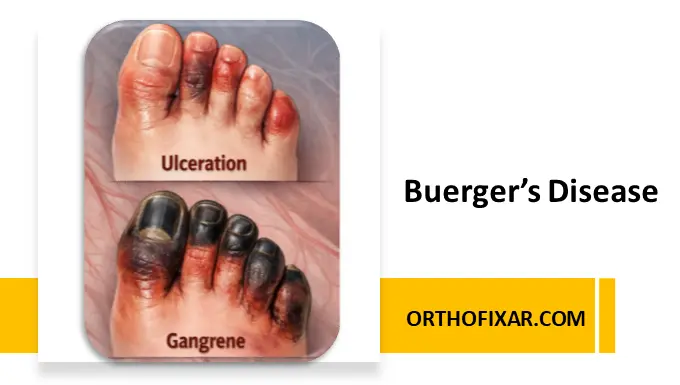
Buerger’s disease, also known as thromboangiitis obliterans, is a rare, non-atherosclerotic inflammatory vascular disorder that affects small- and medium-sized arteries and veins, primarily in the extremities. It is strongly associated with tobacco use and can lead to severe limb ischemia and even amputation if untreated.
This condition is sometimes mistakenly searched as “bergers syndrome”, but the correct term is Buerger’s disease.
What is Buerger’s Disease (Thromboangiitis Obliterans)?
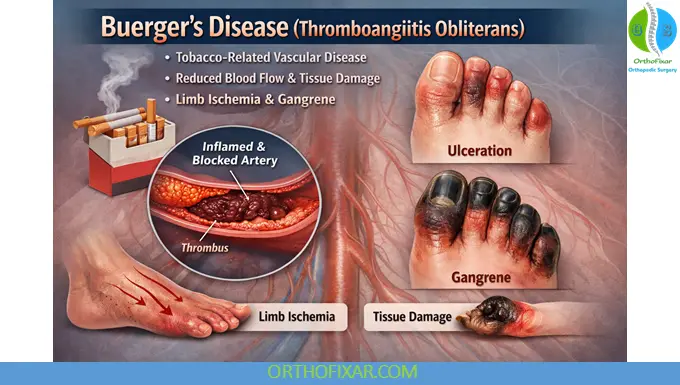
Buerger’s disease is a segmental inflammatory vasculitis characterized by thrombotic occlusion of blood vessels in the hands and feet.
- Affects small and medium vessels
- Causes reduced blood flow (ischemia)
- Leads to tissue damage, ulcers, and gangrene
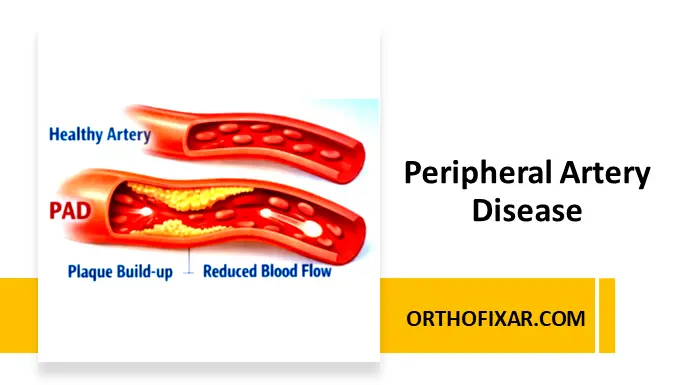
Unlike atherosclerosis, it is not caused by lipid plaques, but by inflammation and thrombosis.
Buerger’s Disease Cause
Main Cause
The exact buerger’s disease cause remains unclear, but strong evidence shows:
- Tobacco exposure is the key trigger
- Chemicals in tobacco damage the vascular endothelium
Proposed Mechanisms
- Immune-mediated vascular injury (autoimmune component)
- Genetic susceptibility
- Inflammatory thrombus formation
👉 Important: Nearly all patients are current or former smokers.
Risk Factors
- Heavy cigarette smoking or chewing tobacco
- Age: typically 20–45 years
- Male predominance (though increasing in females)
- Possible association with cannabis use
See Also: Peripheral Artery Disease (PAD): Symptoms, Causes & Treatment
Symptoms of Buerger’s Disease
Symptoms reflect distal limb ischemia:
Early Symptoms
- Pain in hands or feet (especially with walking – claudication)
- Cold sensitivity
- Numbness or tingling
Progressive Symptoms
- Skin color changes (white, blue, or red)
- Raynaud-like episodes
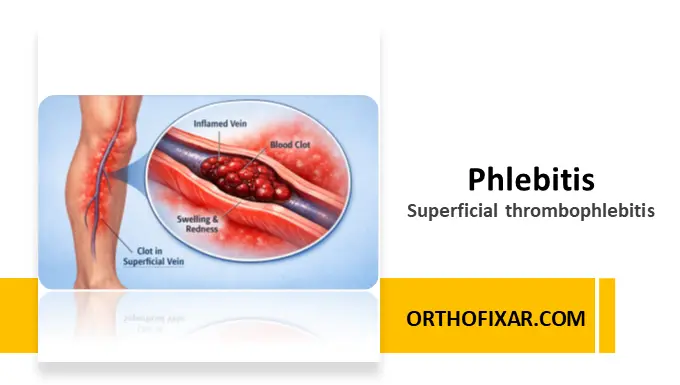
- Superficial thrombophlebitis
Advanced Disease
- Pain at rest
- Non-healing ulcers
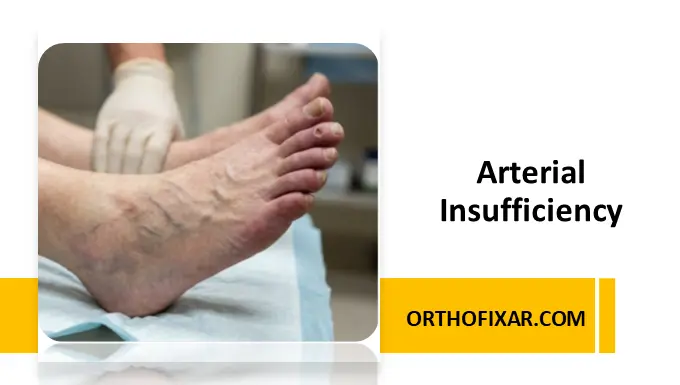
- Gangrene → possible amputation
Pathophysiology
Buerger’s disease involves:
- Inflammation of vessel walls
- Thrombus formation inside vessels
- Segmental occlusion
- Distal ischemia
This leads to reduced oxygen supply and eventual tissue necrosis.
See Also: Raynaud’s Phenomenon: Causes, Symptoms, Diagnosis & Treatment
Diagnosis
There is no single diagnostic test. Diagnosis is clinical and by exclusion.
Typical Findings
- Young smoker with distal ischemia
- Normal proximal arteries
- Segmental occlusions on angiography
Investigations
- Doppler ultrasound
- Angiography (corkscrew collaterals)
- Blood tests to exclude autoimmune and embolic causes
Treatment of Buerger’s Disease
1. Absolute Smoking Cessation (Most Important)
- The only proven intervention to stop disease progression
- Even minimal tobacco exposure can worsen disease
2. Medical Treatment
- Vasodilators (e.g., calcium channel blockers)
- Antiplatelet therapy
- Prostaglandin analogs (e.g., iloprost)
3. Surgical Options
- Sympathectomy (pain relief)
- Amputation in advanced gangrene
4. Emerging Therapies
- Stem cell therapy
- Therapeutic angiogenesis
Complications
- Chronic pain
- Recurrent ulcers
- Infection
- Gangrene → limb loss
Prognosis
- Good if smoking is completely stopped
- Poor if tobacco use continues (high amputation risk)
Buerger’s Disease vs “Bergers Syndrome”
- Correct term: Buerger’s disease
- Incorrect/common misspelling: bergers syndrome
- Medical synonym: thromboangiitis obliterans
Key Takeaways
- Buerger’s disease is a tobacco-related inflammatory vascular disease
- Strongly affects young smokers
- Causes distal ischemia and tissue loss
- Smoking cessation is the only effective treatment
References & More
- Del Conde I, Peña C. Buerger disease (thromboangiitis obliterans). Tech Vasc Interv Radiol. 2014 Dec;17(4):234-40. doi: 10.1053/j.tvir.2014.11.003. Epub 2014 Nov 13. PMID: 25770636. Pubmed
- Klein-Weigel PF, Richter JG. Thromboangiitis obliterans (Buerger’s disease). Vasa. 2014 Sep;43(5):337-46. doi: 10.1024/0301-1526/a000371. PMID: 25147010. Pubmed
- Del Conde I, Peña C. Buerger disease (thromboangiitis obliterans). Tech Vasc Interv Radiol. 2014 Dec;17(4):234-40. doi: 10.1053/j.tvir.2014.11.003. Epub 2014 Nov 13. PMID: 25770636.
- Bickley, L. S., Szilagyi, P. G., Hoffman, R. M., & Soriano, R. P. (2021). Bates’ guide to physical examination and history taking, 12e.