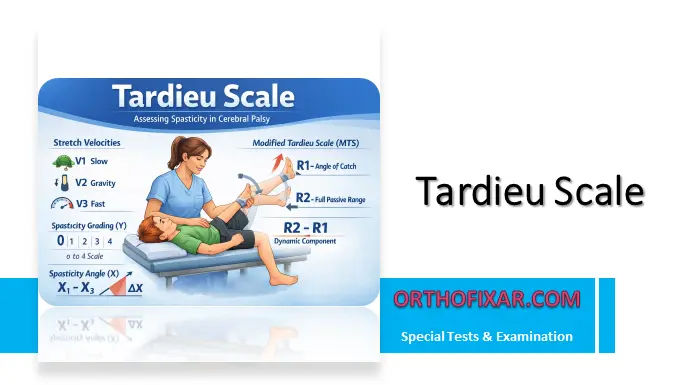
The Tardieu Scale is a standardized clinical method used to evaluate spasticity, particularly in patients with cerebral palsy and other upper motor neuron disorders. Compared with many traditional tone assessment tools, it is considered more sensitive and specific because it measures the velocity-dependent nature of spastic muscle response.
This guide explains how the Tardieu Scale works, how it is scored, and how clinicians interpret results in daily practice.
What Is the Tardieu Scale?
The Tardieu Scale quantifies muscle spasticity using:
- Spasticity Grade (Y) → quality of muscle reaction
- Spasticity Angle (X) → dynamic range difference
- Stretch Velocities → standardized movement speeds
This multi-parameter approach allows clinicians to distinguish between:
- Neural reflex hyperexcitability (true spasticity)
- Mechanical soft-tissue stiffness
- Fixed contractures
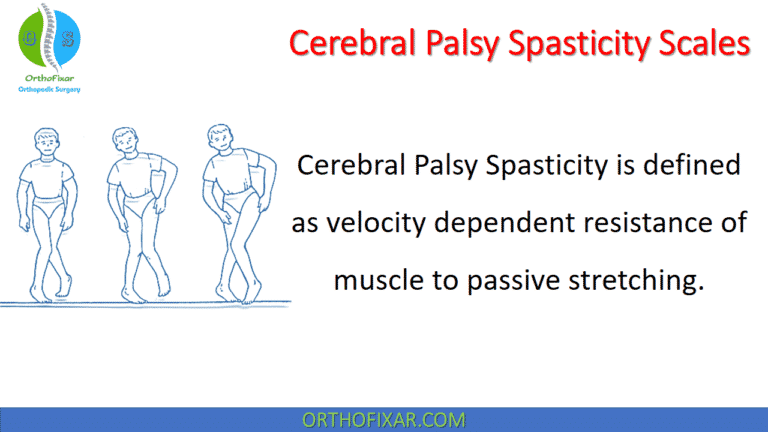
See Also: Cerebral Palsy Spasticity Scales
Patient Positioning and Test Principles
Accurate measurement requires strict standardization:
- The tested muscle must be fully relaxed
- Other joints remain fixed in a constant position
- The neck and trunk must not change position
- Conditions must remain consistent between repeated tests
Improper stabilization can alter stretch reflex responses and invalidate results.
Stretch Velocities (V)
Velocity control is central to the scale:
V1 — Slow Stretch
- “As slow as possible”
- Minimizes stretch reflex activation
- Measures passive range of motion
V2 — Gravity-Assisted Drop
- Limb segment falls under gravity
- Used selectively (see limitations below)
V3 — Fast Stretch
- “As fast as possible”
- Faster than natural gravitational drop
- Maximizes stretch reflex response
- Used to evaluate spasticity
Clinical rule:
- V1 → Passive mechanics
- V2 & V3 → Neural spasticity
Spasticity Grade (Y)
This grade describes the muscle’s reaction during passive stretch:
| Grade | Clinical Finding |
|---|---|
| 0 | No resistance throughout movement |
| 1 | Slight resistance, no clear catch |
| 2 | Clear catch at specific angle, then release |
| 3 | Fatigable clonus (<10 s with sustained pressure) |
| 4 | Infatigable clonus (>10 s with sustained pressure) |
Grades 3–4 indicate marked hyperreflexia.
Spasticity Angle (X)
The spasticity angle quantifies velocity-dependent resistance.
Measurement Steps
- Perform a slow stretch (V1)
- Record angle of passive movement arrest
- Limitation may be mechanical or discomfort-related
- Perform a fast stretch (V3)
- Record angle of catch, release, or clonus
Interpretation
- Large difference → Strong velocity-dependent reflex → Higher spasticity
- Small difference → Mechanical stiffness or contracture predominates
Important Angle Measurement Rule
Angles are measured relative to the muscle’s minimal stretch position, not standard anatomical neutral.
Example — Ankle Plantar Flexors:
- 0° = Full plantarflexion (shortest muscle length)
- Not anatomical neutral
This avoids misinterpretation when muscle length differs from joint reference norms.
Use of V2 Velocity
V2 testing is limited to specific muscle groups:
- Knee extensors
- Wrist extensors
- Elbow flexors
It is not reliable for all joints due to gravity vector variability.
See Also: Modified Ashworth Scale
Modified Tardieu Scale (MTS)
The Modified Tardieu Scale simplifies measurement by focusing on two joint angles:
R1 — Angle of Catch
- Measured during rapid stretch
- First point of resistance or clonus
R2 — Full Passive Range
- Measured during slow stretch
- Maximum achievable joint motion
Interpretation
| Finding | Clinical Meaning |
|---|---|
| Large R2–R1 gap | Predominantly dynamic spasticity |
| Small R2–R1 gap | Fixed contracture / structural shortening |
This distinction is critical for treatment planning (e.g., physiotherapy vs. surgical lengthening).
Clinical Advantages of the Tardieu Scale
- Captures velocity-dependent tone
- Separates neural and mechanical contributors
- Quantifies dynamic vs. fixed deformity
- Useful for:
- Cerebral palsy
- Stroke
- Traumatic brain injury
- Spinal cord lesions
Clinical Applications
The scale supports:
- Baseline neuromuscular assessment
- Monitoring treatment response (e.g., botulinum toxin, casting)
- Surgical planning
- Rehabilitation progress tracking
Key Takeaways
- Tardieu Scale = Velocity-based spasticity assessment
- Y Grade → Quality of muscle response
- X Angle → Velocity-dependent resistance
- MTS (R1–R2) → Dynamic vs fixed component
- Larger angle differences indicate greater neural spasticity
References & More
- Gracies J-M, Burke K, Clegg NJ, Browne R, Rushing C, Fehlings D, et al. Reliability of the Tardieu scale for assessing spasticity in children with cerebral palsy. Arch Phys Med Rehabil. 2010;91:421–428. Pubmed
- Shu X, McConaghy C, Knight A. Validity and reliability of the Modified Tardieu Scale as a spasticity outcome measure of the upper limbs in adults with neurological conditions: a systematic review and narrative analysis. BMJ Open. 2021 Dec 24;11(12):e050711. doi: 10.1136/bmjopen-2021-050711. PMID: 34952873; PMCID: PMC8712979. Pubmed
- Glinsky J. Tardieu Scale. J Physiother. 2016 Oct;62(4):229. doi: 10.1016/j.jphys.2016.07.007. Epub 2016 Aug 4. PMID: 27634157. Pubmed