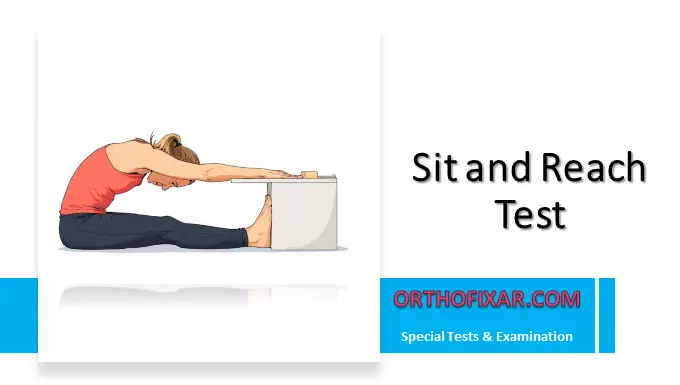
The Sit and Reach Test is one of the most commonly used physical fitness assessments for evaluating flexibility, particularly of the hamstrings and lower back. It is widely applied in schools, athletic screening programs, and general fitness testing due to its simplicity and minimal equipment requirements. Despite its popularity, the test has important limitations that must be understood to avoid misinterpretation and inappropriate clinical or exercise recommendations.
See Also: Hamstring Muscles
Purpose of the Sit and Reach Test
The stated purpose of the sit and reach test is to evaluate the flexibility of the lumbar spine and hamstring muscles. Traditionally, greater reaching distance is interpreted as better flexibility, with emphasis placed on the concept that “the more, the better.”
However, flexibility is a multifactorial characteristic influenced by age, body proportions, growth patterns, and muscle length relationships, all of which affect test outcomes.
See Also: Physical Fitness Tests
Sit and Reach Test Description and Procedure
The sit and reach test is performed as follows:
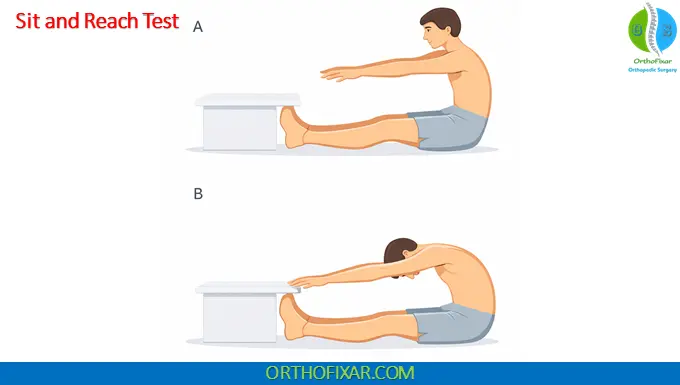
- The individual sits on the floor with knees fully extended.
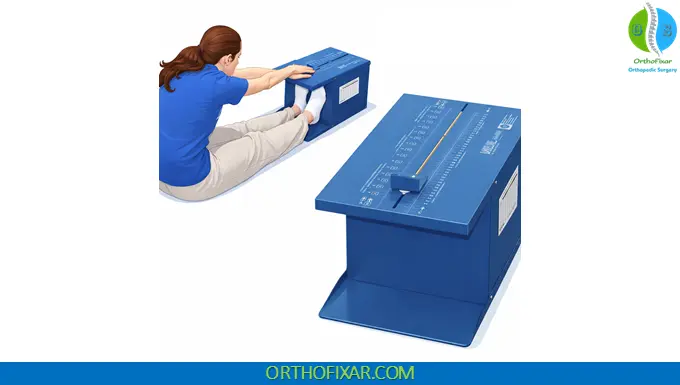
- Feet are placed flat against a measurement box or wall.
- With arms extended forward and hands overlapping, the individual reaches forward toward the toes.
- The distance reached is measured, typically in inches or centimeters.
For young children and most adults, touching the toes in this position is generally considered a normal finding. Reaching beyond the toes is often interpreted as evidence of increased or excessive flexibility.
Sit and Reach Test Scoring
- Scoring is based on how far the fingertips extend to or beyond the toes.
- Greater distance beyond the toes is commonly equated with superior flexibility of the hamstrings and lower back.
- Results are frequently categorized as poor, average, good, or excellent based on normative tables.
This scoring approach assumes a direct relationship between reach distance and spinal or hamstring flexibility, an assumption that is not always valid.
| Age Group (years) | Poor | Moderate | Good | Excellent |
|---|---|---|---|---|
| Male 6–10 | 9.5 cm | 22.8 cm | 29.4 cm | 36.0 cm |
| Female 6–10 | 19.3 cm | 28.9 cm | 35.1 cm | 41.7 cm |
| Male 11–15 | 8.8 cm | 21.7 cm | 29.5 cm | 36.4 cm |
| Female 11–15 | 18.9 cm | 28.9 cm | 35.3 cm | 42.0 cm |
| Male 16–24 | 8.8 cm | 21.6 cm | 30.3 cm | 37.1 cm |
| Female 16–24 | 18.6 cm | 28.8 cm | 35.7 cm | 42.4 cm |
| Male 25–40 | 8.8 cm | 21.3 cm | 29.9 cm | 36.6 cm |
| Female 25–40 | 17.5 cm | 28.3 cm | 36.4 cm | 43.0 cm |
| Male 40+ | 8.4 cm | 20.6 cm | 28.6 cm | 35.2 cm |
| Female 40+ | 15.3 cm | 26.1 cm | 32.0 cm | 40.9 cm |
Age-Related Considerations
Normal variations in sit and reach performance occur across different age groups.
- Children aged 10–14 years often demonstrate an inability to touch their toes.
- This age range corresponds to a period of rapid growth in which leg length increases disproportionately relative to trunk length.
- In these individuals, limited reach is often physiologically normal, not pathological.
Importantly, children at this stage should not be forced to touch their toes, as excessive stretching may increase the risk of musculoskeletal injury.
Limitations of the Sit and Reach Test
The sit and reach test fails to address several critical variables:
- Muscle Length Imbalance
- The test does not differentiate between hamstring flexibility and lumbar spine flexibility.
- Individuals with flexible hamstrings but limited lumbar mobility may achieve normal or high scores, masking spinal stiffness.
- Conversely, individuals with normal spinal mobility but relatively tight hamstrings may score poorly.
- Body Proportions
- Leg-to-trunk length ratio significantly influences reach distance.
- Adults and adolescents with long legs relative to trunk length may have normal flexibility yet be unable to touch their toes.
- False Pass and False Fail Outcomes
- Some individuals may “pass” the test due to hamstring dominance despite limited spinal flexibility.
- Many children and adults with normal, age-appropriate flexibility may “fail” due to anthropometric factors.
In these cases, it is more accurate to conclude that the test has failed the individual, rather than the individual failing the test.
Clinical Implications and Potential Harm
A significant concern is how test results are used in practice:
- Individuals labeled as having “failed” the test are often prescribed spinal flexibility or hamstring stretching exercises.
- In some cases, these exercises are unnecessary or even contraindicated, particularly if flexibility is already adequate or if joint instability exists.
- This misapplication is especially problematic in children and adolescents.
Given the widespread use of physical fitness testing, improper interpretation can lead to inappropriate interventions and misconceptions about musculoskeletal health.
See Also: Hamstring Strain
Evidence on Validity
Research evaluating the validity of the sit and reach test highlights its limitations:
- Moderate criterion-related validity for estimating hamstring extensibility
- Correlation coefficients (rp): 0.46–0.67
- Low criterion-related validity for estimating lumbar spine extensibility
- Correlation coefficients (rp): 0.16–0.35
These findings indicate that while the test may provide some insight into hamstring flexibility, it is a poor indicator of lumbar spine mobility.
Conclusion
The sit and reach test is a simple and widely used screening tool, but it should not be considered a definitive measure of lower back or hamstring flexibility. Age, growth patterns, body proportions, and muscle length imbalances significantly influence test performance.
For clinical, educational, and fitness settings, results should be interpreted cautiously and in conjunction with a comprehensive musculoskeletal assessment. Greater scrutiny of flexibility testing methods is essential to prevent misclassification, unnecessary interventions, and potential harm—particularly in children and adolescents.
References & More
- Mayorga-Vega D, Merino-Marban R, Viciana J. Criterion-related validity of sit-and-reach tests for estimating hamstring and lumbar extensibility: A meta-analysis. Journal of sports science & medicine. 2014 Jan;13(1):1. Link
- Muscles: Testing and Function with Posture and Pain. Book by F. P. Kendall, 5th Edition.