The radial pulse is one of the most commonly assessed peripheral pulses in clinical practice. It provides essential information about heart rate, rhythm, vascular status, and overall cardiovascular health. Because of its superficial location and ease of access, the radial pulse is routinely used in both emergency and routine medical examinations.
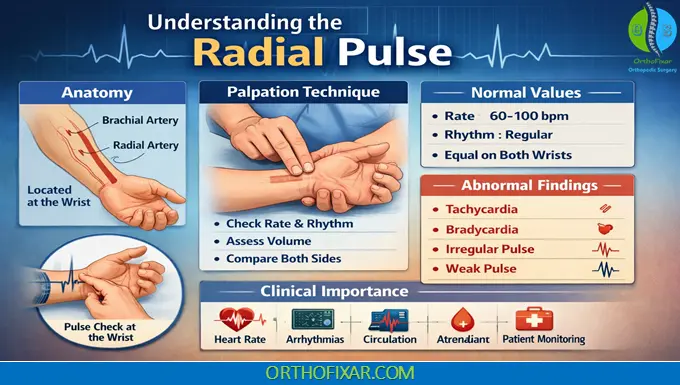
The radial Pulse is palpated just proximal to the thumb on the palmar side of the radial aspect of the wrist.
What is the Radial Pulse?
The radial pulse is the palpable expansion of the radial artery, which occurs with each systolic contraction of the heart. It reflects the transmission of blood from the left ventricle through the arterial system to the periphery.
The radial pulse is typically assessed at the wrist, just proximal to the base of the thumb.
How to Find Radial Pulse Location?
Radial pulse location is found as following:
- With the patient in seated or lying position. Turn the hand over so that the palm-side up.
- Put your index and middle finger tip on the palmer side of lateral part of the distal forearm, just proximal to the thumb and above the styloid process of the radius.
- When you locate the radial pulse, count the number of pulses in a 15-second interval and multiply that number by 4 to determine the number of beats per minute (Count for 60 seconds if rhythm is irregular).
- Also attempts to determine the rhythm, volume (amplitude) and aymmetry (compare both sides if needed)
See Also: Capillary Refill Test

Heart rate outside of expected values or values that deviate from any baseline values Bounding or irregular pulse.
Normal Radial Pulse Findings
Radial pulse normal range is between 60-90 per minute, which reflects the normal heart rate.
| Parameter | Normal Finding |
|---|---|
| Rate | 60–100 beats per minute (adult) |
| Rhythm | Regular |
| Volume | Moderate and equal bilaterally |
| Symmetry | Equal on both wrists |
The quality and quantity of the heart rate established:
- Normal (general population): 60–100 bpm,
- Well-trained athletes: 40–60 bpm,
- Tachycardia: Greater than 100 bpm,
- Bradycardia: Less than 60 bpm.
The baseline heart rate should be recorded and rechecked at regular intervals. Note the rhythm of the beats for symmetry and strength.
Abnormal Radial Pulse Findings
Abnormalities in the radial pulse may indicate underlying cardiovascular or systemic conditions.
Common Abnormalities
- Tachycardia: >100 bpm (e.g., fever, anxiety, shock)
- Bradycardia: <60 bpm (e.g., athletes, heart block)
- Irregular rhythm: Atrial fibrillation or ectopic beats
- Weak or thready pulse: Hypovolemia, heart failure
- Bounding pulse: Fever, anemia, hyperthyroidism
- Asymmetry: Peripheral arterial disease, arterial obstruction
Radial Pulse vs Other Peripheral Pulses
| Pulse | Location | Clinical Use |
|---|---|---|
| Radial | Wrist | Routine monitoring |
| Brachial | Arm | Blood pressure measurement |
| Carotid | Neck | Emergency pulse check |
| Femoral | Groin | Shock assessment |
| Dorsalis pedis | Foot | Peripheral vascular disease |
Radial Artery Anatomy
The course of the radial artery in the forearm is represented by a line joining the midpoint of the cubital fossa to a point just medial to the radial styloid process. The radial artery leaves the forearm by winding around the lateral aspect of the wrist and crosses the floor of the anatomical snuff box.
See Also: Allen Test

Notes
The heart rate is determined by palpating the carotid, radial, femoral, or brachial pulse. An athlete’s resting heart rate typically ranges from 60 to 100 beats per minute (bpm). Highly conditioned athletes have lower heart rates. Older or recreational athletes have heart rates at the higher end of the scale.
When assessing the heart rate of an athlete who has just stopped exercising, an increased heart rate caused by the demands of exercise should be considered.
Palpable pulses should have:
- a consistent rhythm with a smooth,
- quick upstroke,
- consistent summit,
- a gradual downstroke.
An abnormal rate or irregular rhythm could be indicative of an arrhythmia, stimulant use, or anxiety. A rapidly rising, large-amplitude pulse (water-hammer pulse) suggests hypertrophic cardiomyopathy, or aortic or mitral valve regurgitation; a slowly rising, small-amplitude pulse suggests aortic stenosis or heart failure.
Simultaneous palpation of the radial pulse and femoral pulse can identify narrowing (coarctation) of the aorta. A delay of the femoral pulse relative to the radial pulse warrants further cardiovascular examination.
References
- Giese EA, O’Connor FG, Brennan FH, Depenbrock PJ, Oriscello RG. The athletic preparticipation evaluation: cardiovascular assessment. Am Fam Physician. 2007 Apr 1;75(7):1008-14. PMID: 17427614. Pubmed
- Dutton’s Orthopaedic Examination, Evaluation, And Intervention 3rd Edition.