Buerger test is a simple, noninvasive bedside examination used to assess the adequacy of arterial blood supply to the lower extremities. It is commonly performed in patients with suspected peripheral arterial disease (PAD) and provides valuable clinical information regarding arterial insufficiency.
The primary aim of Buerger test is to evaluate arterial perfusion of the lower limb. It helps clinicians identify compromised arterial circulation that may result from atherosclerosis, thromboangiitis obliterans, or other vascular pathologies.
See Also: Allen Test
How to Perform Buerger Test?
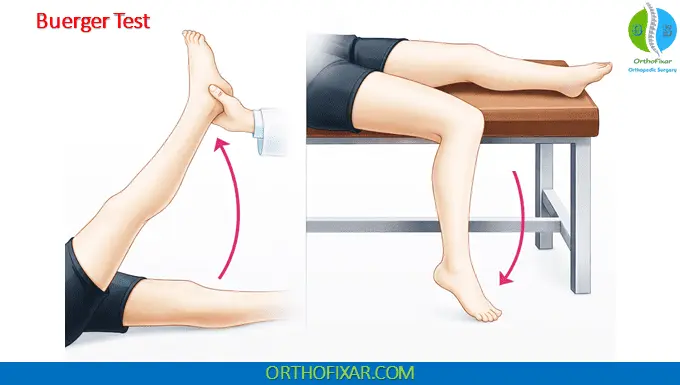
Supine Position (Elevation Phase)
- The patient lies in the supine position.
- The examiner elevates the patient’s leg to approximately 45 degrees and maintains this position for at least 3 minutes.
- During elevation, the examiner observes the color of the foot and the appearance of superficial veins.
Observation During Elevation
- A normal limb maintains its pink coloration with visible veins.
- A positive finding during this phase is blanching of the foot or early collapse of the prominent veins, indicating reduced arterial inflow.
Dependent Position (Dependency Phase)
- The patient is then asked to sit upright with the legs dangling over the edge of the bed.
- The examiner observes the time required for color to return to the limb and for the superficial veins to refill.
What is the Positive Buerger Test?
- Normal response: Color should return to the limb almost immediately, and veins should refill within seconds.
- Positive response: If it takes 1 to 2 minutes for the limb color to be restored and for the veins to become prominent again, the test is confirmed positive for poor arterial circulation.
Note: In severe cases, the foot may transition from pallor (while elevated) to a deep, dusky red color (rubor) when dangled. This is known as reactive hyperemia or “dependent rubor.”
A positive Buerger test suggests significant arterial insufficiency. It is particularly useful as a screening tool in patients with risk factors such as diabetes mellitus, smoking, hypertension, and hyperlipidemia. While the test does not replace vascular imaging, it supports clinical suspicion and guides further diagnostic evaluation, such as ankle–brachial index (ABI) measurement or Doppler studies.
Limitations of the Buerger’s Test
- Subjective interpretation may vary between examiners.
- The test does not localize the level of arterial obstruction.
- The results of the test should always be correlated with patient history and additional vascular assessments.
References & More
- Evans RC. Illustrated Essentials in Orthopedic Physical Assessment. St Louis: Mosby; 1994.
- Orthopedic Physical Assessment by David J. Magee, 7th Edition.
- Insall RL, Davies RJ, Prout WG. Significance of Buerger’s test in the assessment of lower limb ischaemia. J R Soc Med. 1989 Dec;82(12):729-31. doi: 10.1177/014107688908201209. PMID: 2693712; PMCID: PMC1292415. Pubmed