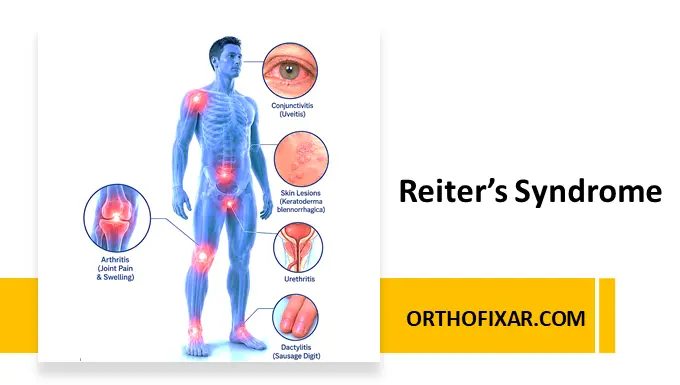
Reiter’s syndrome, historically known as Reiter’s disease, is a form of inflammatory arthritis that develops after certain bacterial infections. Today, the preferred medical term is reactive arthritis, as it more accurately describes the condition and avoids the eponym associated with Hans Reiter.
Reactive arthritis typically affects the joints, eyes, skin, and genitourinary tract. It is characterized by sterile joint inflammation occurring after an infection elsewhere in the body, most commonly within the gastrointestinal or genitourinary system.
Understanding reiter’s syndrome is important because early recognition and treatment can reduce symptoms, prevent complications, and improve long-term outcomes.
What is Reiter’s Syndrome?
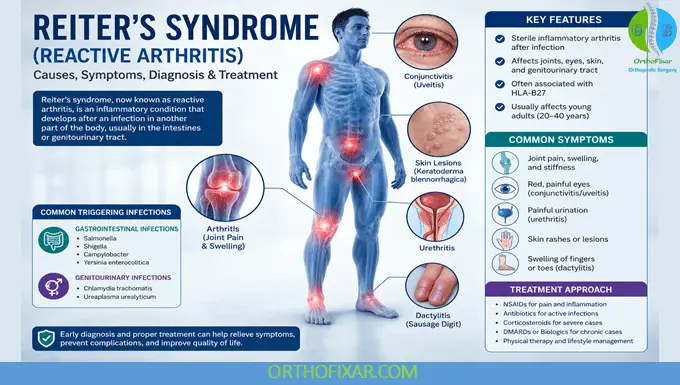
Reiter’s syndrome is a subtype of seronegative spondyloarthritis characterized by inflammatory arthritis triggered by a preceding infection.
Traditionally, the condition was described by the triad of:
- Arthritis
- Urethritis
- Conjunctivitis
However, many patients do not develop all three manifestations simultaneously.
The syndrome usually appears one to four weeks after an infection and most commonly affects young adults between 20 and 40 years of age.
Historical Background
The term Reiter’s disease originated from German physician Hans Reiter, who described the syndrome in the early 20th century. Modern medical literature now favors the term reactive arthritis because it more accurately reflects the underlying pathophysiology.
Although the name reiter’s syndrome is still widely recognized in educational materials and patient discussions, healthcare professionals increasingly use “reactive arthritis.”
Causes of Reiter’s Syndrome
Reactive arthritis develops after an infection triggers an abnormal immune response.
Common Triggering Bacterial Infections
Genitourinary Infections
- Chlamydia trachomatis
- Ureaplasma urealyticum
Gastrointestinal Infections
- Salmonella species
- Shigella species
- Campylobacter jejuni
- Yersinia enterocolitica
- Clostridioides difficile (less common)
The triggering infection may have resolved by the time joint symptoms appear.
Pathophysiology
The exact mechanism remains incompletely understood.
Current evidence suggests that bacterial antigens persist within tissues and stimulate an immune-mediated inflammatory response. Genetic susceptibility also plays an important role.
Role of HLA-B27
Approximately 50% to 80% of patients with reactive arthritis are positive for the HLA-B27 gene.
HLA-B27 positivity is associated with:
- More severe disease
- Increased risk of chronic symptoms
- Greater likelihood of axial involvement
- Higher recurrence rates
See Also: Juvenile Rheumatoid Arthritis: Symptoms, Treatment & Prognosis
Epidemiology
Reactive arthritis occurs worldwide.
Key epidemiological features include:
- More common in males
- Typically affects individuals aged 20–40 years
- Frequently follows sexually transmitted or enteric infections
- Higher prevalence among HLA-B27-positive populations
Symptoms of Reiter’s Syndrome
Symptoms usually begin several weeks after the triggering infection.
Articular Manifestations
Joint involvement is often asymmetric and affects the lower extremities.
Common features include:
- Knee pain and swelling
- Ankle arthritis
- Foot pain
- Hip involvement
- Sacroiliac joint inflammation
Patients may experience:
- Morning stiffness
- Reduced mobility
- Joint tenderness
- Warmth around affected joints
Enthesitis
Inflammation where tendons attach to bone is common.
Typical sites include:
- Achilles tendon
- Plantar fascia
- Patellar tendon
Dactylitis
Diffuse swelling of an entire finger or toe may occur, producing the characteristic “sausage digit” appearance.
Extra-Articular Manifestations
Ocular Involvement
Eye symptoms may include:
- Conjunctivitis
- Anterior uveitis
- Eye redness
- Photophobia
- Blurred vision
Genitourinary Symptoms
Patients may develop:
- Urethritis
- Dysuria
- Prostatitis in men
- Cervicitis in women
Skin Manifestations
Common dermatological findings include:
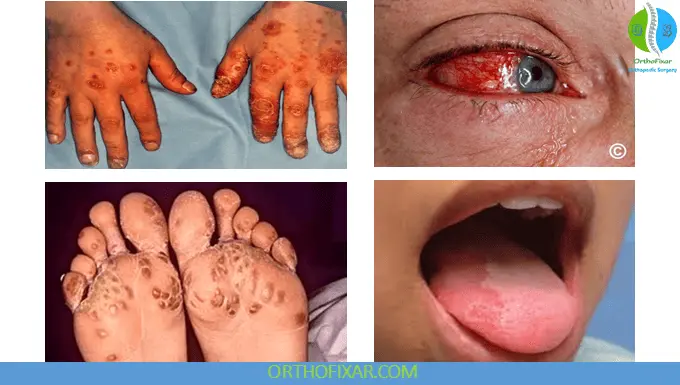
Keratoderma Blennorrhagica
Hyperkeratotic skin lesions usually affecting:
- Soles
- Palms
Circinate Balanitis
Painless inflammatory lesions involving the glans penis.
Oral Lesions
Some patients develop:
- Oral ulcers
- Tongue lesions
Diagnosis of Reiter’s Syndrome
No single laboratory test confirms the diagnosis.
Diagnosis is based on:
- Clinical findings
- History of preceding infection
- Laboratory investigations
- Imaging studies
Medical History
Clinicians should inquire about:
- Recent diarrhea
- Foodborne illness
- Sexually transmitted infections
- Previous episodes of arthritis
Physical Examination
Assessment includes:
- Joint swelling
- Enthesitis
- Eye inflammation
- Skin lesions
- Genitourinary abnormalities
Laboratory Investigations
Blood Tests
Common findings include:
- Elevated ESR
- Elevated C-reactive protein (CRP)
- Mild anemia of chronic disease
HLA-B27 Testing
Useful for prognostic assessment but not required for diagnosis.
Microbiological Testing
Tests may include:
- Urine nucleic acid amplification tests (NAATs)
- Stool cultures
- Chlamydia testing
Synovial Fluid Analysis
Joint aspiration helps exclude:
- Septic arthritis
- Crystal arthropathy
Typically, synovial fluid demonstrates inflammatory changes without bacterial growth.
Imaging Studies
Plain Radiographs
May reveal:
- Soft tissue swelling
- Periostitis
- Joint space narrowing in chronic disease
Ultrasound
Useful for evaluating:
- Synovitis
- Enthesitis
- Tendon involvement
MRI
Provides detailed visualization of:
- Sacroiliitis
- Bone marrow edema
- Early inflammatory changes
Differential Diagnosis
Conditions that may mimic reiter’s syndrome include:
- Septic arthritis
- Rheumatoid arthritis
- Psoriatic arthritis
- Ankylosing spondylitis
- Gout
- Inflammatory bowel disease-associated arthritis
- Lyme disease
Reiter’s Syndrome Treatment
Treatment focuses on controlling inflammation, eradicating active infection, and preserving function.
Nonsteroidal Anti-Inflammatory Drugs (NSAIDs)
NSAIDs are first-line therapy.
Examples include:
- Ibuprofen
- Naproxen
- Diclofenac
- Indomethacin
These medications help reduce:
- Pain
- Stiffness
- Joint swelling
Antibiotic Therapy
Antibiotics are indicated when an active infection is identified.
For Chlamydia-associated disease, treatment may include:
- Doxycycline
- Azithromycin
Routine prolonged antibiotic therapy is not recommended for all patients.
Corticosteroids
Intra-Articular Corticosteroid Injections
Useful for:
- Persistent monoarthritis
- Oligoarthritis
Systemic Corticosteroids
Reserved for severe cases with extensive inflammation.
Disease-Modifying Antirheumatic Drugs (DMARDs)
Patients with chronic disease may benefit from:
- Sulfasalazine
- Methotrexate
Biologic Therapy
For refractory cases, biologic agents may be considered.
Examples include:
- TNF inhibitors
- IL-17 inhibitors
These treatments are generally managed by rheumatology specialists.
Physical Therapy and Rehabilitation
Physical therapy plays a vital role in recovery.
Benefits include:
- Maintaining joint mobility
- Improving muscle strength
- Preventing contractures
- Enhancing function
Recommended activities may include:
- Stretching exercises
- Range-of-motion exercises
- Low-impact aerobic training
Complications
Potential complications include:
- Chronic arthritis
- Recurrent disease episodes
- Sacroiliitis
- Persistent enthesitis
- Vision-threatening uveitis
- Reduced quality of life
Prognosis
The prognosis of Reiter’s disease is generally favorable.
Most patients experience improvement within:
- 3 to 12 months
However, some develop:
- Chronic arthritis
- Recurrent symptoms
- Progressive spondyloarthritis
Poor prognostic factors include:
- HLA-B27 positivity
- Severe initial disease
- Axial involvement
- Recurrent infections
Prevention
Preventive measures focus on reducing infection risk.
Recommendations include:
- Practicing safe sex
- Prompt treatment of sexually transmitted infections
- Proper food hygiene
- Handwashing
- Early medical evaluation after gastrointestinal infections
Key Points
- Reiter’s syndrome is now more commonly called reactive arthritis.
- It develops after gastrointestinal or genitourinary infections.
- Arthritis, conjunctivitis, and urethritis form the classic clinical triad.
- HLA-B27 increases susceptibility and disease severity.
- NSAIDs are first-line treatment.
- Chronic cases may require DMARDs or biologic therapy.
- Early diagnosis improves long-term outcomes.
References & More
- Jogu P, Swamy V, Maher L. Reactive Arthritis. [Updated 2026 May 15]. In: StatPearls [Internet]. Treasure Island (FL): StatPearls Publishing; 2026 Jan-. Available from: https://www.ncbi.nlm.nih.gov/books/NBK499831/
- Barth, W F, and K Segal. “Reactive arthritis (Reiter’s syndrome).” American family physician vol. 60,2 (1999): 499-503, 507. Link
- Amor, B. “Reiter’s syndrome. Diagnosis and clinical features.” Rheumatic diseases clinics of North America vol. 24,4 (1998): 677-95, vii. doi:10.1016/s0889-857x(05)70037-5. Link
- Selmi C, Gershwin ME. Diagnosis and classification of reactive arthritis. Autoimmun Rev. 2014 Apr-May;13(4-5):546-9. PubMed
- Hannu T. Reactive arthritis. Best Pract Res Clin Rheumatol. 2011 Jun;25(3):347-57. PubMed