Assessing vital signs is a fundamental clinical skill that directly impacts patient safety and care decisions. This article provides a practical guide to measuring temperature, pulse, respiration, and blood pressure, explains how to interpret the results correctly, and highlights the most common errors that students and practitioners make. Whether you are preparing for an exam or refining your bedside technique, the content here will help you build confidence and accuracy.
Why Vital Signs Assessment Matters
Vital signs are the body’s basic indicators of life and function. They tell you if a patient is stable, deteriorating, or responding to treatment. A single abnormal reading can be the first clue to a serious condition like sepsis, shock, or respiratory failure. Missing or misinterpreting these signs can delay critical interventions.
Every healthcare student must master the measurement and interpretation of these four core signs: temperature, pulse, respiration rate, and blood pressure. You also need to recognize when a measurement is likely wrong due to technique or equipment issues.
Core Vital Signs: Measurement Techniques
Body Temperature
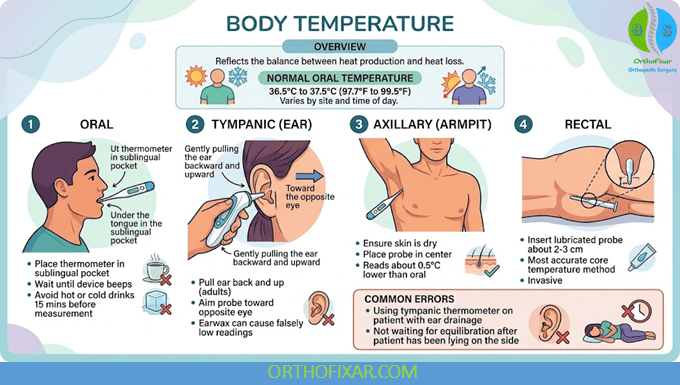
Temperature reflects the balance between heat production and heat loss. Normal oral temperature ranges from 36.5°C to 37.5°C (97.7°F to 99.5°F), but this varies by site and time of day.
- Oral: Place the thermometer under the tongue in the sublingual pocket. Wait until the device beeps. Avoid hot or cold drinks for 15 minutes before measurement.
- Tympanic (ear): Gently pull the ear backward and upward for adults. Aim the probe toward the opposite eye. Earwax can cause falsely low readings.
- Axillary (armpit): Ensure skin is dry. Place the probe in the center of the armpit. This method reads about 0.5°C lower than oral.
- Rectal: Insert the lubricated probe about 2-3 cm. This is the most accurate core temperature method but is invasive.
Common error: Using a tympanic thermometer on a patient with ear drainage or not waiting for equilibration after the patient has been lying on the side.
Pulse (Heart Rate)
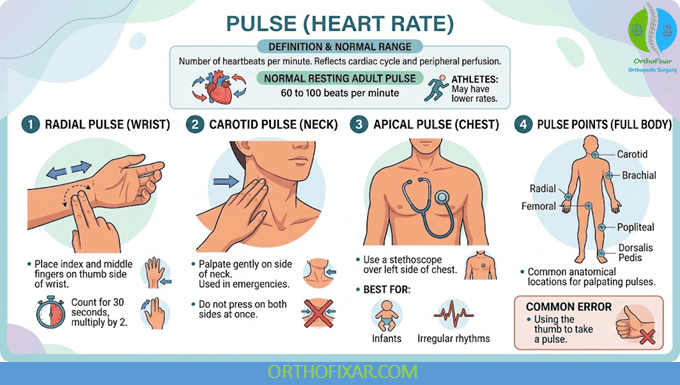
Pulse is the number of heartbeats per minute. Normal resting pulse for adults is 60 to 100 beats per minute. Athletes may have lower rates.
- Radial pulse: Place index and middle fingers on the thumb side of the wrist. Count for 30 seconds and multiply by 2.
- Carotid pulse: Used in emergencies. Palpate gently on the side of the neck. Do not press on both sides at once.
- Apical pulse: Use a stethoscope over the left side of the chest, at the fifth intercostal space. Best for infants or irregular rhythms.
Common error: Using the thumb to take a pulse (the thumb has its own pulse) or counting for only 15 seconds and multiplying by 4, which amplifies errors in irregular rhythms.
See Also: Dorsalis Pedis Pulse Location & Palpation
Respiratory Rate
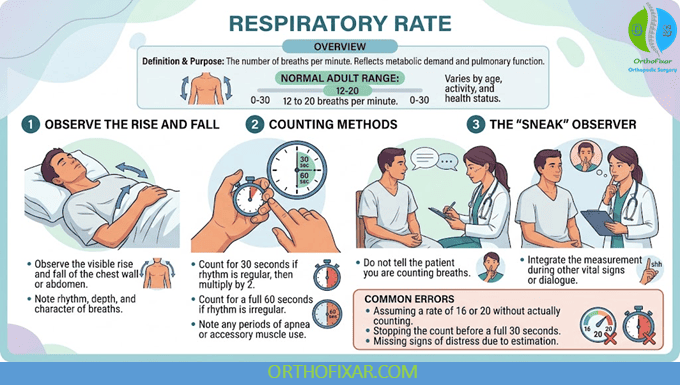
Respiratory rate is the number of breaths per minute. Normal adult rate is 12 to 20 breaths per minute. This sign is often ignored or estimated incorrectly.
- Observe the rise and fall of the chest or abdomen.
- Count for 30 seconds if the rhythm is regular, or a full 60 seconds if irregular.
- Do not tell the patient you are counting breaths, as they may unconsciously change their breathing pattern.
Common error: Assuming a rate of 16 or 20 without actually counting. Also, stopping counting early and doubling incorrectly.
Blood Pressure
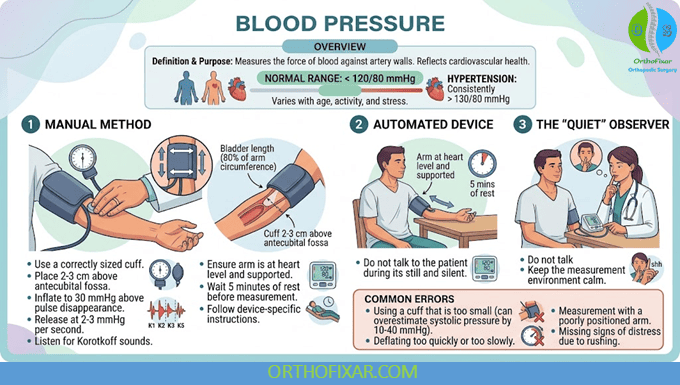
Blood pressure measures the force of blood against artery walls. Normal is less than 120/80 mmHg. Hypertension is defined as consistently above 130/80 mmHg.
- Manual method: Use a correctly sized cuff (bladder length 80% of arm circumference). Place the cuff 2-3 cm above the antecubital fossa. Inflate to 30 mmHg above the point where the pulse disappears. Release at 2-3 mmHg per second. Listen for Korotkoff sounds.
- Automated device: Ensure the arm is at heart level and supported. Wait 5 minutes of rest before measurement.
Common error: Using a cuff that is too small, which can overestimate systolic pressure by 10-40 mmHg. Also, deflating too quickly or too slowly.
Interpreting Vital Signs: What the Numbers Mean
Interpreting vital signs requires context. You must compare readings to the patient’s baseline, age, and clinical condition. A single number is rarely enough.
| Vital Sign | Normal Adult Range | Abnormal (Low) | Abnormal (High) |
|---|---|---|---|
| Temperature (oral) | 36.5 – 37.5°C | Below 36.0°C (hypothermia) | Above 38.0°C (fever) |
| Pulse | 60 – 100 bpm | Below 60 (bradycardia) | Above 100 (tachycardia) |
| Respiratory rate | 12 – 20 breaths/min | Below 12 (bradypnea) | Above 20 (tachypnea) |
| Blood pressure (systolic) | 90 – 120 mmHg | Below 90 (hypotension) | Above 130 (hypertension) |
Example: An elderly patient with a resting heart rate of 55 may be normal if they are physically active. But if the same patient has a fever and their pulse is only 55, that is a red flag for heart block or medication effect.
“Vital signs are not just numbers; they are a story about the patient’s physiological state. The skill is in reading the story, not just the digits.” — Clinical educators often remind students of this principle.
Common Errors in Vital Signs Assessment
Even experienced clinicians make mistakes. Awareness of these errors helps you avoid them.
Equipment Errors
- Using a blood pressure cuff that is too small or too large for the arm circumference.
- Thermometer not calibrated or left in a cold environment before use.
- Pulse oximeter placed on a nail with polish or on a cold finger.
Technique Errors
- Taking blood pressure over clothing.
- Not waiting for the patient to rest for 5 minutes before measurement.
- Counting respiratory rate without actually watching the chest movement.
- Taking a radial pulse without checking for regularity first.
Interpretation Errors
- Ignoring the effect of pain, anxiety, or recent activity on pulse and blood pressure.
- Assuming a normal reading means the patient is stable (compensated shock can have normal vital signs).
- Failing to trend readings over time instead of looking at one number.
“A single normal blood pressure reading does not rule out hemorrhage. The trend over minutes and hours tells the real story.” — Emergency medicine teaching point.
Practical Tips for Students
Build a consistent routine. Always follow the same steps for each patient to reduce missed steps.
- Introduce yourself and explain what you are doing. This reduces patient anxiety and gives more accurate readings.
- Check the equipment before starting. Is the thermometer charged? Is the cuff intact?
- Document immediately after measurement. Do not rely on memory.
- If a reading seems unusual, repeat it. If it is still unusual, double-check with a different method or site.
- Compare with the patient’s previous readings from their chart.
Example: A student measures a blood pressure of 160/100 on a quiet patient who has no history of hypertension. Instead of documenting it immediately, the student rechecks the cuff size, finds it was too small, and repeats with a larger cuff. The correct reading is 128/78. This simple step prevents unnecessary treatment.
The Role of Technology in Vital Signs
Automated monitors are now common in hospitals and clinics. They are convenient but not infallible.
- Automated cuffs can give false readings if the patient moves or has an arrhythmia.
- Temperature probes may be inaccurate if not positioned correctly.
- Always verify unusual automated readings with a manual measurement.
Technology is a tool, not a replacement for clinical judgment. Learn the manual techniques well before relying on machines.
Conclusion
Vital signs assessment is a core competency that requires both knowledge and practice. Accurate measurement, thoughtful interpretation, and awareness of common errors will make you a safer and more effective clinician. Remember that each vital sign tells part of the story, but the full picture comes from combining them with the patient’s history and physical exam. Keep practicing, stay curious, and never assume a reading is correct without questioning it.
Frequently Asked Questions
What is the most accurate method for measuring body temperature?
Rectal temperature is considered the gold standard for core body temperature. It is most accurate in critically ill patients or when hypothermia or hyperthermia is suspected. However, for routine screening, oral or tympanic methods are acceptable if done correctly.
How long should I wait before taking an oral temperature after a patient drinks something?
Wait at least 15 minutes after the patient consumes hot or cold liquids. This allows the mouth to return to baseline temperature, preventing false readings.
Can anxiety cause a falsely high pulse rate?
Yes. Anxiety, fear, or pain can activate the sympathetic nervous system, increasing heart rate. If possible, allow the patient to relax for a few minutes and explain the procedure before measuring.
When should I count a pulse for 60 seconds instead of 30 seconds?
Count for a full 60 seconds when the pulse is irregular, such as in atrial fibrillation. Counting for only 30 seconds in an irregular rhythm can lead to significant error. Also count for 60 seconds in infants and critically ill patients.
What is the most common mistake students make when measuring blood pressure?
The most common mistake is using an incorrectly sized cuff. A cuff that is too small will give a falsely high reading, while a cuff that is too large will give a falsely low reading. Always measure the patient’s arm circumference and choose the correct cuff size.
How do I know if a respiratory rate is truly abnormal?
Observe the patient without them knowing you are counting. Count for 30 to 60 seconds. Compare the rate to the patient’s baseline and consider factors like fever, pain, or anxiety. A rate above 20 or below 12 in an adult at rest warrants further investigation.
What should I do if an automated blood pressure reading seems very different from the manual reading?
Trust the manual reading if you are confident in your technique. Automated devices can be affected by movement, arrhythmias, or cuff placement. Repeat the manual measurement to confirm.
Is it normal for vital signs to change throughout the day?
Yes. Body temperature is usually lowest in the morning and highest in the late afternoon. Blood pressure can vary with activity, stress, and meals. That is why trend patterns are more important than isolated readings.
How can I avoid errors when taking vital signs on a confused or uncooperative patient?
Use distraction techniques, have assistance if needed, and choose the least invasive method. For temperature, try tympanic or axillary. For blood pressure, use a properly sized cuff and try to calm the patient first. Document any difficulties.
Do vital signs differ between children and adults?
Yes, significantly. Children have higher normal heart rates and respiratory rates that decrease with age. Blood pressure norms also change with age, height, and weight. Always use age-appropriate reference ranges when assessing pediatric patients.