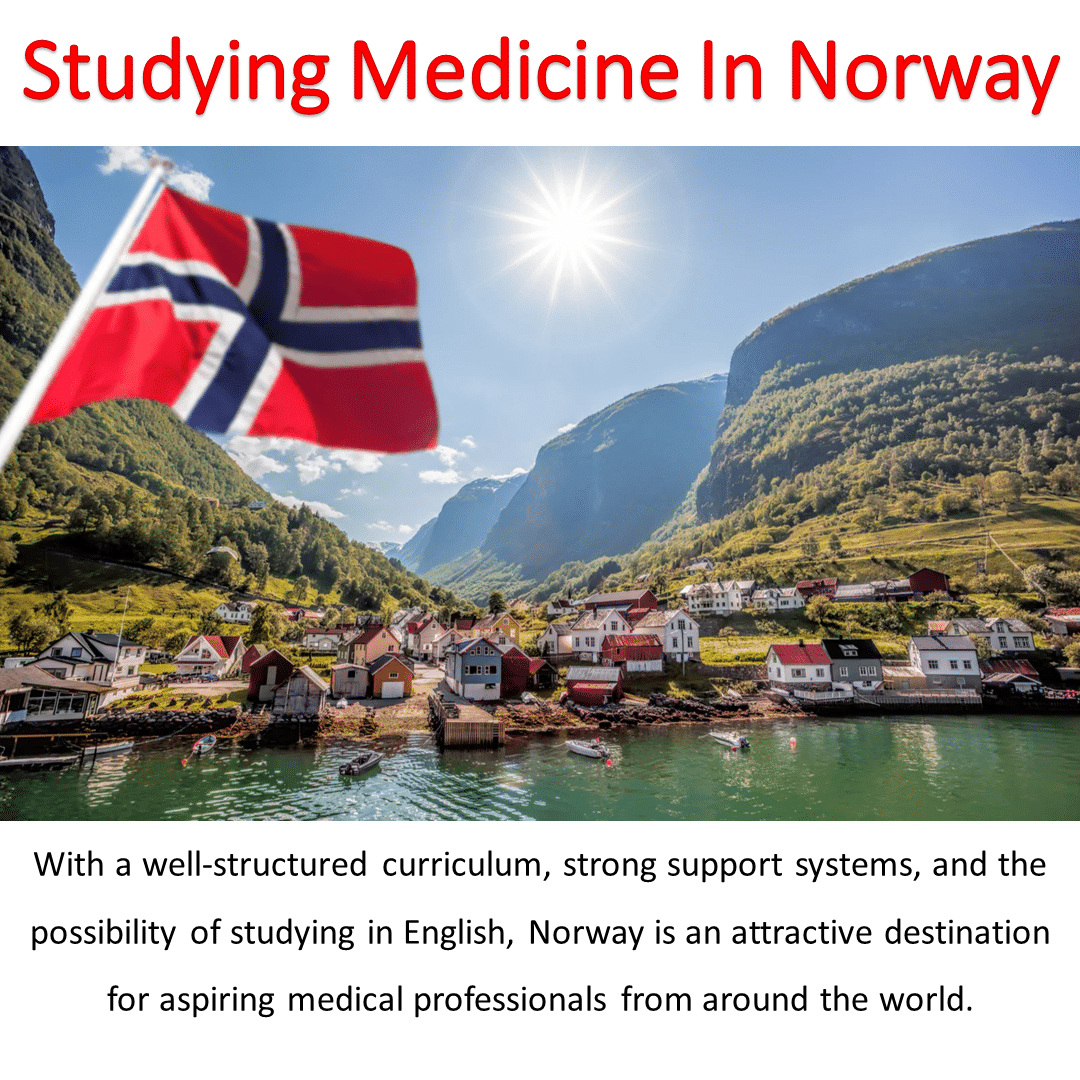
Studying medicine in Norway offers access to a well-established healthcare and medical education system with strong integration of clinical practice, research, and evidence-based medicine. However, international students should be aware that Norway’s professional medical degree is not generally an English-taught programme. The main medical programmes are taught primarily in Norwegian and are highly competitive.
Norway currently has four universities offering the six-year professional medical programme: the University of Oslo, University of Bergen, Norwegian University of Science and Technology (NTNU), and UiT The Arctic University of Norway.
Conditions for Studying Medicine in Norway
Admission to medicine in Norway is competitive and requires more than a general secondary-school qualification. Applicants must meet the Norwegian Higher Education Entrance Qualification or an equivalent qualification recognized for admission.
Medical programmes also have specific science-subject requirements. These commonly include:
- Mathematics
- Physics
- Chemistry
The exact combination and level of subjects required should be checked against the current admission requirements and the applicant’s educational background.
International applicants must also meet the requirements applicable to their country of education. Norway uses country-specific requirements for foreign qualifications, so completing secondary school in another country does not automatically mean that the applicant satisfies the Norwegian admission requirements.
Norwegian language requirement
One of the most important considerations for international students is language.
The professional medical programmes are primarily taught in Norwegian. For example, NTNU states explicitly that its six-year medical programme is offered only in Norwegian and that applicants must document Norwegian proficiency for admission.
The University of Bergen likewise states that Norwegian is the main language of instruction, although parts of the teaching and curriculum are in English.
UiT also teaches its medicine programme primarily in Norwegian, with an international semester in which teaching and examinations are conducted in English.
Therefore, students should not assume that they can complete the Norwegian medical degree entirely in English.
Is Medicine in Norway Available in English?
For students looking for a six-year undergraduate-entry medical degree taught entirely in English, Norway is generally not a suitable destination.
Norway’s official study portal lists English-taught programmes separately, and its health-related English-taught offerings are mainly master’s and other programmes rather than the six-year professional medical degree.
English is nevertheless used in parts of Norwegian medical education. For example, UiT’s seventh semester is designed as an international semester and is taught and examined in English.
Students who do not speak Norwegian should therefore consider countries with established English-taught medical programmes if studying medicine entirely in English is a priority.
Duration of Medical Study in Norway
The Norwegian professional medical degree normally takes six years and comprises 360 ECTS credits.
The degree is an integrated professional programme rather than a separate bachelor’s degree followed by a medical degree. Graduates receive the Candidatus/Candidata medicinae (cand.med.) degree. Norwegian legislation recognizes cand.med. as one of the country’s higher-level professional degrees.
The programme combines:
- Basic medical sciences
- Clinical medicine
- Laboratory and practical training
- Hospital-based education
- Primary healthcare experience
- Research and scientific work
- Communication and professional skills
The four Norwegian medical schools have also been evaluated nationally by NOKUT. The national evaluation describes the programmes as six-year programmes incorporating basic medical sciences, paraclinical and clinical subjects, social medicine, and practical periods in hospitals and municipal healthcare services.
Is there a mandatory one-year internship after medical school?
The previous version of this article stated that students must complete a mandatory one-year internship after the six-year medical degree. This is misleading.
The six-year medical programme itself contains substantial clinical training and leads to the cand.med. qualification. Postgraduate medical training and the LIS1 stage are separate from the university degree and are part of the Norwegian pathway toward further medical specialization.
Therefore, the six-year medical degree should not be described simply as a six-year undergraduate programme followed by a mandatory one-year internship required to graduate.
Tuition Fees for Medicine in Norway
The previous statement that Norwegian public universities are universally tuition-free for international medical students is no longer correct.
Since changes introduced for international students, degree-seeking students from outside the EU/EEA and Switzerland normally have to pay tuition fees at Norwegian public higher education institutions. The amount varies according to the university and programme.
Students from the EU/EEA and Switzerland are normally exempt from tuition fees at public institutions. There are also specific exemption categories for some other students, including certain exchange students and students covered by particular international agreements.
This distinction is particularly important for international students considering medicine in Norway.
Living Costs in Norway
Even students who are exempt from tuition fees need to budget carefully for living expenses.
For the 2026–2027 academic year, Study in Norway estimates student living costs at approximately:
NOK 15,488 per month
or approximately:
NOK 170,368 per year.
Students should also budget for accommodation, food, transportation, insurance, study materials, and other personal expenses.
A semester fee of approximately NOK 1,000 per semester is also normally payable to the student welfare organization associated with the institution.
For students from outside the EU/EEA and Switzerland, proof of sufficient financial support is also required when applying for a Norwegian study permit.
Best Medical Schools in Norway
Norway has four universities offering the professional medical programme. These are the institutions that should be included when discussing where to study medicine in Norway:
| University | Medical programme | Duration | Main language |
|---|---|---|---|
| University of Oslo (UiO) | Professional Medicine | 6 years | Norwegian |
| Norwegian University of Science and Technology (NTNU) | Professional Medicine | 6 years | Norwegian |
| University of Bergen (UiB) | Professional Medicine | 6 years* | Norwegian |
| UiT The Arctic University of Norway | Professional Medicine | 6 years | Norwegian |
*The University of Bergen’s current 2026 study plan notes a nominal duration of six years for the A-cohort and 6.5 years for the B-cohort under its current study plan structure.
1. University of Oslo
The University of Oslo offers a six-year professional medical programme. Its medical education combines scientific foundations with clinical and patient-oriented education.
2. Norwegian University of Science and Technology (NTNU)
NTNU’s medical programme in Trondheim lasts six years and leads to a medical degree. The university states that the programme is taught in Norwegian and requires applicants to meet the Norwegian language requirements.
3. University of Bergen
The University of Bergen offers a 360-ECTS professional medical programme leading to the cand.med. degree. The programme is primarily taught in Norwegian, with some teaching and curriculum in English.
The current programme also includes different study locations, with later years available through Bergen/Stavanger and Bergen/Førde pathways. Students should check the current study plan before applying because campus arrangements can change.
4. UiT The Arctic University of Norway
UiT offers a six-year, 360-ECTS professional medical programme in Tromsø. The programme provides clinical exposure from early in the course and includes substantial clinical training in northern Norway.
UiT currently lists 151 study places and reports the 2025 admission thresholds as 66 points in the ordinary quota and 57.1 points in the first-time certificate quota, illustrating how competitive admission can be.
Admission Competition
Medicine is one of the most competitive fields of study in Norway. Admission is generally based on the Norwegian centralized admissions system, Samordna opptak, together with the required academic qualifications.
For example, UiT’s medicine programme uses Samordna opptak and has an application deadline of 15 April for the standard admission route.
Admission scores can change from year to year depending on the number and qualifications of applicants. Students should therefore use the latest admission statistics rather than relying on historical minimum scores.
Clinical Training During Medical School
Clinical education is an important component of the Norwegian medical degree.
Students receive experience in hospitals and primary healthcare settings rather than completing the programme as a purely theoretical course.
At UiT, for example, the programme includes general-practice experience during the early years, hospital and primary-care placements later in the programme, and clinical teaching during the sixth year at hospitals in northern Norway.
The programmes also use practical skills training, simulation, case-based teaching, laboratory work, and other active learning methods.
Research Opportunities
Norwegian medical schools also provide opportunities for students interested in medical research.
NTNU, for example, offers a Medical Student Research Programme that can extend medical education from six to seven years. The programme provides dedicated periods for research and is designed for students interested in developing research experience during medical school.
UiT similarly offers a research track in medicine. Its research programme extends the standard study period and is intended for students interested in developing a pathway toward doctoral research.
Studying Medicine in Norway as an International Student
Norway can be an attractive destination for international students, but it is important to have realistic expectations.
The main advantages include:
- High-quality medical education
- Strong integration of clinical practice
- Extensive public healthcare infrastructure
- Opportunities for medical research
- Six-year integrated professional medical programmes
- No tuition fees at public institutions for many EU/EEA and Swiss students
- Strong emphasis on evidence-based and patient-centered medicine
However, there are also significant challenges:
- Professional medicine is primarily taught in Norwegian.
- Admission is highly competitive.
- Applicants must satisfy specific science prerequisites.
- Students from outside the EU/EEA and Switzerland normally pay tuition fees.
- Living costs in Norway are relatively high.
- Students from outside the EU/EEA/Switzerland need a study permit and must demonstrate sufficient financial resources.
Conclusion
Studying medicine in Norway can provide excellent medical education and extensive clinical experience, but the country’s medical programmes are very different from the English-taught medical programmes available in some other European countries.
The most important point for international applicants is language: Norway’s four professional medical programmes at the University of Oslo, University of Bergen, NTNU, and UiT are primarily taught in Norwegian.
Tuition also depends on nationality. While EU/EEA and Swiss students are normally exempt from tuition fees at public institutions, degree-seeking students from outside the EU/EEA and Switzerland generally have to pay tuition fees.
For applicants who can meet the Norwegian-language, academic, financial, and admission requirements, Norway remains a strong option for medical education and a potential pathway into the Norwegian healthcare system.
References
- Study in Norway – Tuition Fees for Students
- Study in Norway – Cost and Requirements
- NTNU – FAQ for Prospective Medicine Students
- University of Bergen – Medicine Study Plan
- UiT – Medicine Professional Study
- NOKUT – Evaluation of Professional Medicine Programmes
- Norwegian Directorate of Health – Authorisation Requirements