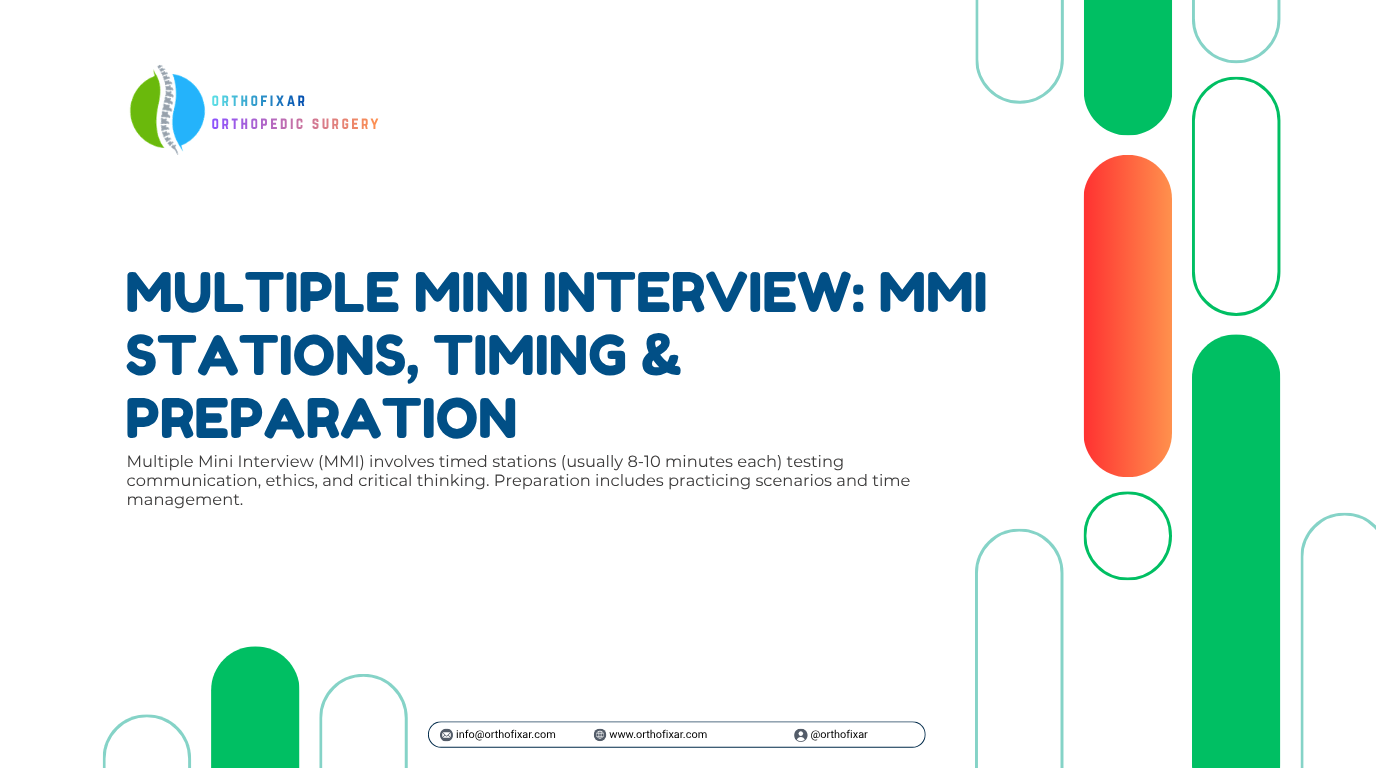
The Multiple Mini Interview (MMI) is a timed circuit of short stations used by many medical, dental, and health professional schools to assess communication, ethics, teamwork, and reasoning. Instead of one long panel interview, you rotate through several rooms, each with a different scenario and a fresh assessor. This guide explains how MMI stations work, how timing is structured, and how to prepare in a practical, low-stress way.
The format rewards clear thinking more than rehearsed speeches. You cannot predict every prompt, but you can build habits that work across almost any station. The sections below cover station types, timing mechanics, preparation methods, common mistakes, and a worked example so you can see how a strong answer is built.
What the Multiple Mini Interview Actually Measures
MMI designers are not testing whether you have memorized a list of ethical principles. They are testing how you think when information is incomplete and time is short. Assessors watch how you structure an answer, how you treat the people in the scenario, and whether you stay calm under pressure.
Most schools publish a general list of competencies they look for. These usually include communication, empathy, ethical reasoning, teamwork, resilience, and motivation for the profession. The MMI gives each of these its own short window, which is why consistency across stations matters more than a single brilliant performance.
A useful way to think about it: every station is a small sample of professional behavior. Assessors are asking, “Would I be comfortable with this person interacting with a patient, a colleague, or a stressed family member?”
- Communication clarity under time pressure
- Empathy and respect for others in the scenario
- Ethical reasoning and awareness of competing interests
- Teamwork and willingness to share responsibility
- Self-awareness and ability to reflect on mistakes
- Motivation and realistic understanding of the profession
- Problem-solving when no perfect answer exists
Common Types of MMI Stations
Stations vary by school, but most fall into a handful of recognizable categories. Knowing the categories helps you adapt quickly because you can recognize the task within the first few seconds.
Scenario and Role-Play Stations
Here you interact with a trained actor or an assessor playing a role. You might need to explain a treatment decision, comfort a distressed relative, or address a colleague who is not pulling their weight.
The key is to engage with the person, not to deliver a monologue. Ask questions, acknowledge their feelings, and respond to what they actually say rather than following a script in your head.
Ethical Dilemma Stations
These present a conflict between values, such as confidentiality versus safety, or honesty versus kindness. There is rarely one correct answer. Assessors want to see that you can identify the competing principles and reason toward a defensible position.
State the tension out loud, weigh both sides, and then commit to a decision with a brief justification. Waffling for the whole station is a common way to lose marks.
Collaborative and Teamwork Stations
Some stations ask you to solve a puzzle or plan a task with other candidates. You are being watched for how you include others, handle disagreement, and share credit.
Invite quieter group members in, build on other people’s ideas, and avoid dominating the conversation. Leadership here looks like facilitation, not control.
Policy, Analysis, and Opinion Stations
You might be given a short article, a graph, or a statement and asked to discuss it. These stations test whether you can form a reasoned view and defend it without becoming rigid.
A simple structure works well: summarize the issue, state your position, give two supporting reasons, acknowledge one counterargument, and conclude.
Personal and Motivational Stations
These ask why you chose this field, how you handle failure, or what you learned from a difficult experience. Honest, specific stories land better than generic statements about “helping people.”
- Role-play with an actor or assessor
- Ethical dilemma with no clean answer
- Group task or collaborative problem
- Analysis of a short text or data set
- Personal reflection and motivation
- Explaining a concept in plain language
- Prioritization and time-management scenario
How MMI Timing Works
Timing is the defining feature of the MMI. Each station runs on a fixed clock, and a bell or buzzer moves everyone forward at the same moment. You cannot borrow time from one station to finish another.
A typical circuit has somewhere between six and twelve stations, and each station usually lasts around five to ten minutes. Many formats also include a short reading period before you enter the room, often one to two minutes, where you see the prompt.
The exact numbers differ by school, so check the specific instructions you receive. What stays constant is the rhythm: read, enter, engage, exit, reset.
| Stage | Typical Duration | What Happens | Your Priority |
|---|---|---|---|
| Reading period | 1–2 minutes | You see the prompt before entering | Identify the task and pick a structure |
| Station itself | 5–10 minutes | Interaction, discussion, or task | Engage the person and answer the question |
| Transition | Under 1 minute | Move to the next room | Reset emotionally, drop the last station |
| Full circuit | 60–120 minutes | All stations completed | Stay consistent and manage energy |
Why the Reading Period Matters
The reading period is where strong candidates gain an early advantage. You are not expected to memorize the prompt. You are expected to notice what is being asked and choose a rough shape for your answer.
Underline the actual task in your mind. If the prompt says “explain,” do not spend the station debating. If it says “discuss both sides,” do not rush to a verdict in the first sentence.
Managing the Clock Inside a Station
You will usually not see a timer, so develop an internal sense of pace. A rough approach is to spend the first portion understanding and framing, the middle portion reasoning or interacting, and the final portion concluding.
If you notice the station is nearly over, summarize your position in one or two sentences. A clean ending is far better than trailing off mid-thought.
- Read the prompt for the task verb, not just the topic
- Decide your structure before you enter the room
- Spend the opening on framing, not rambling
- Leave time for a short conclusion
- Do not try to finish an argument after the buzzer
- Treat every station as a fresh start
How to Prepare for the Multiple Mini Interview
Preparation works best when it is active rather than passive. Reading advice is useful, but practicing out loud under a timer is what actually builds the skill.
Practice With Real Timing
Set a timer and answer a prompt out loud in the time you will actually have. Recording yourself, even on a phone, reveals filler words, rushed endings, and unclear structure.
Practice with a partner when you can. A partner can play an actor, push back on your reasoning, and give feedback you would never notice alone.
Build a Small Bank of Flexible Structures
You do not need a script for every scenario. You need a few reliable frameworks you can adapt. These reduce panic because you always know your next step.
- Ethics: identify the conflict, weigh both sides, decide, justify
- Role-play: greet, explore feelings, share information, agree next steps
- Analysis: summarize, take a position, give reasons, note a counterpoint
- Personal: situation, action, result, lesson learned
- Teamwork: invite input, build on ideas, summarize the group’s decision
Strengthen Your Communication Habits
Speak at a steady pace and finish your sentences. Silence is acceptable; it often reads as thoughtfulness rather than weakness. Filler sounds such as “um” and “like” are more distracting than a brief pause.
Use the person’s name if you know it, and reflect back what they said before you respond. This single habit improves role-play stations dramatically.
Prepare Honest Personal Stories
Before the interview, think of a handful of real experiences: a time you helped someone, a time you failed, a time you disagreed with a team, and a time you changed your mind. These cover most personal stations.
Keep each story short and specific. A concrete detail is more convincing than an abstract claim about your character.
Understand the Profession You Are Entering
Motivational stations reward candidates who know what the work actually involves. Be ready to discuss the realities, not just the rewards, and how you have tested your interest through real experience.
Strong MMI candidates are not the ones with the most polished words. They are the ones who listen carefully, think clearly, and treat every person in the scenario with respect.
A Worked Example Station
Imagine a station where you are told a patient has refused a treatment you believe is in their best interest. You have eight minutes. The actor plays the patient.
A weak response jumps straight to persuasion. A strong response starts by understanding why the patient is refusing, then shares information clearly, then respects their right to decide while making sure they understand the consequences.
How a Strong Answer Unfolds
- Open with a calm, respectful greeting
- Ask what concerns the patient has about the treatment
- Listen without interrupting and reflect their concern back
- Explain the reasoning behind your recommendation in plain language
- Check their understanding rather than assuming it
- Acknowledge their right to make the final decision
- Offer to revisit the conversation or involve others if appropriate
- Close by summarizing what you agreed
Notice that the answer does not “win” the argument. It demonstrates professional communication, which is exactly what the station is designed to measure.
Common MMI Mistakes to Avoid
Most candidates lose points through avoidable habits rather than lack of knowledge. Watching for these patterns in practice can protect your score.
- Ignoring the actor and talking only to the assessor
- Delivering a memorized speech that ignores the prompt
- Refusing to take any position in an ethics station
- Dominating group tasks and dismissing other candidates
- Running out of time without a conclusion
- Carrying frustration from one station into the next
- Making claims about the profession that are clearly unrealistic
- Speaking too fast and skipping over the actual question
The Reset Between Stations
Each station is scored independently, so a weak answer does not have to affect the next one. Take a slow breath during the transition and deliberately let the previous room go.
Candidates who recover quickly often outperform those who dwell. Treat the circuit as a series of fresh opportunities rather than one continuous judgment.
Day-of-Interview Practicalities
Logistics matter more than people expect. Arrive early, bring any required identification, and follow the instructions you were given exactly. Small administrative errors create unnecessary stress.
Dress professionally and comfortably. You will be standing, walking, and sitting repeatedly, so choose clothing you can move in without adjusting constantly.
- Confirm the location and arrival time in advance
- Bring required documents and identification
- Eat something light before the circuit starts
- Use the restroom before the first station
- Silence your phone completely
- Follow staff instructions without debate
- Stay hydrated between stations if permitted
How MMI Scores Are Usually Used
Each station typically has its own assessor and its own scoring sheet. Your station scores are usually combined into an overall MMI result, which is then considered alongside your academic record and other application materials.
Because stations are scored separately, a single poor station does not sink your whole interview. This is one of the format’s strengths: it spreads risk across many small samples instead of concentrating it in one conversation.
Exact weighting and scoring rubrics are set by each school and are usually not published in detail. Focus on consistent, respectful, well-reasoned performance rather than trying to reverse-engineer the marks.
Conclusion
The Multiple Mini Interview rewards preparation that is practical rather than theatrical. Learn the station types, respect the timing, build a few flexible structures, and practice out loud under a real clock. Treat every person in every scenario with genuine respect, and give yourself permission to reset between rooms. If you prepare your reasoning and your communication habits, you will be ready for whatever the circuit asks.
Frequently Asked Questions
How many stations are in a typical MMI?
Most circuits include somewhere between six and twelve stations. The exact number depends on the school and the length of the interview day. Each station is scored independently, so the total number mainly affects how long your circuit lasts rather than how you should prepare.
How long is each MMI station?
Stations commonly run from about five to ten minutes, often with a short reading period beforehand. A bell or buzzer moves all candidates forward at the same time. Because you cannot borrow time, practice answering under a real timer so your pacing feels natural.
Is there a right answer in ethics stations?
Usually there is no single correct answer. Assessors look for clear identification of the competing values, balanced reasoning, and a defensible decision. Refusing to take any position is generally weaker than committing to a well-justified one.
Can I prepare for the MMI without a partner?
Yes. Recording yourself answering timed prompts is a strong solo method. You can review your structure, pacing, and clarity afterward. A partner adds value because they can play a role and push back, but solo practice still builds most of the core skill.
What should I do if I blank during a station?
Pause, breathe, and return to the task in the prompt. Restate the question in your own words and begin with what you do know. A short, honest pause reads far better than filling the silence with unrelated talking.
Should I memorize answers in advance?
Memorized answers tend to sound generic and often ignore the specific prompt. It is better to memorize flexible structures and a few real personal stories. That way you can adapt to whatever the station actually asks.
How important is my body language?
Body language contributes to how you are perceived, especially in role-play stations. Face the person you are speaking to, keep an open posture, and avoid fidgeting. These habits support your words rather than replacing them.
Do I need to know medical facts for the MMI?
Generally no. Most stations assess reasoning, communication, and ethics rather than clinical knowledge. If a station involves a health topic, the prompt usually gives you the information you need to reason about it.
What happens if I perform poorly at one station?
Because stations are scored separately, one weak station does not determine your overall result. The format is designed to sample your performance across many situations. Reset during the transition and treat the next station as a completely fresh start.
How early should I arrive on interview day?
Arrive with enough buffer to handle traffic, parking, and check-in without rushing. Being early reduces stress and gives you time to settle before the circuit begins. Follow the school’s arrival instructions exactly.