When you break a bone, doctors use the words “open” and “closed” to describe whether the broken bone has created a wound in the skin. This simple distinction changes nearly everything about your treatment, your risk of infection, and how long you may need to recover. In short, the open vs closed fracture difference comes down to one question: Is the fracture site exposed to the air and outside contaminants? If the skin is intact, it is closed. If the skin is broken, it is open. Both injuries need prompt medical care, but an open fracture is always treated as an emergency.
Understanding Open vs Closed Fracture
Fractures are breaks, cracks, or splinters in a bone. The terms open and closed describe the connection between the fracture and the outside environment. This distinction is a major factor in deciding how urgently you need care and what surgical steps might be needed.
Closed Fracture (Simple Fracture)
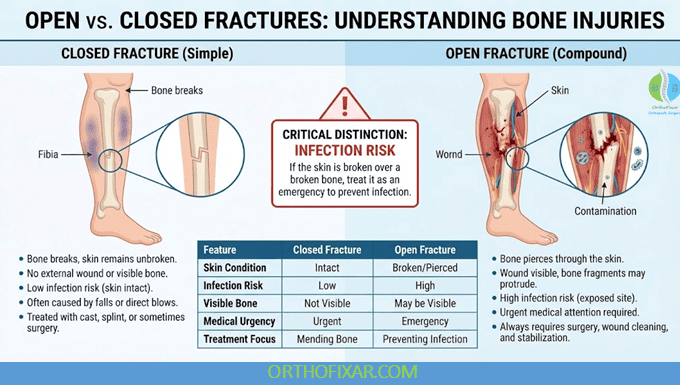
A closed fracture means the bone breaks but the overlying skin remains unbroken. There is no visible wound leading down to the fracture.
- The skin stays intact even if there is severe bruising and swelling beneath it.
- Because the skin is unbroken, the chance of bacteria entering the bone is very low.
- Closed fractures are often caused by falls, direct blows, or twisting injuries.
- Many closed fractures can be treated with a cast or splint, though some still require surgery if the bone pieces are unstable.
Open Fracture (Compound Fracture)
An open fracture occurs when the broken bone pierces through the skin, or when an object punctures the skin down to the bone. This injury is also called a compound fracture.
- The wound may be small, like a poke, or large enough to expose bone fragments clearly.
- Blood vessels, muscles, nerves, and skin around the fracture may also be damaged.
- The exposed injury site is highly vulnerable to bacteria, so infection is the biggest immediate risk.
- Treatment always includes urgent wound cleaning and usually requires surgery.
“If the skin is broken over a broken bone, treat it as an emergency.”
This is a useful rule of thumb in the emergency room. The presence of a wound changes the focus from “mending the bone” to “preventing infection first.”
Key Differences at a Glance
If you need a quick summary of open vs closed fracture differences, this table compares the most important features side by side.
| Feature | Closed Fracture | Open Fracture |
|---|---|---|
| Skin condition | Intact over the fracture | Broken, torn, or pierced |
| Infection risk | Low | High |
| Bleeding | Usually internal bruising | External bleeding from the wound |
| Visible bone | Not visible | May be visible, but not always |
| Urgency | Urgent but not always emergency | Emergency medical care needed |
| Surgical need | Often managed with a cast or splint | Almost always requires surgical cleaning and fixation |
| Healing outlook | Healing time varies with the fracture pattern | Longer recovery and more follow-up visits |
Causes and Common Examples
Both types of fractures happen in similar everyday situations, but the force and angle of the injury often determine whether the skin stays intact.
- Closed fracture example: You slip on an icy sidewalk and throw your hand out to catch yourself. The wrist bone cracks but your skin is not damaged. Swelling and bruising appear quickly, and the pain increases when you move your wrist.
- Open fracture example: A cyclist is hit by a car and the force breaks their femur. A sharp piece of the thighbone tears through the skin, leaving an open wound that needs immediate cleaning and surgery.
- Lower-risk example: Trip over a curb and break your ankle. If the bone does not break the skin, it is likely a closed fracture. But even a small cut over the ankle fracture can turn it into an open fracture.
- High-energy examples: Falls from heights, Motocross crashes, industrial accidents, and any injury that involves crushing often cause open fractures because the force is strong enough to drive bone through tissue.
Closed fractures can happen from low-energy falls too. A child falling from a tree may have a greenstick fracture, which is a partial break on one side of the bone while the other side bends. That type of break usually does not puncture the skin.
Symptoms and When to Seek Emergency Care
Knowing the symptoms can help you decide whether to call an ambulance or go to the emergency room. Remember that not every open fracture has a bone sticking out. A tiny cut in the skin near a fracture also qualifies as an open fracture because bacteria can enter through that opening.
Symptoms of a Closed Fracture
- Deep pain that worsens with pressure or movement.
- Swelling, bruising, or tenderness around the injured bone.
- Visible deformity, such as a bent wrist or finger, even without any wound.
- Difficulty moving the affected limb or putting weight on it.
Symptoms of an Open Fracture
- An obvious wound in the skin near the injury, sometimes with bone fragments visible.
- Bleeding from the wound site.
- Severe pain and sometimes a grinding feeling when the bone ends move against each other.
- Heavy contamination, such as dirt, gravel, or grass, in the wound if the injury happened outdoors.
When to Go to the Emergency Room
If you suspect any fracture, seek medical help promptly. For open fractures, do not wait. If you are caring for someone with an open fracture, keep the area as clean as possible and do not push bone fragments back in. Cover the wound with a clean cloth or sterile dressing and seek emergency care. The risk of infection increases with every hour that passes before proper cleaning begins.
How Doctors Diagnose the Injury
Before deciding on treatment, an orthopedic doctor will assess the type and severity of the fracture. This is not just about naming it open or closed; it also helps the team understand which layers of tissue are affected.
- Physical examination: The doctor looks for wounds, swelling, skin color changes, and nerve or blood vessel problems. They also check whether the bone is stable and whether you can feel and move your toes or fingers beyond the injury.
- X-rays: Standard X-rays are the first imaging test. They reveal where the break is and how far out of place the bone ends sit.
- CT scan: For severe open fractures in complex areas like the heel, ankle, pelvis, or elbow, a CT scan gives a three-dimensional view of the fracture fragments.
- Vascular examination: If the doctor suspects an injury to an artery near the fracture, they may use ultrasound or an angiogram to check blood flow to the limb.
Treatment Options for Closed Fractures
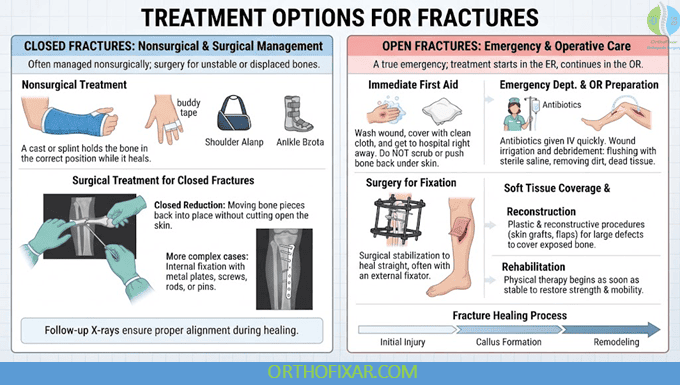
Closed fractures are often managed with nonsurgical methods, but surgery is used when the bone fragments are unstable or out of alignment.
Nonsurgical Treatment
- A cast or splint holds the bone in the correct position while it heals.
- Some fractures, such as a broken finger, may only need to be “buddy taped” to a healthy finger for support.
- Slings for collarbone fractures or walking boots for ankle fractures are also common.
Surgical Treatment for Closed Fractures
- If the fracture is displaced but the skin is intact, the doctor may perform a closed reduction, which means moving the bone pieces back into place without cutting open the skin.
- In more complex cases, metal plates, screws, rods, or pins are used to hold the bones in a more rigid position.
- You will have some follow-up X-rays to make sure the bone stays in good alignment while it heals.
Treatment Options for Open Fractures
An open fracture is a true emergency. Treatment starts in the emergency department and almost always continues in the operating room.
Wash the wound, cover it with a clean cloth, and get to a hospital right away. Do not attempt to scrub the tissue or push the bone back under the skin.
- Wound irrigation and debridement are performed as soon as possible. This involves flushing the wound with sterile saline and removing all dirt, dead tissue, and nonviable bone fragments.
- Antibiotics are given quickly, usually through an IV, because any open fracture can introduce bacteria that may lead to severe bone infection.
- Surgery for fixation stabilizes the bone so it can heal in a straight position. This may involve an external fixator, where metal pins outside the limb hold it in place, especially if the soft tissue is badly swollen.
- Soft Tissue Coverage: Severe open fractures often result in large skin and muscle defects. Plastic and reconstructive procedures, such as skin grafts or flap surgery, are frequently necessary to cover exposed bone and prevent chronic infection.
- Rehabilitation: Physical therapy begins as soon as the fracture is stable enough to prevent joint stiffness, restore muscle strength, and help the patient regain full mobility.