Learning to use crutches safely is one of the first practical skills required after a leg injury, surgery, or a period of restricted weight-bearing. Stairs tend to cause the most anxiety, and for good reason: a single misstep can lead to a fall. The reassuring news is that crutch walking follows a simple, repeatable pattern. With correct equipment fit and a little practice, most people can move around their home and community with confidence.
This guide explains how to size crutches correctly, how to walk on level ground, how to climb and descend stairs, how to sit and stand safely, and how to manage everyday obstacles such as curbs, doorways, and narrow spaces. It also covers the “up with the good, down with the bad” rule that makes stair travel predictable, along with common mistakes, practical tips, and answers to frequently asked questions.
Before You Take a Single Step
Proper fit is the foundation of safe crutch use. Crutches that are too short or too tall force you into awkward positions and increase your risk of falling. A physical therapist or doctor should adjust them for you, but it helps to understand what correct fit looks like so you can check it yourself over time.
How to Check Crutch Height
Stand as tall as you can with your normal shoes on. The top of the crutch should sit about two to three finger widths below your armpit. It should not press into the armpit when you stand upright.
The handgrips should be positioned so your elbows bend slightly, roughly 15 to 30 degrees, when you hold them. Your weight should rest on your hands and palms, never on your armpits. Leaning on the armpit pads for long periods can press on nerves and cause numbness or weakness in the arm.
Quick Fit Checklist
- Top of the crutch sits two to three finger widths below the armpit.
- Elbows bend slightly when your hands are on the grips.
- Wrist crease lines up roughly with the top of the handgrip.
- Rubber tips are intact, not worn flat or cracked.
- Crutch height is the same on both sides.
- You can stand comfortably without hunching your shoulders.
The Basic Crutch Walking Pattern on Level Ground
On flat surfaces, most people use one of two main patterns, depending on how much weight they are allowed to put on the injured leg. Your doctor or therapist will tell you which one applies to you.
Non-Weight-Bearing Walking
If you cannot put any weight on the injured leg, you will use a three-point pattern. Move both crutches forward about one step, then swing your injured leg through while keeping it off the ground, then step your good leg up to the crutches.
Keep your injured leg slightly bent and lifted so it never touches the floor. The rhythm feels awkward at first but becomes natural within a few days of practice.
Partial Weight-Bearing Walking
If you are allowed to put some weight on the injured leg, place both crutches forward, then step the injured leg forward while using the crutches for support, then bring the good leg through. The crutches and the injured leg move together as a unit.
Your therapist may describe this as “crutches and the bad leg move first, the good leg follows.” That single sentence captures the whole pattern.
Step-by-Step Summary for Level Ground
- Stand tall with crutches under your arms, weight on your hands.
- Move the crutches forward a comfortable distance, about one normal step.
- Step or swing the injured leg forward, keeping it off the floor if instructed.
- Bring the good leg forward to meet the crutches.
- Repeat in a steady, unhurried rhythm.
The Golden Rule for Stairs: Up With the Good, Down With the Bad
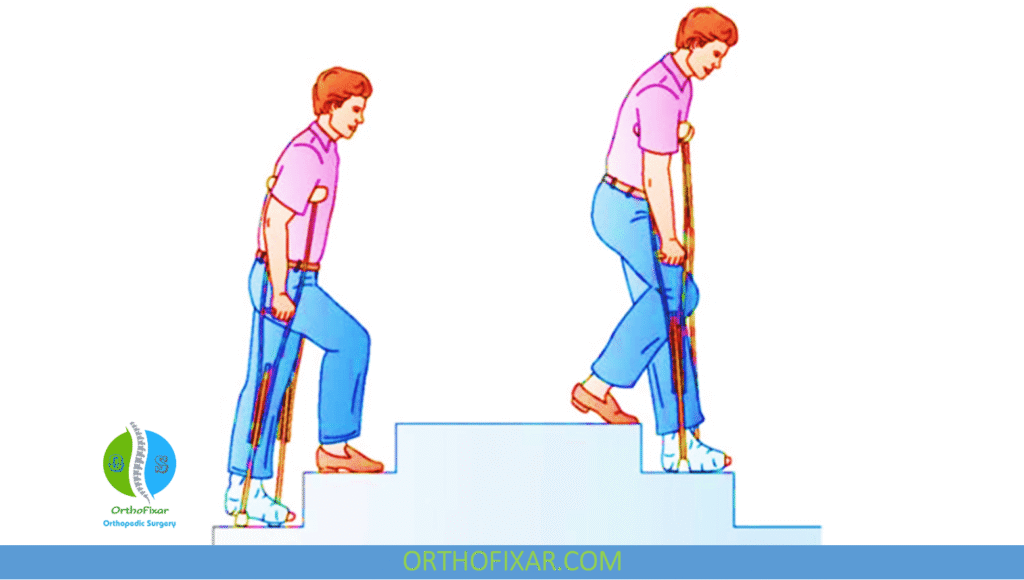
This is the single most important rule in crutch walking, and it is easy to remember. Going up, the good leg goes first. Going down, the injured leg and crutches go first. Say it to yourself every time you approach a staircase.
Up with the good, down with the bad. The strong leg always leads you up the stairs, and the injured leg always leads you down.
The reason is simple. When you climb, your good leg is strong enough to push you upward while the crutches steady you. When you descend, the crutches and the injured leg go first so you can lower yourself in a controlled way instead of dropping weight onto a healing leg.
How to Go Up Stairs With Crutches
Find a handrail if one is available. A handrail on at least one side adds a great deal of stability, and you should use it whenever you can.
Going Up, Step by Step
- Stand close to the bottom step, facing the stairs.
- Place both crutches on the step below the one you are climbing, or hold both crutches in one hand and grip the rail with the other.
- Push down through your hands and step up with your good leg first.
- Bring the crutches and the injured leg up onto the same step.
- Straighten up, check your balance, and repeat for the next step.
Move one step at a time. Rushing is where most stair accidents happen. If you feel unsteady, stop, reset your footing, and continue.
Using a Handrail While Climbing
If there is a rail on one side, tuck both crutches under the arm on that side and hold the rail with your free hand. Step up with the good leg, then bring the crutches and injured leg up together. This method is often faster and steadier than using crutches alone.
How to Go Down Stairs With Crutches
Going down feels scarier than going up, but the pattern is just as simple. The crutches and the injured leg move first, and the good leg follows.
Going Down, Step by Step
- Stand at the top of the stairs, facing down.
- Place both crutches on the step below.
- Lower the injured leg onto the same step, keeping it slightly bent.
- Shift your weight onto your hands and the crutches.
- Step down with the good leg to join the crutches and injured leg.
- Check your balance, then repeat for the next step.
Keep your body close to the crutches and avoid leaning backward. Leaning back is a common cause of slips on stairs.
Using a Handrail While Descending
Hold the rail with one hand and keep both crutches on the other side. Lower the crutches and the injured leg to the step below, then bring the good leg down. The rail takes some of your weight and gives you a second point of contact.
Stairs Without a Handrail
Some staircases, especially outdoor steps or older buildings, have no rail at all. These require extra caution and a slower pace.
- Place both crutches on the step below and take one step at a time.
- Keep both crutches level with each other so your weight is evenly supported.
- Pause on each step to confirm your balance before moving again.
- Ask someone to stand nearby the first few times, especially on steep or narrow stairs.
- Avoid carrying anything in your hands while using stairs.
- If the stairs feel unsafe, look for a ramp or an elevator instead.
Sitting Down and Standing Up With Crutches
Getting into and out of a chair is a skill people often overlook, yet it is where many falls happen. The key is to keep your injured leg out in front and use your strong leg and arms to control the movement.
How to Sit Down Safely
- Back up slowly until the back of your good leg touches the chair.
- Hold both crutches in one hand, on the side of your injured leg.
- Reach back with your free hand to grip the chair or armrest.
- Lower yourself slowly, keeping the injured leg extended forward.
- Sit down gently, then move the injured leg into a comfortable position.
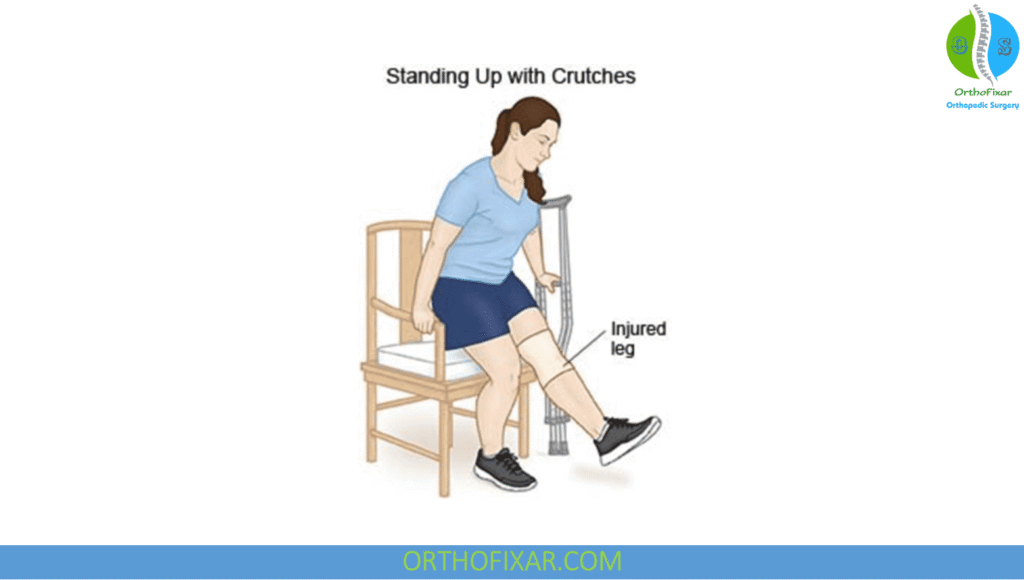
How to Stand Up Safely
- Scoot forward until you are near the edge of the seat.
- Hold both crutches in one hand on the injured side.
- Push up with your free hand and your good leg.
- Keep the injured leg extended and off the floor as you rise.
- Once upright, place the crutches under your arms and check your balance.
Handling Curbs, Doorways, and Tight Spaces
Real life is not a flat hallway. Curbs, thresholds, and narrow doorways all need a slightly different approach.
Stepping Up a Curb
Treat a curb like a single stair. Step up with the good leg first, then bring the crutches and injured leg up. When stepping down a curb, place the crutches and injured leg down first, then bring the good leg down.
Going Through Doorways
- Open the door and hold it with your body if it does not stay open on its own.
- Move one crutch through the doorway first, then step through with your good leg.
- Bring the second crutch and injured leg through last.
- Never rush to beat a closing door, especially a heavy one.
- Avoid doors that swing toward you while your hands are full.
Narrow Hallways and Small Bathrooms
In tight spaces, you may need to move one crutch at a time instead of both together. Take short steps and use walls or counters for light support if needed. Keep the floor clear of rugs, cords, and clutter so you have room to maneuver.
Quick Reference Table for Crutch Movement
| Situation | What Moves First | What Follows | Key Reminder |
|---|---|---|---|
| Level ground, non-weight-bearing | Both crutches | Injured leg, then good leg | Keep injured foot off the floor |
| Level ground, partial weight-bearing | Crutches and injured leg together | Good leg | Use hands for support, not armpits |
| Going up stairs | Good leg | Crutches and injured leg | Up with the good |
| Going down stairs | Crutches and injured leg | Good leg | Down with the bad |
| Stepping up a curb | Good leg | Crutches and injured leg | Treat it like one stair |
| Stepping down a curb | Crutches and injured leg | Good leg | Lower slowly and check balance |
Common Mistakes That Lead to Falls
Most crutch-related injuries come from a handful of avoidable mistakes. Recognizing them ahead of time helps you stay safe.
- Resting weight on the armpits instead of the hands.
- Taking stairs too quickly or skipping the pause between steps.
- Carrying bags or drinks in your hands while walking.
- Using crutches on wet, icy, or highly polished floors.
- Wearing loose slippers or backless shoes that slip off.
- Letting rubber tips wear down until they no longer grip.
- Leaning backward when going down stairs.
- Turning sharply instead of taking small, controlled steps.
Everyday Tips for Living With Crutches
Small adjustments around the home make a big difference in comfort and safety. A little planning goes a long way during recovery.
- Clear walkways of rugs, cords, and low furniture.
- Use a backpack or shoulder bag so your hands stay free.
- Keep frequently used items within easy reach.
- Wear supportive, closed shoes with non-slip soles.
- Add a nightlight or two along the path to the bathroom.
- Ask for help with heavy or awkward items.
- Take breaks before you feel tired, not after.
- Keep a phone within reach in case you need assistance.
When to Ask for Help
It is fine to accept help, especially in the first days after an injury or surgery. Ask a family member or friend to carry items, hold doors, or walk beside you on stairs. If you live alone, consider arranging a check-in call or visit during the early part of your recovery.
How to Build Confidence Safely
Confidence comes from repetition in a safe setting. Before you tackle a full staircase, practice the pattern on a single step or a low platform with someone nearby.
- Practice the up and down sequence on one step until it feels automatic.
- Count the steps out loud if it helps you keep the rhythm.
- Start with short distances and gradually increase them.
- Use a mirror or a helper to check your posture.
- Stop and rest whenever you feel shaky.
- Celebrate small progress; recovery takes time.
If you feel pain, numbness, or tingling in your hands, arms, or armpits, stop and check your crutch height. These symptoms often mean the crutches are pressing in the wrong place.
Conclusion
Using crutches safely on stairs and level ground comes down to a few reliable habits. Keep your weight on your hands, move slowly, and remember the rule that guides every staircase: up with the good, down with the bad. On flat ground, move your crutches and injured leg together, then bring the good leg through.
Check your crutch fit regularly, keep the rubber tips in good condition, and clear your walking paths at home. With a little practice and a steady pace, you can move around confidently while your leg heals. When in doubt, ask your physical therapist to watch you walk and climb a few steps so they can correct your technique before small errors become habits.
Frequently Asked Questions
Which leg goes first when going up stairs with crutches?
When going up stairs, your good leg goes first. Push up through your hands and step up with the strong leg, then bring the crutches and the injured leg up onto the same step. This lets your healthy leg do the lifting while the crutches keep you stable.
Which leg goes first when going down stairs with crutches?
When going down stairs, the crutches and the injured leg go first. Place the crutches on the step below, lower the injured leg to the same step, then bring the good leg down to join them. This keeps your weight controlled and protects the healing leg.
How do I remember the stair rule for crutches?
Use the phrase “up with the good, down with the bad.” The good leg leads going up, and the injured leg leads going down. Repeating this to yourself each time you approach a staircase keeps the pattern automatic.
Should I use a handrail when I have crutches?
Yes, use a handrail whenever one is available. Hold the rail with one hand and tuck both crutches under the arm on that side, or keep both crutches on the opposite side. The rail gives you extra support and makes each step steadier.
How do I use crutches on flat ground?
Move both crutches forward about one step, then step or swing the injured leg forward, then bring the good leg up to meet the crutches. If you are allowed partial weight, move the crutches and injured leg together, then bring the good leg through.
Where should my weight rest when using crutches?
Your weight should rest on your hands and palms through the handgrips, never on your armpits. Leaning on the armpit pads can press on nerves and cause numbness or tingling in the arms. Keep your elbows slightly bent for better control.
How high should my crutches be?
The top of the crutch should sit about two to three finger widths below your armpit when you stand tall in your normal shoes. Your elbows should bend slightly, around 15 to 30 degrees, when your hands are on the grips. Ask your therapist to check the fit.
What should I do if there is no handrail on the stairs?
Place both crutches on the step below and take one slow step at a time, pausing to check your balance on each step. Keep both crutches level with each other. If the stairs feel unsafe, ask for help or look for a ramp or elevator instead.
Can I carry things while using crutches?
It is best to keep your hands free. Use a backpack or a shoulder bag so both hands remain available for the crutches. Carrying items in your hands makes it harder to grip the crutches and increases your risk of falling.
When should I call my doctor about crutch use?
Contact your doctor or physical therapist if you have numbness, tingling, or weakness in your hands or arms, if you keep losing your balance, or if you feel pain under your armpits. They can adjust your crutches or teach you a different technique that fits your needs.