Hip reconstruction is an umbrella term for surgical procedures that reshape, rebuild, or replace parts of the hip joint when arthritis, injury, deformity, or prior surgery has damaged it beyond what conservative care can manage. People researching this topic are usually weighing a major decision: whether surgery is right for them, what the operation involves, and how long recovery really takes. This guide explains the main procedures, who tends to be a candidate, what rehabilitation looks like phase by phase, and the outcomes you can reasonably expect.
What Hip Reconstruction Actually Means
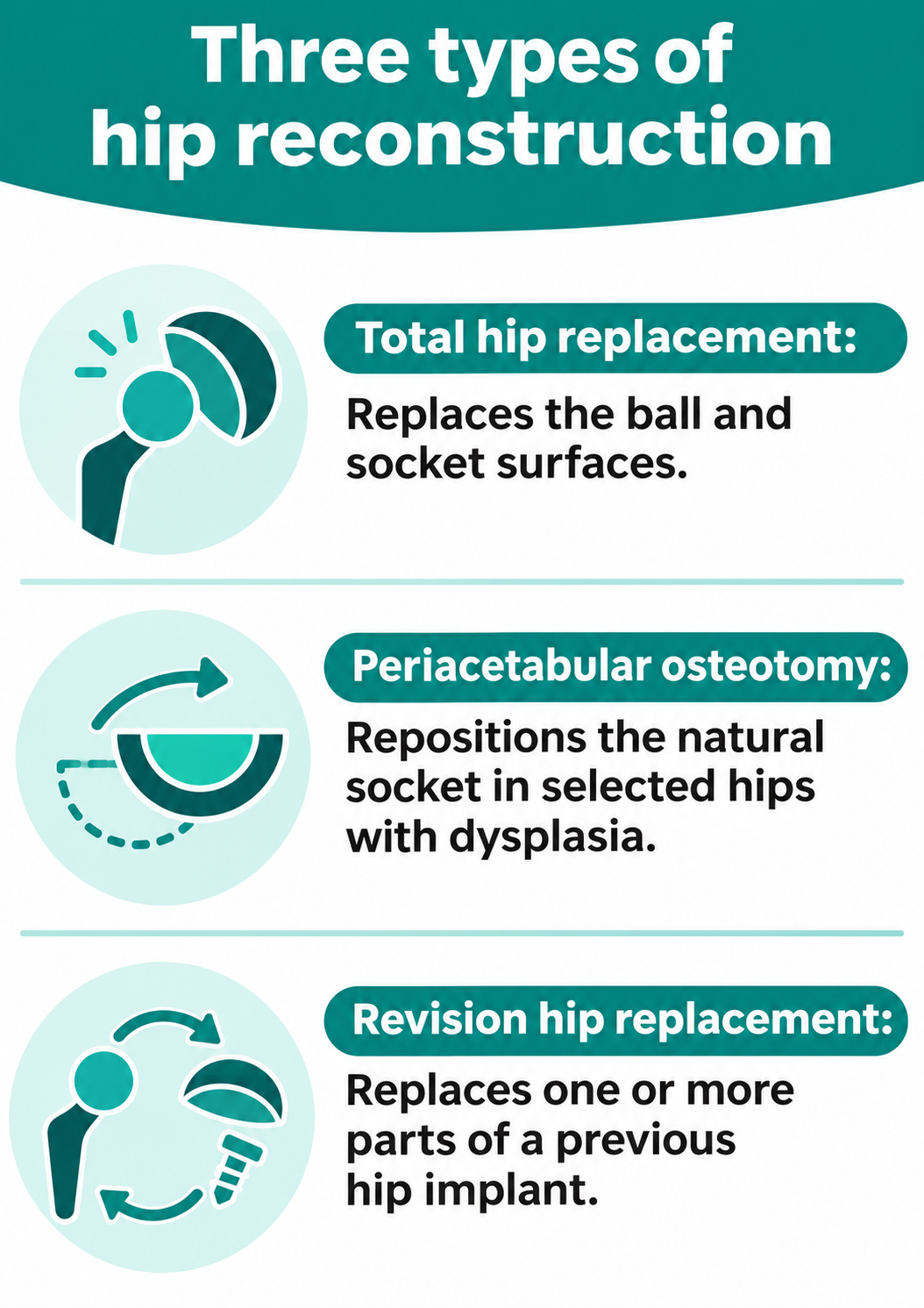
In clinical practice, “hip reconstruction” covers a spectrum. At one end sits total hip replacement, where the ball and socket are both replaced with implants. At the other end are joint-preserving operations such as periacetabular osteotomy or surgical hip dislocation, which reshape bone rather than replace it. In between are partial replacements, revision surgery, and procedures for specific problems such as femoroacetabular impingement.
The right choice depends on the diagnosis, the condition of the cartilage, age and activity level, and the quality of the surrounding bone. A hip replacement for an older adult with advanced osteoarthritis is a very different decision from a joint-preserving procedure for a young adult with a shallow socket. Understanding that distinction early makes the rest of the decision easier to navigate.
The Main Hip Reconstruction Procedures
Surgeons group these operations by what they preserve and what they replace. Understanding the categories makes it easier to follow a conversation with an orthopedic surgeon.
Total Hip Replacement (Arthroplasty)
Total hip replacement removes the damaged femoral head and the worn socket surface, then implants a metal stem with a ball and a cup lined with plastic or ceramic. It is the most common reconstructive hip operation worldwide and is generally reserved for advanced arthritis, avascular necrosis, or fractures that cannot be fixed.
- Fixed-bearing vs. mobile-bearing designs: both are used; the surgeon selects based on anatomy and preference.
- Bearing surfaces: ceramic-on-polyethylene, metal-on-polyethylene, and ceramic-on-ceramic are common choices with different wear profiles.
- Approaches: posterior, direct anterior, lateral, and anterolateral approaches each carry different soft-tissue considerations.
Hip Resurfacing
Resurfacing caps the femoral head with a metal component instead of removing it, preserving more bone stock. It is generally considered for younger, larger-framed, active patients with good bone quality. Metal ion surveillance and careful patient selection are important, and many surgeons reserve it for specific cases rather than routine use.
Hemiarthroplasty
In this partial replacement, only the femoral side is replaced and the native socket is retained. It is most often used for certain femoral neck fractures in older adults where the socket cartilage is still healthy.
Periacetabular Osteotomy (PAO)
PAO repositions the acetabulum to improve coverage in developmental dysplasia of the hip. It is a joint-preserving option for younger patients with a shallow socket and minimal cartilage damage. Recovery is longer than after replacement, and outcomes depend heavily on cartilage status at the time of surgery.
Surgical Hip Dislocation and Osteochondroplasty
These procedures address femoroacetabular impingement and related deformities by reshaping the femoral head-neck junction or the acetabular rim. They aim to remove the mechanical conflict that damages cartilage over time.
Revision Hip Replacement
Revision surgery replaces or adjusts components from a previous hip replacement because of loosening, wear, infection, instability, or fracture. It is technically more complex, often requires special implants, and typically carries a longer recovery than a first-time replacement.
Who Is a Candidate for Hip Reconstruction?
Candidacy is a clinical judgment, not a checklist. Surgeons weigh symptoms, imaging, general health, and goals. The most consistent signals that reconstruction may be appropriate include:
- Persistent hip pain that limits walking, sleep, work, or recreation despite physical therapy, activity modification, and medication.
- Radiographic evidence of advanced joint damage, such as joint space narrowing, cysts, or deformity.
- Progressive loss of range of motion or a limp that is not improving.
- Failure of a reasonable trial of conservative care, usually several months of targeted rehabilitation.
- For joint-preserving procedures, a specific structural diagnosis such as dysplasia or impingement with preserved cartilage.
Equally important are the reasons to pause. Active infection, uncontrolled medical conditions that make anesthesia unsafe, severe osteoporosis in some cases, and unrealistic expectations about returning to high-impact sport all warrant careful discussion. Smoking and poorly controlled diabetes are associated with higher complication rates and are usually addressed before elective surgery.
How Surgeons and Patients Choose the Right Procedure
The decision is shared. Surgeons use imaging, exam findings, and outcome data, while patients bring their activity goals, work demands, and tolerance for recovery time. A few practical comparisons help frame the conversation.
- Age and activity: younger, high-demand patients may be offered joint-preserving options if cartilage allows.
- Bone quality: poor bone stock can make resurfacing or certain fixation strategies less suitable.
- Cartilage status: PAO and impingement surgery work best when cartilage is largely intact.
- Prior surgery: previous operations can alter anatomy and favor revision-specific planning.
- Recovery capacity: living situation, support, and work obligations influence timing and procedure choice.
Comparing Common Hip Procedures
| Procedure | Typical Candidate | What Is Replaced or Reshaped | Typical Recovery Timeline |
|---|---|---|---|
| Total hip replacement | Advanced arthritis, older or less cartilage-preserving candidates | Femoral head and acetabular surface replaced | Walking with aids within days; return to many daily activities in 6–12 weeks |
| Hip resurfacing | Younger, active patients with good bone quality | Femoral head capped; socket replaced | Similar early milestones; return to impact activity often 4–6 months |
| Hemiarthroplasty | Selected femoral neck fractures in older adults | Femoral side only | Early mobilization; full recovery over weeks to months |
| Periacetabular osteotomy | Young adults with hip dysplasia and preserved cartilage | Socket repositioned | Protected weight-bearing for weeks; full return often 6–12 months |
| Revision replacement | Failed or worn prior implant | Components revised or replaced | Variable; often longer than primary replacement |
What Happens During Surgery and the Hospital Stay
Most hip reconstructions are performed under spinal or general anesthesia, often with regional nerve blocks for postoperative pain. Surgery typically takes one to three hours depending on complexity. Many patients are encouraged to stand and take steps with assistance on the day of surgery or the next day.
Hospital stays vary. Many primary replacements are done as inpatient procedures with one to three nights, and some centers offer outpatient pathways for selected patients. Revision and joint-preserving surgeries usually require longer stays. Blood clot prevention, wound care, and early movement are standard priorities.
Recovery: A Practical Timeline
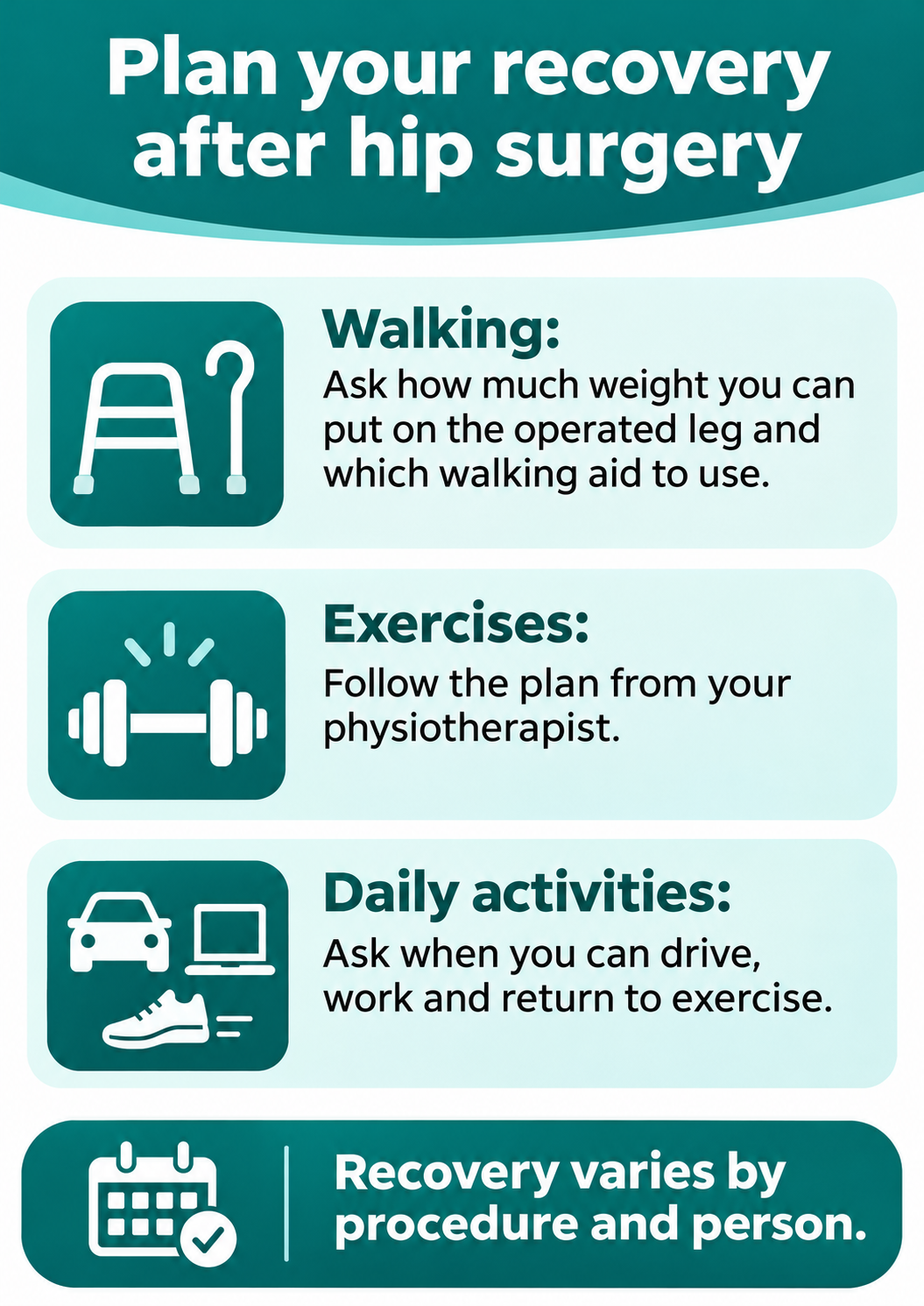
Recovery is not a straight line, and timelines differ by procedure and individual. The phases below describe typical patterns rather than fixed rules.
First Two Weeks
- Manage swelling and pain with ice, elevation, and prescribed medication.
- Use walking aids as directed; many patients progress from a walker to crutches or a cane.
- Perform gentle range-of-motion and circulation exercises several times daily.
- Follow wound care instructions and watch for signs of infection.
Weeks Two to Six
- Gradual strengthening of hip abductors, glutes, and quadriceps.
- Progressive walking distance and return to light household tasks.
- Driving resumption depends on side of surgery, medication, and reaction time; discuss with your surgeon.
- Return to desk-based work is often possible in this window with modifications.
Weeks Six to Twelve
- Balance and gait training become priorities.
- Many patients reduce or stop using walking aids.
- Low-impact activity such as swimming or stationary cycling is often introduced.
- Return to more physically demanding work varies and should be planned with the surgical team.
Beyond Three Months
- Strength and endurance continue to improve for up to a year or more.
- Impact activity after replacement is individualized and generally discussed rather than assumed.
- Joint-preserving procedures often require a longer protected phase before full loading.
The Role of Physical Therapy
Rehabilitation is where much of the outcome is built. The patients who do best are not necessarily the fittest at the start—they are the ones who follow precautions, attend sessions consistently, and communicate honestly about pain rather than pushing through warning signs.
- Prehabilitation: strengthening and gait training before surgery can improve early recovery.
- Early phase: focus on swelling control, safe transfers, and gentle activation.
- Middle phase: progressive loading of hip abductors and extensors to correct the limp many patients develop.
- Late phase: sport- or job-specific training with attention to mechanics.
- Precautions: posterior-approach precautions may limit certain hip flexion and rotation movements early on; anterior approaches have their own considerations.
Patients can find qualified therapists through the American Physical Therapy Association, which also publishes consumer information on rehabilitation.
Risks and Complications to Understand
No operation is risk-free. Discussing these openly with your surgeon is part of informed consent.
- Infection, which may require additional surgery in serious cases.
- Blood clots in the leg or lung, reduced with medication and early movement.
- Dislocation, especially in the early weeks after replacement.
- Leg length difference, usually small but sometimes noticeable.
- Nerve or vessel injury, uncommon but possible.
- Implant wear, loosening, or failure over time, which may eventually require revision.
- Persistent pain or stiffness despite technically successful surgery.
Outcomes You Can Realistically Expect
Most patients report substantial relief from arthritic hip pain after replacement, with improved walking tolerance and sleep. Functional gains typically continue for six to twelve months. Joint-preserving procedures can delay or avoid replacement in well-selected patients, but outcomes depend on cartilage health and adherence to rehabilitation.
Outcomes are not uniform. Factors associated with better results include realistic expectations, good general health, strong social support, and consistent rehabilitation. Patients with severe preoperative stiffness, significant medical comorbidity, or high psychological distress often need more support and may have a slower course.
How to Prepare Before Surgery
- Complete any recommended medical optimization, including dental and skin checks.
- Arrange home modifications such as raised seating and clear walking paths.
- Plan transport and post-operative support for the first couple of weeks.
- Discuss medication management, especially blood thinners, with your care team.
- Attend pre-operative education sessions where available.
For general information on joint replacement and patient resources, the American Academy of Orthopaedic Surgeons patient education library is a reliable starting point.
Conclusion
Hip reconstruction spans joint-preserving surgery and replacement, and the right option depends on your diagnosis, cartilage status, age, activity goals, and overall health. Recovery follows predictable phases, but timelines vary widely and rehabilitation is central to a good result. The most useful next step is a detailed conversation with an orthopedic surgeon and a physical therapist who can assess your specific situation.
Frequently Asked Questions
How long does it take to recover from hip reconstruction?
Recovery depends on the procedure. After total hip replacement, many people walk with aids within days, return to light daily activities over several weeks, and continue improving for up to a year. Joint-preserving procedures such as periacetabular osteotomy often require protected weight-bearing for weeks and a longer return to full activity.
Is hip reconstruction the same as hip replacement?
No. Hip replacement is one type of hip reconstruction. The term also includes joint-preserving operations like periacetabular osteotomy, surgical hip dislocation, and revision procedures. The common thread is reshaping or rebuilding the hip joint to restore function.
Am I too old or too young for hip reconstruction?
Age alone rarely decides candidacy. Surgeons consider cartilage status, bone quality, general health, and activity goals. Younger patients with preserved cartilage may be offered joint-preserving options, while older patients with advanced arthritis often do well with replacement.
How painful is recovery after hip surgery?
Pain is expected early and is usually managed with regional blocks, medication, ice, and positioning. Most patients report that pain becomes manageable within the first week or two, though discomfort during rehabilitation exercises can persist longer. Persistent or worsening pain should be reported to the surgical team.
When can I drive after hip reconstruction?
Driving depends on which hip was operated on, your medication, reaction time, and surgeon guidance. Many patients resume driving within several weeks after replacement, but this should be confirmed with the surgical team rather than assumed.
Can I return to sports after hip reconstruction?
Many people return to low-impact activity such as walking, cycling, and swimming after replacement. High-impact sports are individualized and often discouraged after replacement, while some joint-preserving procedures are designed to allow a return to impact activity in selected patients. Discuss goals with your surgeon before surgery.
How long do hip implants last?
Modern implants generally perform well for many years, but longevity depends on bearing surfaces, patient activity, body weight, and surgical technique. Wear or loosening can eventually require revision surgery, which is why follow-up and honest reporting of symptoms matter.
Do I need physical therapy after hip reconstruction?
Yes, rehabilitation is a standard part of recovery. It helps restore strength, gait, and function, and reduces the risk of complications such as stiffness. Programs are individualized, and some patients attend formal sessions while others follow guided home programs under supervision.
What is the difference between hip resurfacing and total hip replacement?
Resurfacing preserves more of the femoral head by capping it with a metal component, while total replacement removes the head and uses a stem. Resurfacing is generally considered for younger, active patients with good bone quality, and both options have distinct risks and recovery profiles.
When should I see a doctor about hip pain?
Seek evaluation if hip pain limits walking, sleep, or daily activities, persists beyond a few weeks, or is accompanied by swelling, fever, or inability to bear weight. Early assessment allows conservative options to be tried before surgery becomes necessary.