Gait training is a core part of physical therapy that helps people walk again with more confidence, balance, and control. Whether you are recovering from a stroke, joint replacement, or a sports injury, this type of rehabilitation focuses on rebuilding a safe and efficient walking pattern. In this article, you will learn what gait training involves, which techniques therapists use, and how you can make the most of every session.
What Is Gait Training?
Gait training is a structured physical therapy program designed to improve the way you walk. It is not just about standing up and taking steps. It involves practicing patterns that make walking smoother, safer, and less tiring over time.
Physical therapists use gait training to address common problems like limping, shuffling, foot dragging, and poor balance. The goal is to help you move with less effort and reduce your risk of falls.
Gait training may help people with a variety of conditions, including:
- Stroke recovery
- Spinal cord injuries
- Hip or knee replacement surgery
- Lower limb amputations
- Parkinson’s disease
- Multiple sclerosis
- Orthopedic injuries and fractures
- General weakness after a long hospital stay
“I never thought I would need to relearn how to walk. Gait training gave me a plan and the confidence to take each step safely.” — A patient recovering from hip surgery
Common Causes of Gait Impairments
Walking problems can happen for many reasons. Sometimes they appear suddenly after an injury or stroke. Other times, they develop slowly due to a chronic condition or lack of physical activity.
- Neurological conditions — Stroke, spinal cord injury, and Parkinson’s disease can disrupt the signals between your brain and leg muscles.
- Musculoskeletal injuries — A broken leg, torn ligament, or severe joint pain can force you to walk in a guarded or uneven way.
- Joint replacement surgery — After hip or knee surgery, your body needs time to adjust to a new joint and a new normal walking pattern.
- Muscle weakness — Weak gluteal, thigh, or calf muscles make it hard to push off, lift your toes, or control your knee as you walk.
- Balance and vestibular problems — Dizziness or inner ear issues can make walking feel unsteady.
- Foot drop — Weakness in the front of the lower leg makes the toes catch on the ground during each step.
Understanding the cause of your walking difficulty is important because it shapes the physical therapy approach. Your therapist will look beyond your legs and also consider your posture, footwear, vision, and confidence.
How Physical Therapists Assess Your Walk
Before starting gait training, your physical therapist will perform a detailed evaluation. This helps them identify what is making your walking pattern unsafe or inefficient. The assessment is painless and usually takes around 15 to 30 minutes.
Common assessment tools include:
- Observation — Watching you walk from the front, side, and back to spot asymmetries.
- Gait speed test — Timing how fast you walk a short distance.
- Balance tests — Checking your stability while standing with feet together, in tandem, or on one leg.
- Range of motion measures — Checking your ankles, knees, and hips for stiffness.
- Strength testing — Evaluating key muscles like the glutes, quads, hamstrings, and calf muscles.
- Assistive device review — Making sure your cane, walker, or crutches are set to the correct height.
- Footwear check — Recommending supportive shoes that provide a stable base.
Your therapist may also ask about your daily routine. Do you have carpets at home? Do you need to climb stairs? These details help the team design a program that fits your actual life, not just a clinic environment.
Gait Training Techniques Used by Physical Therapists
There is no single “best” walking exercise. Physical therapists combine several techniques to challenge your balance, strength, and coordination in different ways. The exact plan depends on your abilities, goals, and tolerance.
Here are common gait training techniques:
- Overground walking practice — Walking on a flat floor with or without an assistive device while a therapist gives verbal cues about posture, step length, and foot placement.
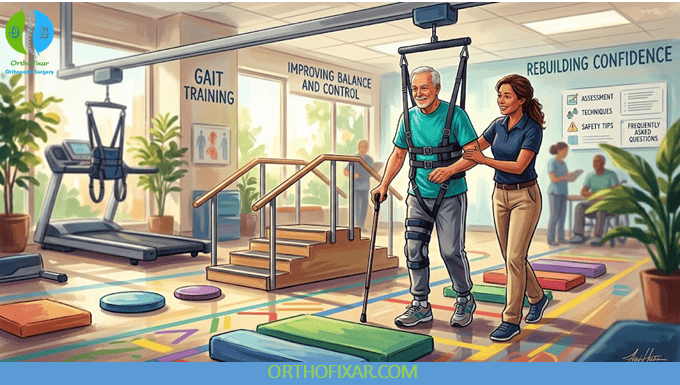
- Treadmill training with body-weight support — A harness supports part of your weight so you can practice more steps without fatigue or fear of falling.
- Heel-to-toe stepping — Placing the heel down first, rolling through the foot, and pushing off with the toes.
- Obstacle training — Stepping over cones, foam pads, or small hurdles to improve agility and confidence on uneven surfaces.
- Stair and curb practice — Learning to go up and down stairs using an alternating or step-by-step pattern.
- Balance integration — Standing on one leg, shifting weight, or reaching for objects while maintaining a stable base.
- Muscle strengthening — Target exercises like sit-to-stands, bridges, calf raises, and leg presses to support your walking mechanics.
“Walking is not just a leg activity. Gait training looks at your whole body, from how you hold your head to how your arms swing.” — A physical therapist
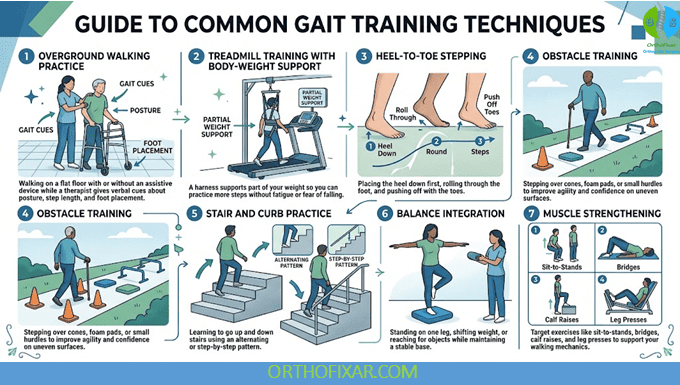
Sample Gait Training Activities
Your therapy sessions will likely include a mix of simple and complex movements. Below are examples of activities your physical therapist might prescribe. Always get guidance before trying them at home.
- Marching in place — Lifts each foot off the ground with control to improve rhythm and hip strength.
- Weight shifting — Moving your hips from side to side while standing to prepare for single-leg support.
- Long steps — Taking exaggerated steps forward to practice proper stride length.
- Sideways walking — Strengthens hips and improves balance during lateral movements.
- Standing on one leg — Improves stability during the swing phase of walking.
| Activity | Main Focus | Example Use |
|---|---|---|
| Straight-line walking | Coordination and balance | Walking on a marked line to reduce veering |
| Stepping over cones | Obstacle clearance | Recovering a more natural step height |
| Treadmill walking | Endurance and rhythm | Building confidence with continuous stepping |
| Stair stepping | Leg strength and control | Returning to stair climbing after knee surgery |
| Backward walking | Knee and hip coordination | Improving lower body awareness |
Your therapist will select only a few of these activities per session. Resting between sets is allowed, and pain should never be intense.
How Long Does Gait Training Take?
There is no fixed timeline because every person’s starting point is different. Some people see noticeable improvements within a few weeks. Others need months of consistent work, especially after a stroke or complex injury.
Several factors affect how long your gait training will last:
- Cause of the walking problem — A recent muscle weakness may respond faster than a neurological condition.
- Overall health — Age, nutrition, sleep, and other medical conditions matter.
- Session frequency — Going to physical therapy twice or three times per week is common at the beginning.
- Home exercise compliance — Consistency between sessions speeds up progress.
- Comfort level — Fear of falling can slow things down, but a gradual program helps build trust.
Your physical therapist will reassess your walking pattern every few sessions and change the program when needed. Progress may not be linear, and that is normal.
Tips for Staying Safe During Gait Training
Safety is the most important part of training that improves safe walking. The fear of falling is common, especially in the early stages. The right precautions help you gain confidence without pushing too far.
Use these tips to stay safe and get the most from gait training:
- Use your assistive device exactly as prescribed. Do not skip your cane or walker just because you feel stronger.
- Clear your walking path. Remove loose rugs, cords, and clutter before practicing at home.
- Wear supportive, non-slip shoes. Flat soles with good grip are better than slippers or slippery socks.
- Start in small spaces. Practice along a counter or with a wall nearby until your balance improves.
- Take rest breaks. Fatigue increases the risk of tripping or walking strangely.
- Tell your therapist about pain. Mild soreness is fine, but sharp or lasting pain should change the plan.
- Focus on one cue at a time. If you try to fix every part of your step at once, you may feel overwhelmed.
Gait training is a gradual process, but it can make a real difference in your daily life. By rebuilding strength, coordination, and confidence, physical therapy helps you walk with less effort and greater safety. Stick with the program, practice between sessions, and trust the process. Every safe step is progress.
Frequently Asked Questions
What is the main goal of gait training?
The main goal is to help you walk in a safer and more efficient way. Physical therapy focuses on improving balance, strength, coordination, and stamina so you can move with less fear and more independence.
How soon can I start gait training after surgery?
It depends on the type of surgery and your doctor’s clearance. Many people start some form of walking practice within 24 to 48 hours after hip or knee replacement. Your physical therapist will guide you from there.
Do I need a referral to see a physical therapist for gait training?
Some patients need a referral while others can book directly. Check with your insurance plan or local clinic. In most cases, a physical therapist will complete an evaluation before starting treatment.
What should I wear to a gait training session?
Wear loose, comfortable clothing and supportive flat shoes. Sneakers with good grip are usually the best option. Avoid flip-flops and heels because they make walking less stable.
Will gait training be painful?
You may feel muscle fatigue, especially when you use weak muscles again. Pain should not be sharp or severe. If something hurts, let your therapist know right away so they can adjust the exercise.
How is gait training different from regular walking?
Regular walking is an everyday activity. Gait training is a structured exercise that analyzes your step and uses specific cues to correct problems. It also includes strengthening and balance work that regular walking does not provide.
Can gait training help with foot drop?
Yes. Gait training can improve ankle strength and coordination for some people with foot drop. A physical therapist may use exercises to lift the front of your foot, depending on the cause and severity.
Do I need special equipment at home?
You may not need anything special at first. Safe space, supportive shoes, and a chair for rest breaks are often enough. Your therapist might