Ankle fusion, also known as ankle arthrodesis, is a surgical procedure that permanently joins the bones of the ankle joint into a single solid unit. This guide explains what the surgery involves, how recovery typically unfolds, and the real-world benefits and limitations, so you and your family can approach the decision with clear expectations.
What Is Ankle Fusion?
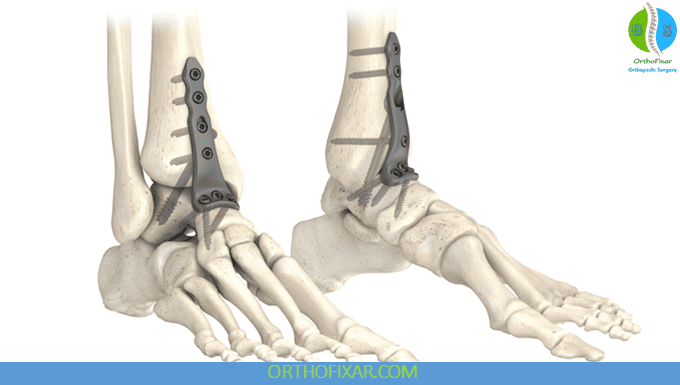
Ankle fusion is a procedure in which a surgeon removes the damaged cartilage from the ankle joint and uses screws, plates, or rods to hold the bones together until they heal into one bone. This eliminates the grinding motion that causes pain in a worn-out or arthritic joint.
The goal is not to preserve movement but to create a stable, pain-free ankle that can bear weight safely.
Key facts about the procedure:
- It is usually recommended when conservative treatment, such as physical therapy, braces, or injections, has failed.
- The surgery is performed under general or spinal anesthesia.
- Most procedures take between two and four hours depending on the technique used.
- After healing, the ankle loses nearly all up-and-down movement, but side-to-side motion from other foot joints often remains.
- Patients typically stay in the hospital for one to two nights.
Why Is Ankle Fusion Done?
Patients consider ankle fusion when chronic ankle pain interferes with daily activities and simpler treatments no longer provide relief. This procedure is particularly common among older adults, but it can also be appropriate for younger patients with severe joint damage from trauma.
Common reasons for recommending ankle fusion include:
- Advanced osteoarthritis, including post-traumatic arthritis after a fracture.
- Rheumatoid arthritis that has destroyed the ankle joint surface.
- Severe joint deformity that affects walking stability.
- Infection inside the joint that has damaged the bone and cartilage.
- Failed previous ankle surgery, such as an ankle replacement.
- Avascular necrosis, where the bone tissue loses blood supply and collapses.
“Ankle fusion trades a painful and unstable joint for a stiff but dependable one. Most people who choose this surgery say the reduction in pain is worth the lost motion.”
How to Prepare for Ankle Fusion Surgery
Preparation begins weeks before the operation. Your orthopedic surgeon will review your medical history, order imaging scans, and may ask you to stop smoking, as nicotine significantly delays bone healing.
Practical steps you can take before surgery:
- Arrange for someone to drive you home from the hospital and help you during the first two weeks.
- Prepare your home by placing essential items within easy reach—ideally at counter height to avoid bending.
- Stock up on easy-to-prepare meals, ice packs, and entertainment.
- Get a knee scooter or walker if recommended by your care team.
- Follow fasting guidelines from your anesthesiologist starting the night before surgery.
- Wear loose clothing that can fit over a bulky cast or splint.
Your surgeon may also prescribe preemptive pain medication and antibiotics to reduce the risk of infection.
How the Ankle Fusion Procedure Works
The operation can be performed using an open incision or a minimally invasive technique. Both approaches follow the same core principle: remove damaged tissue, align the bones, and fix them together securely.
The main steps of the procedure:
- An incision is made on the front or side of the ankle to expose the joint.
- Remaining cartilage is carefully removed from the bone surfaces.
- Small bone grafts may be used to fill gaps and encourage healing.
- The bones are aligned in a functional position—usually neutral, with the foot at a right angle to the leg.
- Screws, plates, or an intramedullary rod are inserted to hold the bones firmly in place.
- The incision is closed, and a cast or splint is applied.
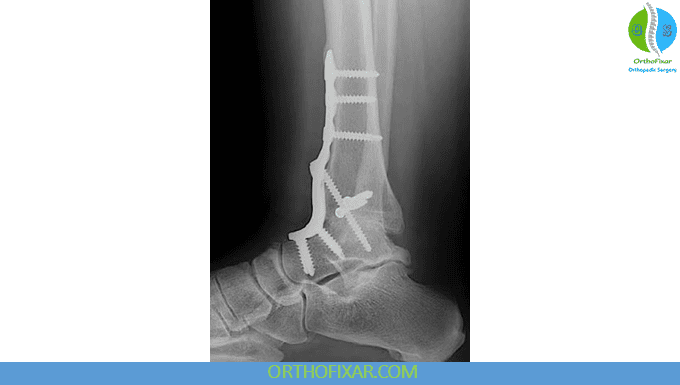
Arthroscopic Ankle Fusion
In some cases, surgeons use an arthroscope—a thin camera—through tiny incisions rather than a large opening. Arthroscopic fusion offers smaller scars and a shorter hospital stay, but it is best suited for patients with less severe deformity or bone loss.
Recovery Timeline and What to Expect
Ankle joint fusion recovery is a slow, steady process. Full bone healing takes roughly eight to twelve weeks, but regaining strength and confidence can take six months to a year.
| Time After Surgery | What to Expect | Activity Level |
|---|---|---|
| Day 0 to 2 weeks | Swelling and pain control; non-weight-bearing on crutches or a knee scooter | Minimal movement; keep the foot elevated |
| 2 to 6 weeks | Cast or boot remains; sutures removed; starts gentle toe wiggling | Still non-weight-bearing; progress to partial weight-bearing only if the surgeon approves |
| 6 to 10 weeks | Bone union begins to appear on X-rays; transition to a walking boot | Gradual weight-bearing, often starting at 25% and increasing weekly |
| 10 to 14 weeks | Swelling decreases; physical therapy intensifies with balance exercises | Full weight-bearing in a shoe; walking aids may still be helpful |
| 4 to 6 months | Most daily activities are possible; low-impact exercises encouraged | Walking, cycling, swimming; avoid running and jumping |
| 6 to 12 months | Final bone consolidation; maximal improvement in pain relief | Full return to most activities, with permanent restrictions on high-impact sports |
“The hardest part of ankle fusion recovery is patience. The bone needs time to grow across the joint, and pushing too hard too early can delay healing or cause the fusion to fail.”
Benefits of Ankle Fusion
Despite the loss of motion, ankle fusion offers several meaningful advantages that many patients find appealing.
- Reliable pain relief: Once the bones fuse, the damaged joint surfaces no longer rub together, eliminating the source of most arthritis pain.
- Long-lasting result: No wear-and-tear issues exist because there is no artificial bearing surface to wear out.
- High activity tolerance: A fused ankle can handle heavy loads and long-distance walking better than some joint replacements, which have lifespan limits.
- Lower reoperation rate: Compared to ankle replacement, fusion is less likely to require revision surgery in the long term.
- Good stability: The joint becomes structurally solid, reducing the risk of giving way or feeling unstable.
Limitations and Potential Complications
Ankle fusion is not a perfect solution. It permanently changes how you walk, and it comes with real trade-offs that should be considered honestly.
- Lifetime motion loss: You will not be able to bend the ankle up or down after surgery, which can affect walking on slopes and stairs.
- Adjacent joint strain: The subtalar and midfoot joints compensate for the lost motion, which can lead to arthritis in those areas years later.
- Long recovery: Expect several months of restricted weight-bearing, which can be difficult for working people and caregivers.
- Nonunion risk: In some cases, the bones fail to heal together, especially among smokers or patients with poor blood supply.
- Infection and nerve injury: As with any surgery, infection, blood clots, and nerve damage are possible, though uncommon.
- Limp pattern: Many patients develop a slightly noticeable limp, particularly when walking fast.
Life After Ankle Fusion: Practical Tips
Adapting to life with a fused ankle takes time, but most patients manage well with a few key adjustments.
- Choose shoes with a rocker-bottom sole or a slight heel to help your foot roll forward more smoothly while walking.
- Use handrails on stairs and slopes whenever possible.
- Ask a physical therapist to teach you gait training techniques that reduce strain on your knee and hip.
- Avoid running on hard surfaces, which sends excessive shock through the fused area.
- Maintain a healthy body weight to reduce stress on the surrounding joints.
Conclusion
Ankle fusion is a proven surgical option for people who have exhausted conservative treatments and want dependable pain relief. The procedure eliminates ankle movement, but it provides a stable and durable result for most patients. Recovery is long, and the decision should be made together with your orthopedic surgeon, weighing your age, activity goals, and overall health. Understanding the benefits and limitations will help you approach surgery with realistic expectations and a clear plan for rehabilitation.
Frequently Asked Questions
How painful is ankle fusion surgery?
Pain is significant during the first few days after surgery, but it is usually well controlled with prescribed medications, ice, and elevation. Most patients report that the chronic arthritis pain they felt before surgery is much worse than the post-operative pain experienced after the initial healing phase.
Will I be able to walk normally after ankle fusion?
You will walk, but not with a perfectly normal gait. A fused ankle loses up-and-down motion, so your other foot joints and hip flexors compensate. Most people develop a subtle limp, especially when walking on uneven ground or climbing stairs. Physical therapy helps you retrain your walking pattern to make the limp as small as possible.
How long do I need to be off work after the surgery?
This depends on your job. Sedentary desk workers can sometimes return after four to six weeks, provided they can elevate the leg. People with physically demanding jobs such as construction, nursing, or retail often need three to six months off. Discuss your specific work demands with your surgeon before scheduling surgery.
Can I drive after ankle fusion?
Driving is not safe until you can press the pedals firmly and perform an emergency stop. For a right ankle fusion, most people wait at least six weeks and only after their surgeon confirms the bones are healing. For a left ankle fusion in an automatic car, you may be able to drive sooner, but check with your care team first.
How long does it take for the bones to fuse after ankle arthrodesis?
Bone union usually occurs around eight to twelve weeks after surgery, but complete consolidation can take up to six months. X-rays are taken periodically to monitor healing. The surgeon looks for continuous bone bridging across the joint before you are allowed to bear full weight.
What is the success rate of ankle fusion?
Reported success rates for ankle fusion in terms of pain relief and patient satisfaction are generally high, often above 80 to 90 percent. However, success depends on several factors, including smoking status, bone quality, the surgeon’s technique, and how well you follow post-operative instructions.
Will I need a second surgery in the future?
Some patients eventually develop arthritis in adjacent joints due to increased stress from the fused ankle. This can require additional treatment, but it may take ten or more years to develop. Nonunion or hardware irritation may also require a second procedure, but this is not the norm for most patients.
Can I run or play sports after ankle fusion?
High-impact activities like running and jumping are generally discouraged because they place excessive stress on surrounding joints and the fusion itself. Low-impact sports such as swimming, cycling, golf, and hiking on flat terrain are usually well tolerated. Always ask your surgeon what sports are safe for your specific situation.
What is the difference between ankle fusion and ankle replacement?
Ankle fusion removes the joint and locks the bones together permanently, while ankle replacement removes the damaged joint and installs an artificial implant that preserves motion. Fusion offers greater stability and a lower risk of revision, but replacement offers better range of motion. Your surgeon will help determine which procedure fits your age and activity level.
Does smoking affect ankle fusion healing?
Yes, strongly. Smoking reduces blood flow to bone and slows the healing process significantly, increasing the risk of nonunion. Most surgeons will ask you to quit smoking at least six to eight weeks before surgery and remain smoke-free for several months after the procedure.