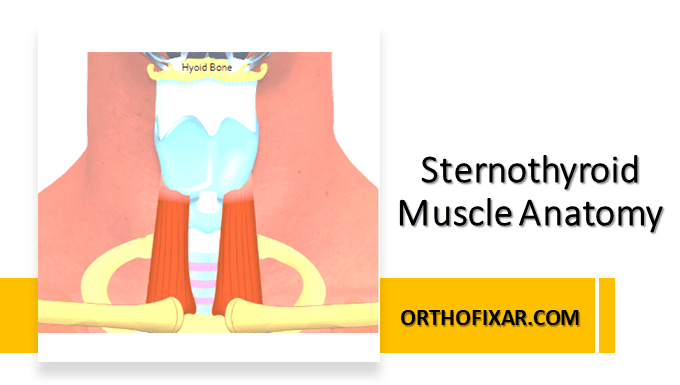
The sternothyroid muscle is a paired, flat, ribbon-like infrahyoid (strap) muscle located in the anterior region of the neck. It lies deep to the sternohyoid muscle and is shorter and broader in shape compared to its superficial counterpart. The sternothyroid muscle plays a crucial role in laryngeal depression, particularly during swallowing and phonation.
Sternothyroid Muscle Anatomy
Embryology of the Sternothyroid Muscle
From an embryological standpoint, the sternothyroid muscle develops from the hypaxial portions of the cervical myotomes. This origin is consistent with other infrahyoid muscles and explains its shared innervation via the cervical plexus.
Origin and Insertion
The sternothyroid muscle originates from:
- The posterior surface of the manubrium sterni
- Occasionally from the first costal cartilage
It ascends superiorly to insert on the oblique line of the lamina of the thyroid cartilage. This anatomical orientation allows the muscle to effectively depress the larynx.
In the anterior neck, the sternothyroid muscle maintains significant relationships with several vital structures:
- Anteriorly, it lies deep to the sternohyoid muscle and the investing layer of deep cervical fascia.
- Posteriorly, it covers portions of the thyroid gland, trachea, and inferior thyroid vessels.
- These relationships hold particular importance during thyroid surgery and other anterior neck procedures.
Innervation and Blood Supply
- Innervation: Supplied by the ansa cervicalis (anterior rami of C1–C3 spinal nerves)
- Blood Supply: Primarily from the superior thyroid artery and inferior thyroid artery, with additional branches from the lingual artery.
- Venous drainage follows the superior and inferior thyroid veins.
Preservation of the ansa cervicalis is important during cervical dissections to prevent dysfunction of infrahyoid muscles.
See Also: Sternohyoid Muscle Anatomy
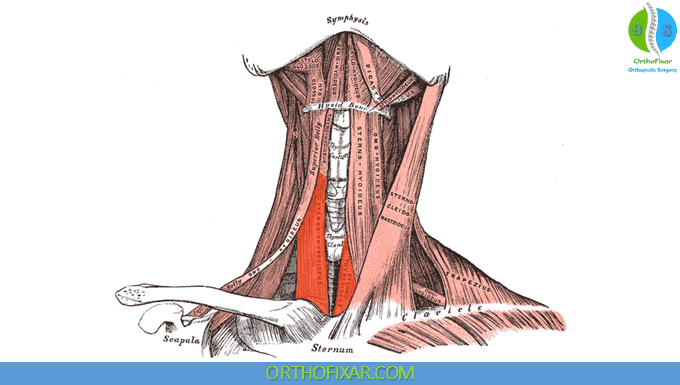
Function of the Sternothyroid Muscle
The primary action of the sternothyroid muscle is to depress the thyroid cartilage and larynx. This function is essential for:
- Swallowing (deglutition)
- Voice production and pitch modulation
- Stabilization of the laryngeal framework during phonation
It works synergistically with other infrahyoid muscles to control vertical laryngeal movement.
Summary Table
| Origin | Posterior surface of manubrium of sternum, Costal cartilage of rib 1 |
| Insertion | Oblique line of thyroid cartilage |
| Innervation | Anterior rami of C1-3 (via the ansa cervicalis) |
| Blood Supply | Superior thyroid and lingual arteries |
| Action | Depress the larynx |
Clinical Considerations
The sternothyroid muscle is of particular importance during thyroid surgery. It is often retracted or partially divided to expose the thyroid gland. Proper identification and preservation help prevent post-operative laryngeal dysfunction, voice changes, and swallowing difficulties.
Injury to the ansa cervicalis can cause:
- Mild swallowing dysfunction
- Weak laryngeal depression
- Altered voice projection
Biomechanics & Functional Role
Role in Swallowing (Deglutition)
During swallowing:
- Suprahyoid muscles elevate the hyoid and larynx
- After bolus passage, the sternothyroid muscle actively depresses the larynx
- This resets the airway for respiration
Failure of this mechanism may contribute to dysphagia or voice fatigue.
Role in Phonation
- Stabilizes the laryngeal framework
- Assists in lowering vocal pitch by depressing the thyroid cartilage
- Works synergistically with intrinsic laryngeal muscles
This function is especially important in professional voice users.
References & More
- Clinically Oriented Anatomy, 8th Edition https://shop.lww.com/Clinically-Oriented-Anatomy/p/9781975140403
- Standring, S. (2016) Gray’s Anatomy: The Anatomical Basis of Clinical Practice. Gray’s Anatomy Series 41st edn.: Elsevier Limited.