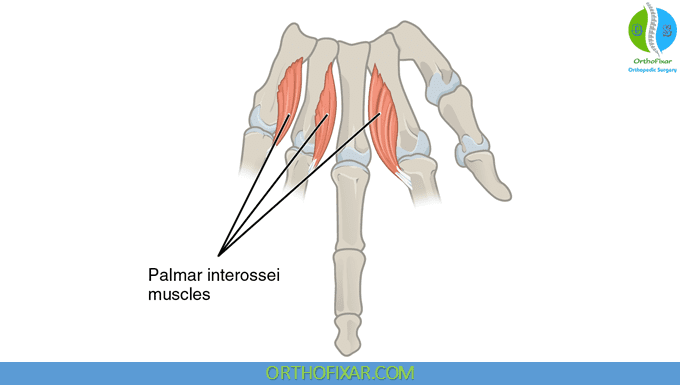
The three palmar interosseous muscles (palmar interossei) are on the palmar surfaces of the metacarpals in the interosseous compartment of the hand. Sometimes there are 4 palmar interossei muscles.
Anatomy of the Palmar Interossei of Hand
The 1st palmar interossei (if present) originates from the ulnar side of the base of the 1st metacarpal bone. It inserts into a sesamoid bone on the ulnar side of the proximal phalanx of the thumb, as well as on its extensor expansion.
The 2nd palmar interossei originates from the entire length of the 2nd metacarpal bone and is inserted into the ipsilateral extensor expansion of the index finger.
The 3rd palmar interossei originates from the radial side of the 4th metacarpal bone and inserts together with the third lumbrical into the radial base of proximal phalanx of ring finger and on its extensor expansion.
The 4th palmar interossei originates from the radial side of the 5th metacarpal bone and inserts with the fourth lumbrical into the base of the proximal phalanx of the little finger and on its extensor expansion.
See Also: Hand Anatomy, Bones & Muscles
They are all innervated by the deep branch of ulnar nerve (C8 and T1) and get their blood supply from the palmar metacarpal arteries.
The main function of palmar interossei muscles is to adduct the fingers in a longitudinal axis, they also assist lumbricals in flexing metacarpophalangeal joints and extending interphalangeal joints.
| Origin | Palmar 1 – 3: Palmar surfaces of 2nd, 4th and 5th metacarpals (unipennate muscles) |
| Insertion | Palmar 1 – 3: Extensor expansions of digits and bases of proximal phalanges of digits 2, 4 and 5 |
| Innervation | Deep branch of ulnar nerve (C8 and T1) |
| Blood Supply | Palmar 1 – 3: Palmar metacarpal arteries |
| Action | Palmar 1 – 3: Adduct digits toward axial line and assist lumbricals in flexing metacarpophalangeal joints and extending interphalangeal joints |
To test the palmar interossei, a sheet of paper is placed between adjacent fingers. The individual is asked to “keep the fingers together” to prevent the paper from being pulled away by the examiner.

References & More
- Cael, C. (2010). Functional anatomy: Musculoskeletal anatomy, kinesiology, and palpation for manual therapists. Philadelphia, PA: Wolters Kluwer Health/Lippincott, Williams & Wilkins.
- Moore, K. L., Dalley, A. F., & Agur, A. M. R. (2014). Clinically Oriented Anatomy (7th ed.). Philadelphia, PA: Lippincott Williams & Wilkins.
- Valenzuela M, Bordoni B. Anatomy, Shoulder and Upper Limb, Hand Palmar Interosseous Muscle. [Updated 2023 Jul 24]. In: StatPearls [Internet]. Treasure Island (FL): StatPearls Publishing; 2024 Jan-. Available from: Pubmed
- Clinically Oriented Anatomy – 8th Edition