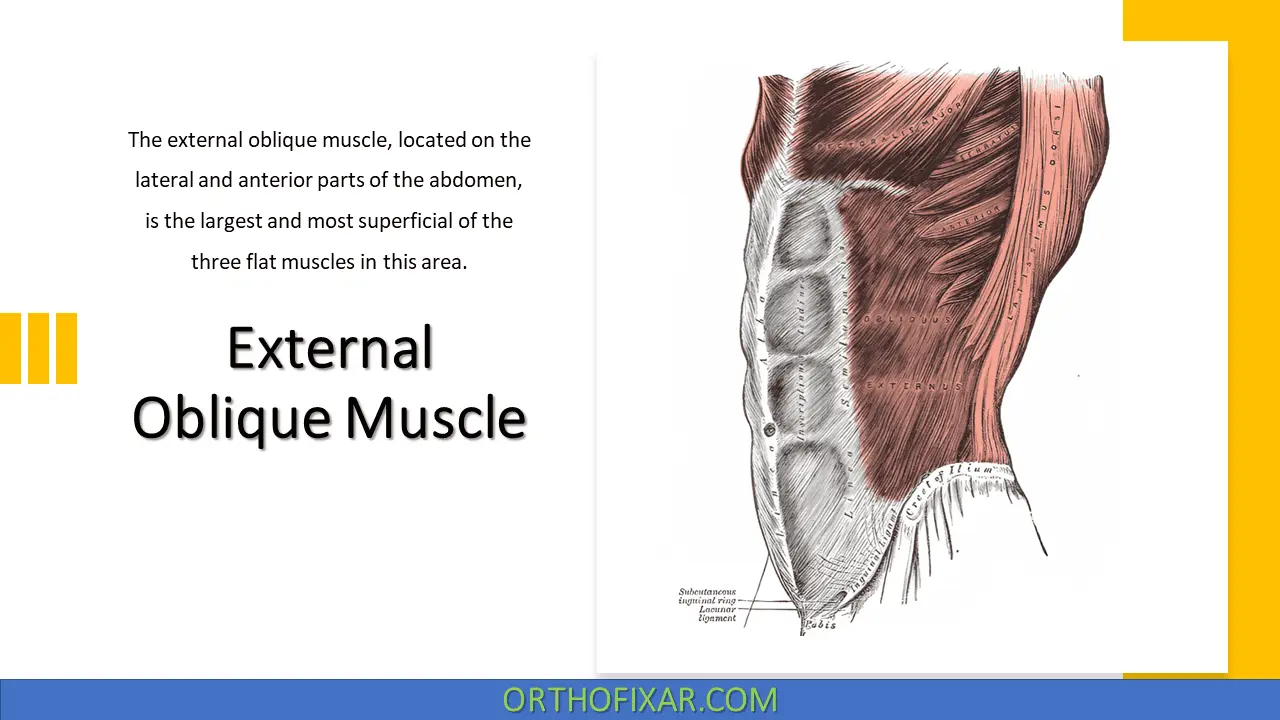
The external oblique muscle is a major component of the abdominal wall and plays a critical role in core stability, trunk movement, posture, and respiration. This comprehensive guide covers the anatomy, function, innervation, blood supply, clinical relevance, injuries, and strengthening exercises of the external oblique muscle—making it ideal for medical students, healthcare professionals, fitness enthusiasts, and anatomy learners.
External Oblique Muscle Anatomy
The external oblique muscle is located on the anterolateral abdominal wall. It is the largest and most superficial of the three flat abdominal muscles, lying superficial to the internal oblique and transversus abdominis.
The muscle fibers run inferomedially (“hands-in-pockets” direction) from the ribs toward the pelvis and midline.
See Also: Internal Oblique Muscle
Origin
- Outer surfaces of the lower eight ribs (ribs 5–12)
Insertion
- Linea alba
- Pubic tubercle
- Anterior half of the iliac crest
Innervation
- Thoracoabdominal nerves (T7–T11)
- Subcostal nerve (T12)
Blood Supply
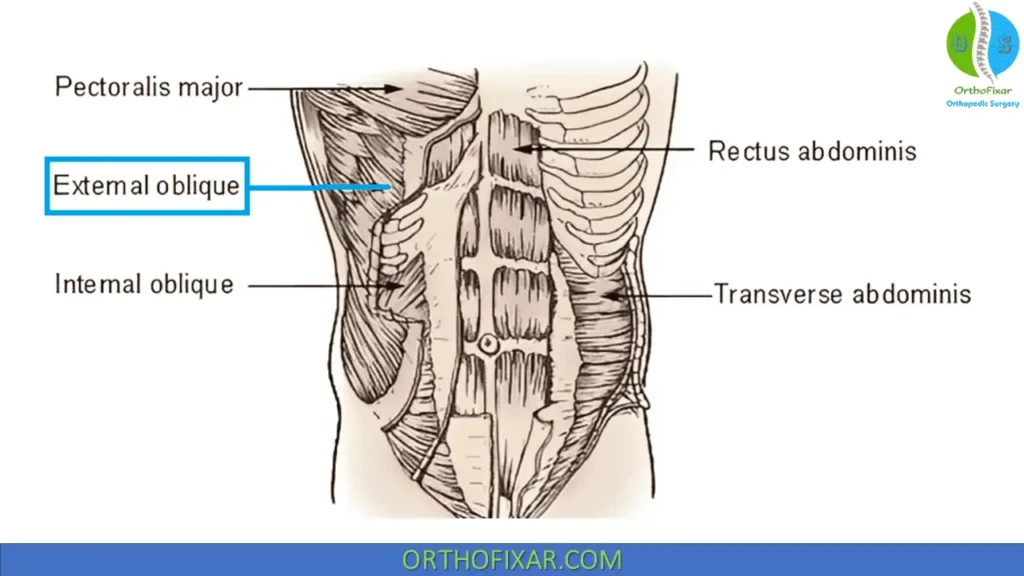
External Oblique Muscle Function
The external oblique muscle works bilaterally and unilaterally to support trunk motion and abdominal pressure regulation.
Primary Functions
- Trunk Rotation
Contracts with the opposite internal oblique to rotate the trunk - Lateral Flexion
Bends the torso toward the same side - Abdominal Compression
Supports forced expiration, coughing, defecation, and digestion - Postural Stability
Contributes to spinal stability and core control
Significance in Health and Fitness
Role in Athletic Performance
- Enhanced Stability: Crucial for balance and core strength in various sports.
- Injury Prevention: Strong external obliques contribute to lower risk of abdominal and lower back injuries.
Importance in Everyday Activities
- Posture Maintenance: Essential for maintaining an upright posture.
- Breathing Support: Assists in the breathing process, particularly during exertion.
Common Injuries and Disorders
Types of Injuries
- Strains and Tears: Overexertion or improper movement can lead to muscle strains.
- Hernias: Weakness in the muscle can lead to abdominal hernias.
Prevention and Management
External oblique pain treatment include:
- Regular Exercise: Strengthening and flexibility exercises.
- Proper Technique: Ensuring correct form during physical activities.
- Immediate Attention: Seeking medical help for pain or discomfort in the abdominal area.
External Oblique Strengthening
Effective Exercises
- Side Planks: Enhances lateral stability.
- Russian Twists: Improves rotational strength.
- Bicycle Crunches: Targets the obliques for core conditioning.
Training Tips
- Consistency: Regular training for gradual strengthening.
- Variety: Incorporating different exercises for balanced development.
- Safety: Avoid overexertion and focus on proper form.
Conclusion
The external oblique muscle, a vital part of our muscular system, is essential for various physical functions, from sports performance to daily activities. Understanding its anatomy, functions, and the importance of maintaining its health is crucial for overall well-being. Regular exercise, proper care, and attention to any discomfort in this area can ensure its optimal functioning and prevent potential injuries.
References & More
- Clinically Oriented Anatomy – 8th Edition
- Schlenz I, Burggasser G, Kuzbari R, Eichberger H, Gruber H, Holle J. External oblique abdominal muscle: a new look on its blood supply and innervation. Anat Rec. 1999 Aug 1;255(4):388-95. doi: 10.1002/(SICI)1097-0185(19990801)255:4<388::AID-AR4>3.0.CO;2-Q. PMID: 10409811. Pubmed
- Nakai Y, Kawada M, Miyazaki T, Araki S, Takeshita Y, Kiyama R. A self-oblique exercise that activates the coordinated activity of abdominal and hip muscles-A pilot study. PLoS One. 2021 Aug 12;16(8):e0255035. doi: 10.1371/journal.pone.0255035. PMID: 34383772; PMCID: PMC8360586. Pubmed

Closed.