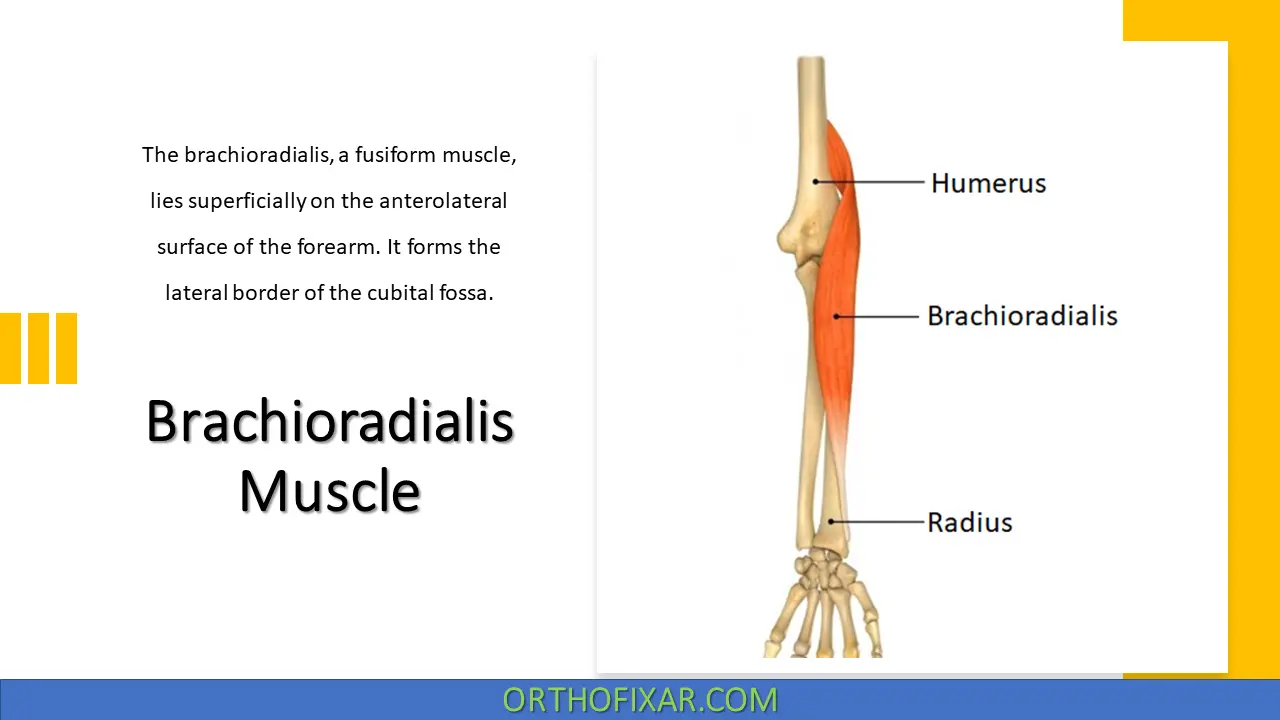
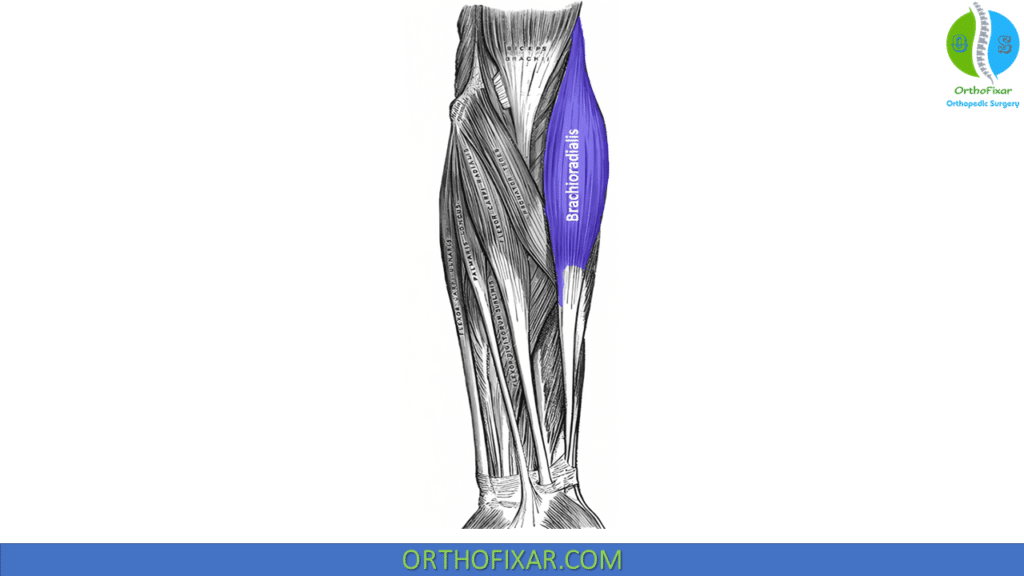
The brachioradialis, a fusiform muscle, lies superficially on the anterolateral surface of the forearm. It forms the lateral border of the cubital fossa.
The brachioradialis is exceptional among muscles of the posterior (extensor) compartment in that it has rotated to the anterior aspect of the humerus and thus flexes the forearm at the elbow. It is especially active during quick movements or in the presence of resistance during flexion of the forearm (e.g., when a weight is lifted), acting as a shunt muscle resisting subluxation of the head of the radius.
The brachioradialis and the supinator are the only muscles of the compartment that do not cross the wrist and therefore are incapable of acting at the wrist. As it descends, the brachioradialis overlies the radial nerve and artery where they lie together on the supinator, pronator teres tendon, FDS, and FPL. The distal part of the tendon is covered by the abductors pollicis longus and brevis as they pass to the thumb.
See Also: Forearm Muscles Anatomy & Function
Brachioradialis Muscle Anatomy
Origin and Insertion
The Brachioradialis muscle arises from the proximal 2/3 of lateral supracondyle ridge of humerus.
It rotates to the anterior aspect of the humerus, crossing the elbow joint and inserts on the lateral surface of distal end of radius.
Innervation
The Brachioradialis muscle is innervated by the radial nerve. This nerve receives contributions from the C5 to C7 spinal roots, although most of the neural input to the brachioradialis comes from C5 and C6. The radial nerve’s distal portion lies between the brachioradialis and brachialis muscles anteriorly
Blood Supply
Blood supply to this muscle comes from the radial recurrent artery, a radial artery branch that supplies the forearm and contributes to the elbow joint’s anastomotic network.
The brachioradialis lymphatic drainage is part of the upper limb lymphatic system and consists of superficial and deep lymphatic vessels. The superficial lymphatic vessels closely follow the superficial venous vasculature. Part of the superficial lymphatic system follows the basilic vein to drain into the cubital lymph nodes.
Action
Functionally, the brachioradialis is a flexor of the forearm, but it is located in the posterior (posterolateral) or extensor compartment and is thus supplied by the radial nerve. Therefore, this a major exception to the rule that the radial nerve supplies only extensor muscles and that all flexors lie in the anterior (flexor) compartment.
| Origin | Proximal 2/3 of lateral supracondyle ridge of humerus |
| Insertion | Lateral surface of distal end of radius |
| Innervation | Radial nerve (C5, C6, C7) |
| Blood Supply | Radial recurrent artery |
| Action | Flexes forearm |
The brachioradialis is an important muscle in the volar approach to the radius (Henry approach), where the surgeon must take care not to damage the superficial radial nerve that runs along the undersurface of the brachioradialis.
Wartenberg syndrome occurs when the brachioradialis and extensor carpi radialis longus tendons or fascial bands in the subcutaneous plane compress the superficial radial nerve.
To test the brachioradialis, the elbow joint is flexed against resistance with the forearm in the midprone position. If the brachioradialis is acting normally, the muscle can be seen and palpated.
MCQs Section
References & More
- Clinically Oriented Anatomy – 8th Edition
- Lung BE, Ekblad J, Bisogno M. Anatomy, Shoulder and Upper Limb, Forearm Brachioradialis Muscle. [Updated 2023 Jul 25]. In: StatPearls [Internet]. Treasure Island (FL): StatPearls Publishing; 2023 Jan-. Available from: Pubmed
- Leversedge FJ, Casey PJ, Payne SH, Seiler JG. Vascular anatomy of the brachioradialis rotational musculocutaneous flap. J Hand Surg Am. 2001 Jul;26(4):711-21. [PubMed]