Ask a prosthetist which part of an above-knee leg causes the most trouble, and the answer rarely changes. The foot gets plenty of attention in product photos, and the socket takes the blame for most day-to-day discomfort, yet the knee is where the engineering gets genuinely hard. A biological knee bends about 60 degrees during an ordinary step, holds firm for a split second while the entire weight of the body passes over it, and then releases again, all without its owner giving it a single conscious thought. Recreating that behavior in a machine, on uneven ground, for a person who cannot feel what the joint is doing, has kept engineers busy for well over a century.
What a Knee Actually Does During a Single Step
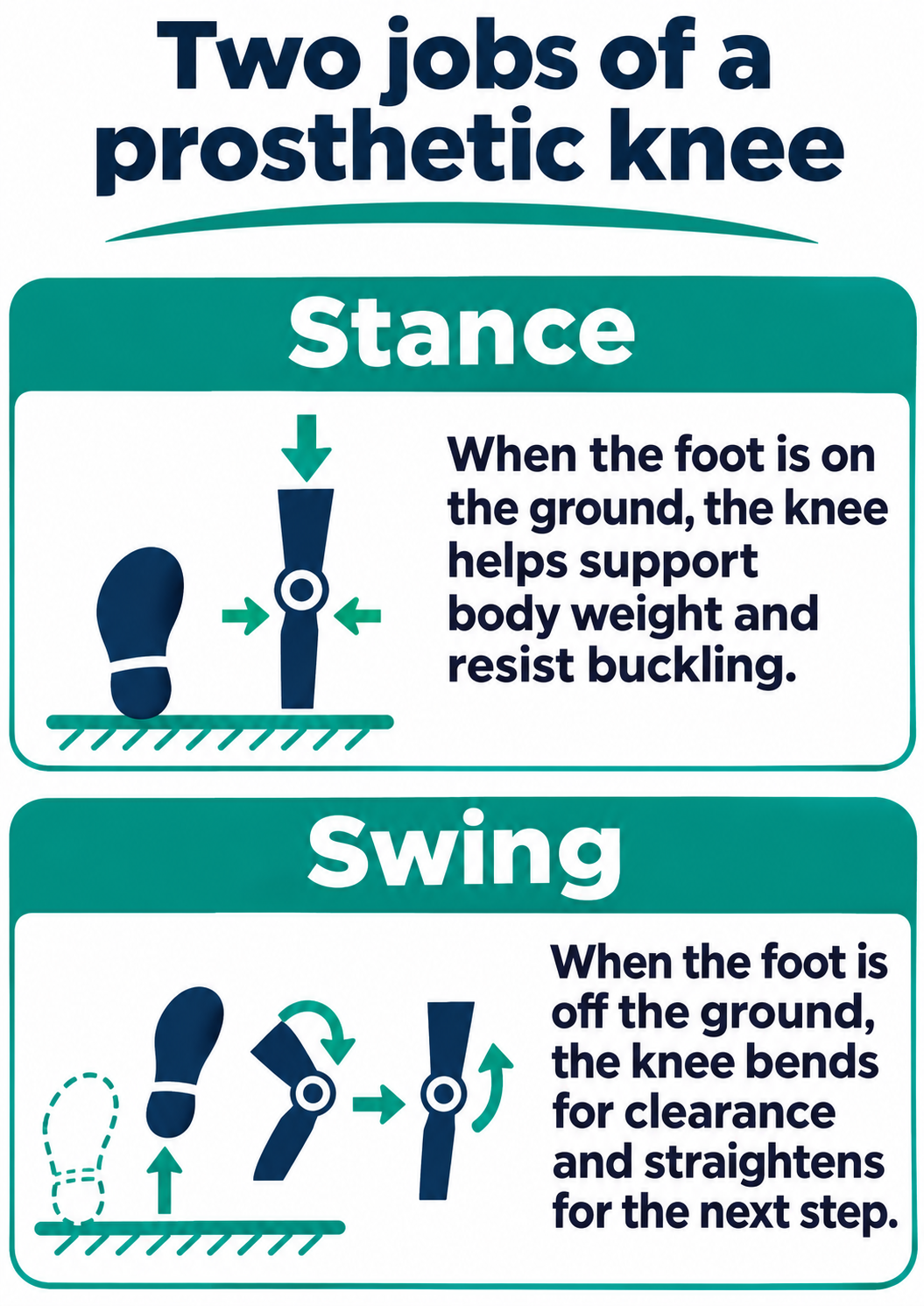
Walking looks simple from the outside, but gait researchers split every stride into two very different jobs. Roughly 60 percent of the cycle is stance, when the foot is on the ground and the leg has to carry load. The remaining 40 percent or so is swing, when the leg travels forward through the air and needs to bend enough for the toes to clear the floor before straightening again for the next heel strike.
Those two phases ask for opposite things. During stance, the knee has to resist buckling, and it even flexes slightly at heel contact to soften the impact, a small bend of around 15 degrees that most people never notice. During swing, it has to move freely but within limits, because a shin that flies forward unchecked slams into full extension with a jolt. The same tension comes up in fittings everywhere, at a university hospital or at PrimeCare Orthotics & Prosthetics, since a joint that has to be stubborn and relaxed within the same second is a hard thing to build.
For someone with an amputation above the knee, there is also no muscle across the joint to fix mistakes. A person with an intact leg catches a stumble with the quadriceps almost instantly. A prosthetic user has to rely on hip muscles, body position, and whatever the mechanism itself can do, so the design of the knee decides a surprising share of how safe each step feels.
From Locking Hinges to Fluid Resistance
The earliest artificial knees solved the stability problem in the bluntest way available, by locking straight. A manual-lock knee keeps the leg rigid while walking and only bends when the user pulls a release to sit down. It is very hard to fall on one, which is why the design still has a place for some users today, but the stiff-legged gait it produces forces the person to swing the leg out to the side or vault up on the other foot to clear the ground.
Later designs tried to be smarter about when to hold and when to give. Weight-activated “safety” knees use a friction brake that engages when the user loads the leg, so the joint stays stable in stance and swings freely once the weight comes off. Polycentric knees took a different route, replacing a single hinge with a linkage of four or more bars. Because the joint’s pivot point shifts as it bends, engineers can tune the geometry so the knee feels secure under load and effectively shortens the leg during swing, which helps with toe clearance. Prosthetists call that moving pivot the instantaneous center of rotation, and its placement is a big reason one polycentric knee walks very differently from another.
Curiously, the biggest leap toward natural-looking gait came from fluid, and the clever linkages played a smaller part. Pneumatic and hydraulic swing control units push air or oil through small valves as the knee bends and straightens, and the resistance rises the faster the joint moves. That property means the knee automatically adapts when the user speeds up or slows down, something a fixed friction setting cannot do. Hydraulic units in particular made it possible to walk at a range of speeds with a smoother, more even rhythm, and many modern knees still rely on oil-filled cylinders at their core.
The limitation was that every valve setting represented a compromise. A prosthetist could tune a hydraulic knee for an average walking speed on flat ground, but the same setting might feel sluggish on a brisk walk and loose on a steep ramp. Most users learned to live with those trade-offs, simply because nothing better existed yet.
The Microprocessor Era
By the late 1990s, the hydraulic hardware was already good enough, and what it lacked was judgment. The first commercially successful microprocessor-controlled knees added sensors that measure knee angle and the load passing through the leg, along with a small computer that reads those signals and adjusts the hydraulic valves continuously, dozens of times per second. Instead of one setting chosen in the clinic, the knee picks its own resistance for whatever the user is doing at that moment.
A knee is also only one link in a longer lower-limb chain, and the parts have to be chosen together. A change at the knee usually ripples into how the socket fits and which foot makes sense. A heavier computerized unit, for instance, may call for a different suspension system than a light mechanical hinge did.
The practical results of microprocessor control are well documented in rehabilitation research. People using these knees tend to stumble and fall less often, they handle slopes and stairs with more confidence, and many report that they spend less mental effort watching the ground. Walking with an above-knee prosthesis is known to cost noticeably more energy than walking on two intact legs, and a large part of that cost is cognitive, the constant low-level vigilance required to avoid a misstep.
When the Knee Starts Doing the Work
Most microprocessor knees are still passive, meaning they control motion but do not generate it. A smaller group of powered knees adds a motor that can actively straighten the joint. That matters for tasks where a passive knee offers little help, such as rising from a low chair or climbing stairs step over step instead of one at a time. Powered designs also add weight, a battery to charge and a higher price, so they tend to suit specific users with specific goals.
Matching a Knee to the Person Wearing It
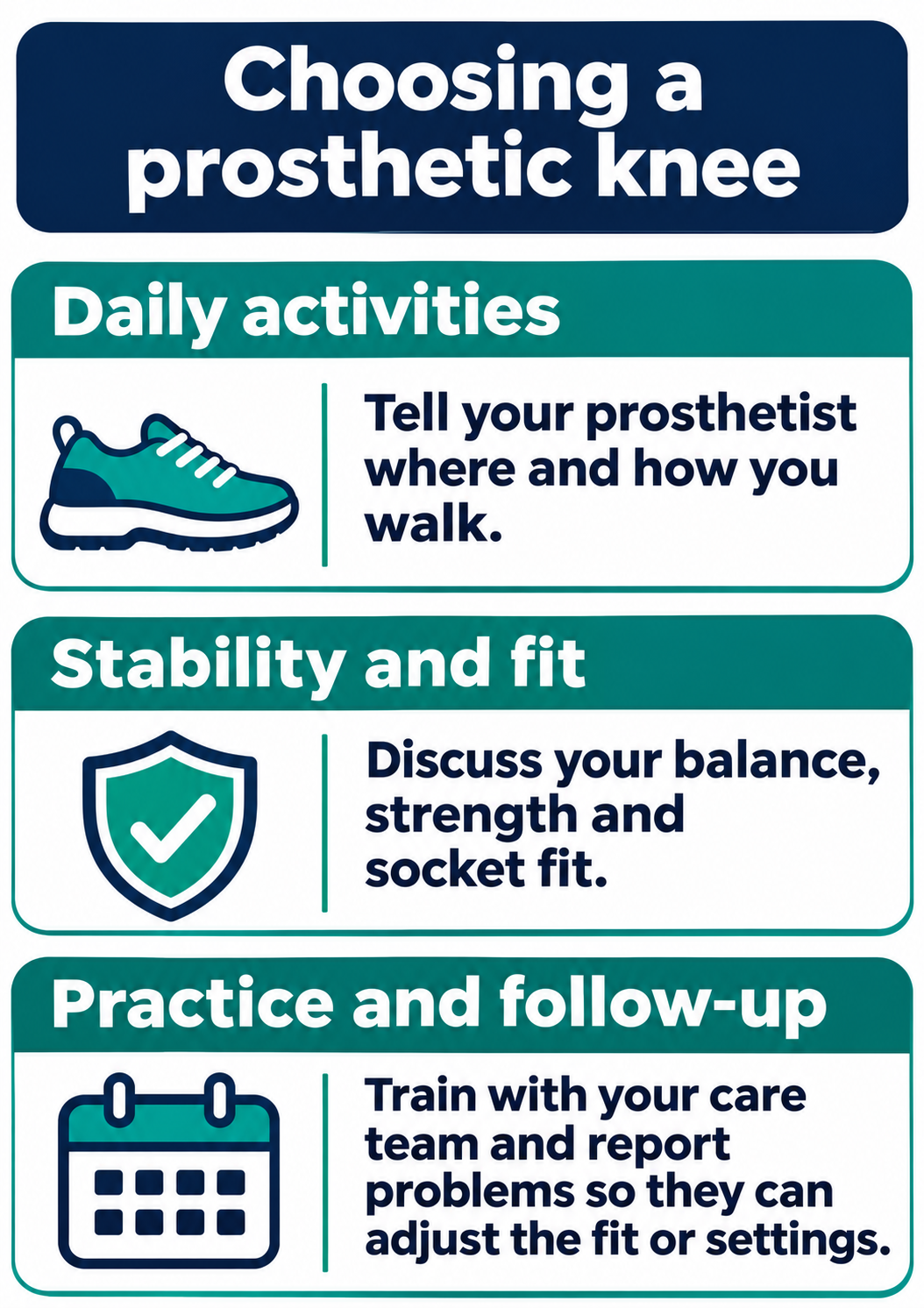
No single knee is the right answer for everyone, and clinical assessment carries most of the weight in choosing one. In the United States, insurers and clinicians commonly use the Medicare functional classification system, known as K-levels, to describe a person’s expected activity, from limited household walking to high-impact athletics. A K-level helps determine which categories of components are considered appropriate and, often, which ones insurance will cover.
Activity is only part of the picture. The length of the residual limb, hip strength, body weight, balance, and even whether the person works around water or dust can steer the decision. An older adult who mainly walks indoors may get more benefit from stance security than from speed adaptation, while a younger user who hikes on weekends may care far more about how the knee behaves on a descending trail. That is why the search for a new prosthetic knee typically starts with a long conversation about daily routines, with product catalogs coming much later.
The technology also asks something of the person wearing it. People have to learn to trust stance control enough to put full weight on the leg, to start a swing with the hip instead of fighting the joint, and to walk down a slope by letting the knee yield in a controlled way. Physical therapists who specialize in amputee gait training often say the first weeks with a new knee are as much about unlearning old compensations as they are about learning new movements.
Follow-up adjustments matter just as much. Residual limbs change shape over months, walking habits evolve as confidence grows, and microprocessor knees in particular can be retuned through software as the user’s needs shift. A knee that felt cautious and heavy in the first month may be set to behave quite differently a year later.
The biological knee remains a remarkable piece of design, and no artificial joint fully matches it yet. Research groups are already testing prostheses anchored directly to bone and control systems that read signals from nerves and muscles, which could someday close the gap between a joint that reacts and one that simply belongs to the body. For now, the quiet progress shows up in ordinary moments, such as a curb stepped over without a second thought or a walk across a parking lot that no longer requires staring at the pavement.