Yes, you can get out of a low chair without knee pain, and the solution usually comes down to three things: shifting your weight forward before you stand, using your hips and trunk instead of your knees, and choosing a chair height that lets your feet work with you rather than against you. This article explains the mechanics behind that sharp pain, provides a step-by-step technique you can practice today, covers practical chair and footwear adjustments, and outlines when knee pain during standing up deserves a proper assessment. The guidance reflects everyday clinical practice with people who have knee osteoarthritis, patellofemoral pain, and post-injury stiffness, and it is general education rather than a personalized treatment plan.
Why Standing Up From a Low Chair Hurts Your Knees
Standing from a seated position is essentially a small squat. Your knee bends deeply, your thigh muscles (the quadriceps) generate force, and pressure across the kneecap and joint surfaces rises as you lean forward. The lower the chair, the deeper the starting knee angle and the more demand placed on the joint and surrounding tissue.
In clinical practice, the pattern is predictable. People with patellofemoral pain describe a sharp ache at the front of the knee as they push up. Those with osteoarthritis often feel a grinding or pinching sensation at the start of the movement. Others notice pain only when the chair is unusually low, such as a soft sofa or a low garden bench.
Two mechanical problems drive most of this discomfort:
- Insufficient forward trunk lean. If you keep your back upright, your knees must travel far forward to bring your body weight over your feet, which loads the kneecap heavily.
- Pushing through the toes instead of the whole foot. Rising on your toes shifts load toward the front of the knee and reduces the help you get from your hip muscles.
Understanding this helps you see why technique changes can reduce pain quickly, even before strength improves.
The Step-by-Step Technique for Getting Up Pain-Free
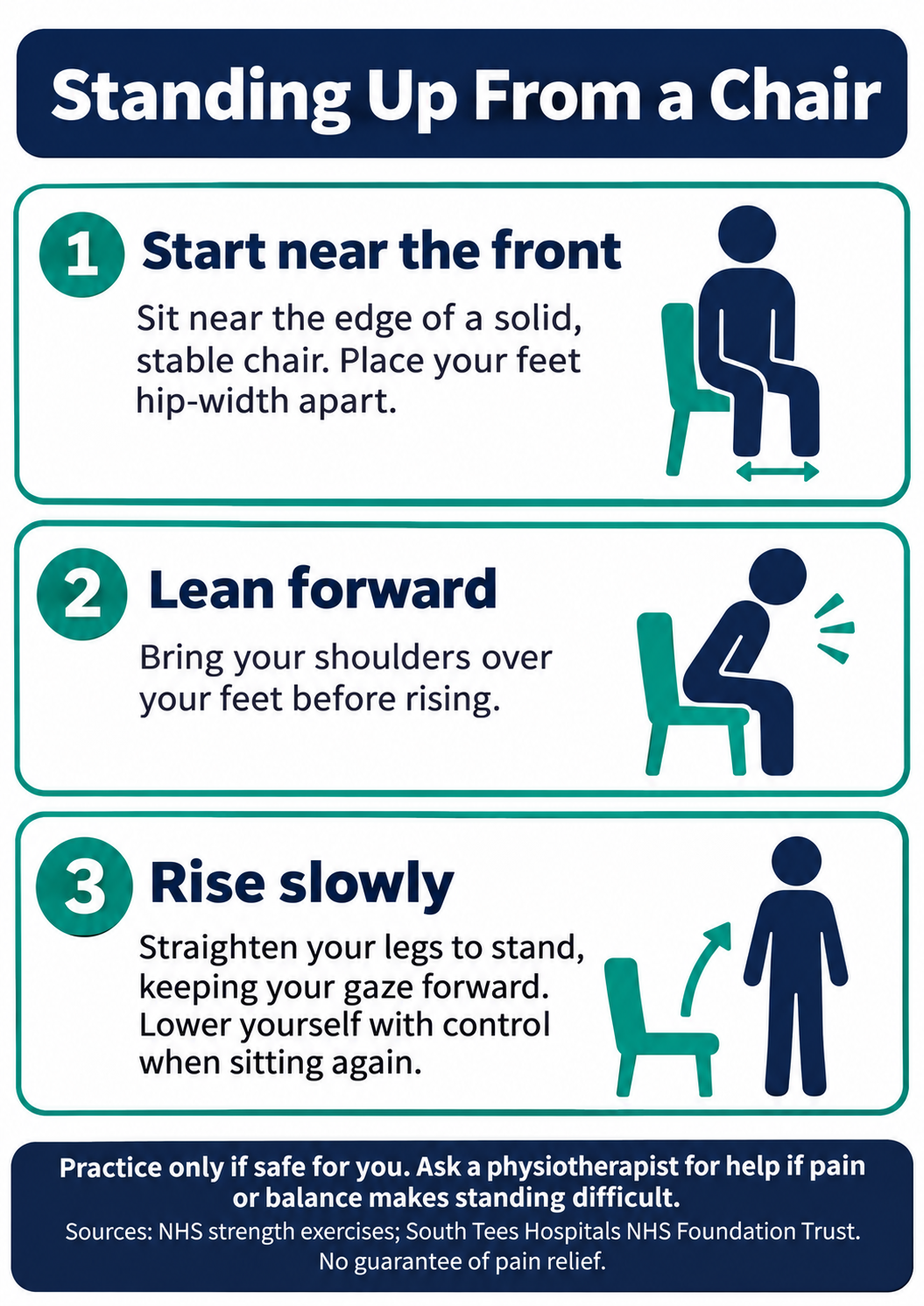
Practice this sequence slowly on a standard-height chair first, then progress to lower seats. The goal is to make the movement feel like a hip hinge with a controlled knee bend, not a knee-dominant push.
- Scoot to the front edge. Move your hips forward until your feet are directly under or slightly in front of your knees. This single change shortens the lever arm on your knee.
- Plant both feet flat and shoulder-width apart. Toes point forward or turn out slightly, whichever feels natural.
- Lean your chest forward over your toes. Think “nose over toes.” This shifts your center of mass forward so your knees do less of the work.
- Push through your whole foot, especially the heel and midfoot. Imagine pressing the floor away rather than pulling yourself up.
- Drive up with your hips. Squeeze your glutes as you rise, keeping your knees tracking over your second toe.
- Stand tall and pause. Avoid locking your knees hard; a soft finish is fine.
If you feel a pinch at the front of the knee, you likely leaned back too early or your feet were too far forward. Reset and try again with more forward lean.
Chair Height, Depth, and Firmness: What Actually Helps
Chair choice matters more than most people realize. A seat that is too low or too soft forces a deeper knee bend and makes it harder to push off. As a general guide, a chair is a comfortable height when your hips are level with or slightly higher than your knees when seated, and your feet rest flat on the floor.
Seat depth and firmness also play a role. A deep seat pushes you back, so you have to scoot forward before you can stand. A soft cushion sinks you down, effectively lowering the chair. Firm, supportive seating with a seat depth that leaves a small gap behind your knees tends to be easiest.
- Too-low sofas: add a firm cushion or a seat riser to raise the height.
- Deep armchairs: use the armrests to push up, and scoot forward before rising.
- Soft garden chairs: place a firm board or cushion under you to stop sinking.
- Toilets and low benches: consider a raised toilet seat or grab bars, which are widely available and often recommended by occupational therapists.
If you are considering home modifications, your local health service or an occupational therapist can advise on equipment. In the United States, the Medicare durable medical equipment coverage page explains how certain mobility and bathroom safety devices may be covered when prescribed, though eligibility varies by individual circumstances.
Use Your Arms and Environment Strategically
Your arms are free power. Pushing off armrests or a sturdy table reduces the load on your knees during the rise. This is not cheating; it is smart biomechanics that many people with knee pain should use routinely.
- Place both hands on the armrests and push down as you lean forward.
- Use a walking stick or cane in the hand opposite your more painful knee for support.
- Position a firm chair next to a counter or table so you have something to push against.
- Avoid twisting your body as you rise; keep your knees and feet aligned.
Small environmental tweaks like these often make the biggest immediate difference for people who struggle with a low chair.
Building the Strength That Makes Standing Easier
Technique buys you comfort now; strength keeps it. The muscles that matter most for rising from a chair are the quadriceps, glutes, and hip extensors. A physiotherapist can tailor a program, but the following exercises are commonly used and easy to progress at home.
- Sit-to-stand practice: start from a higher chair and gradually lower the seat as you get stronger. Aim for controlled repetitions without using your hands.
- Wall sits or mini squats: hold a shallow squat for 10–20 seconds to build quadriceps endurance.
- Glute bridges: lie on your back, knees bent, and lift your hips to strengthen hip extensors.
- Step-ups: use a low step and step up slowly, leading with the stronger leg, to train the same push pattern.
- Heel raises and calf strengthening: these support ankle push-off during standing.
Progress gradually and expect some muscle soreness, but sharp joint pain during exercise is a signal to ease off and seek advice. For evidence-based exercise guidance on knee osteoarthritis, the Versus Arthritis knee osteoarthritis information page is a reliable, regularly updated resource.
Compare: Common Chair Situations and What to Do
| Situation | Why It Hurts | Practical Fix |
|---|---|---|
| Low sofa or armchair | Deep knee bend, soft cushion sinks you lower | Add firm cushion or riser; push off armrests; scoot forward |
| Standard dining chair | Usually fine, but poor technique can still cause pain | Lean chest forward, push through whole foot, use hips |
| Car seat | Low height and confined space limit forward lean | Swing legs out first, use door frame or seat edge for support |
| Toilet | Low seat and limited space to lean forward | Raised toilet seat and grab bars; lean forward with hands on thighs |
| Soft garden or beach chair | Unstable base and sinking surface | Place firm support underneath; avoid if pain is sharp |
When Knee Pain During Standing Needs Professional Assessment
Most knee pain when rising from a chair is mechanical and responds to the strategies above. Some symptoms, however, warrant a clinical review rather than self-management. A physiotherapist or physician can assess joint stability, swelling, and strength, and rule out other causes.
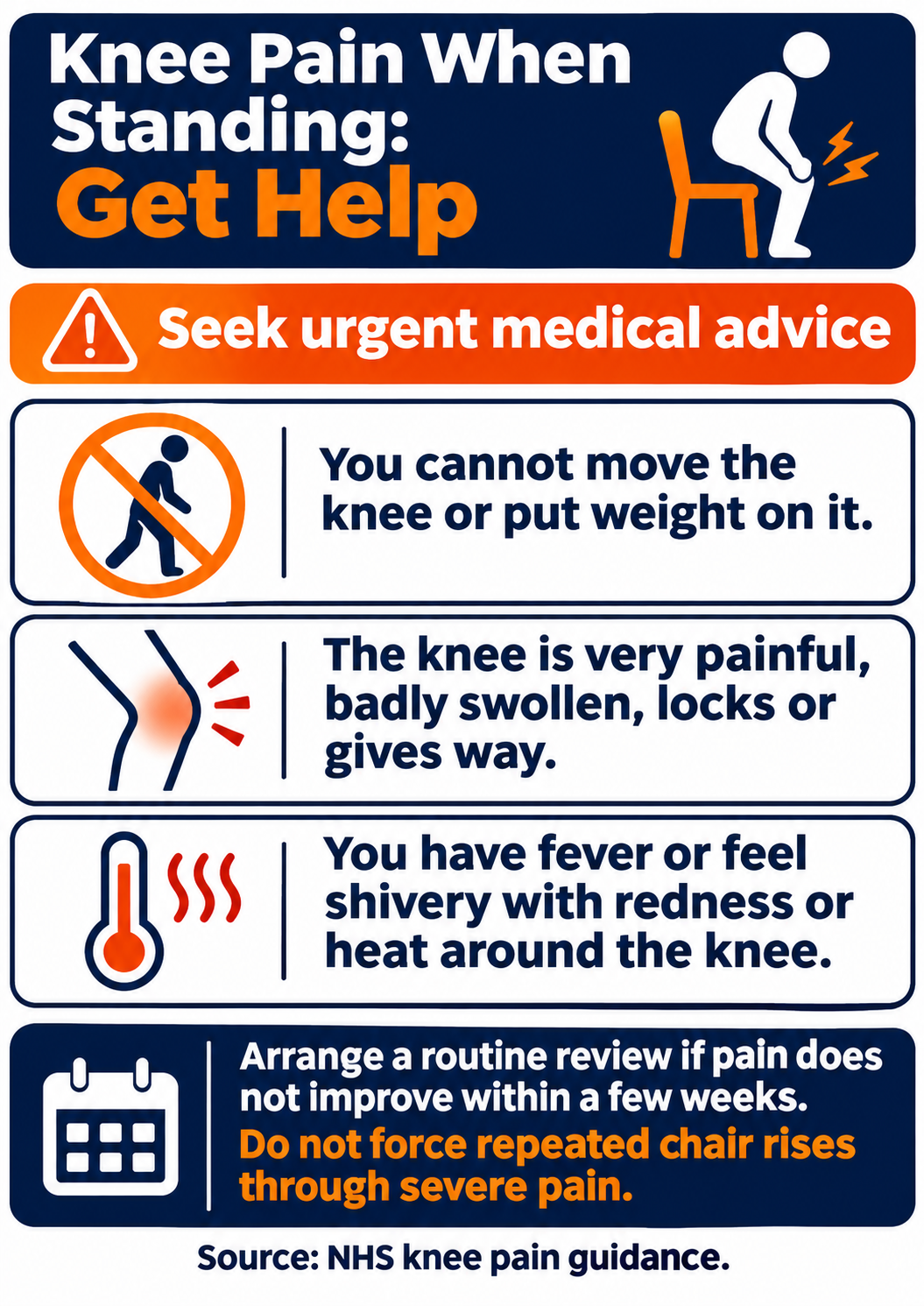
Seek assessment if you notice any of the following:
- Sudden locking, giving way, or inability to bear weight.
- Significant swelling, warmth, or redness around the knee.
- Pain that persists at rest or wakes you at night.
- Fever alongside knee pain.
- Pain after a fall or injury that is not improving.
For general, trustworthy information on knee conditions and when to seek help, the American Academy of Orthopaedic Surgeons condition library is a useful starting point.
Footwear and Daily Habits That Reduce Knee Load
What you wear on your feet changes how you rise. Cushioned, supportive shoes with a firm sole give you a stable base, while slippers or bare feet on a soft rug can make push-off less efficient. Avoid very high heels or completely flat, unsupportive footwear when you know you will be getting up from low seats.
- Wear supportive shoes with a firm heel counter when possible.
- Keep frequently used chairs at a comfortable height and within easy reach.
- Arrange furniture so you can push off a nearby surface.
- Rise slowly and deliberately rather than rushing.
- Stay generally active; regular walking and strength work support knee function over time.
A Quick Daily Practice Plan
Consistency matters more than intensity. A short daily routine can improve both confidence and comfort when standing from a low chair.
- Practice 8–10 slow sit-to-stands from a comfortable chair once or twice daily.
- Add 2–3 sets of glute bridges and mini squats on alternate days.
- Use a mirror or phone video to check your forward lean and knee alignment.
- Progress to lower seats only when the current height feels easy and pain-free.
Conclusion
Getting out of a low chair without knee pain is mostly about load management and movement strategy. Scoot forward, lean your chest over your toes, push through your whole foot, and let your hips and arms help. Choose firmer, higher seating where possible, and build quadriceps and glute strength over time. If pain is sharp, persistent, or accompanied by swelling or instability, get it assessed by a qualified clinician rather than pushing through.
Frequently Asked Questions
Is it normal for my knees to hurt when standing up from a low chair?
It is common, especially with knee osteoarthritis or patellofemoral pain, but it is not something you simply have to accept. A low chair increases the knee bend and the force through the joint, so discomfort is a mechanical signal. Technique changes, chair adjustments, and strengthening usually reduce it.
Should I avoid low chairs completely if my knees hurt?
Not necessarily. Avoiding all low seating can reduce your confidence and function over time. Use higher, firmer chairs while you build strength and refine technique, then gradually reintroduce lower seats as tolerated. If a particular chair consistently causes sharp pain, it is reasonable to modify it or avoid it for now.
Does leaning forward when standing put strain on my back?
A controlled forward lean from the hips is normal and helps shift load off the knees. The key is to hinge at the hips rather than rounding your lower back. If you have back pain, a physiotherapist can help you find a lean that works for both your knees and your spine.
Can knee pain when standing be a sign of something serious?
Most cases are mechanical and not dangerous. However, sudden locking, giving way, significant swelling, fever, or pain that wakes you at night should be assessed promptly. These features can indicate injury or inflammation that needs clinical review.
How long does it take to strengthen the muscles needed to stand easily?
Many people notice improved confidence and comfort within a few weeks of consistent practice. Meaningful strength gains typically take several weeks to a few months, depending on your starting point and consistency. Progress gradually and avoid pushing into sharp pain.
Are chair risers or raised toilet seats worth using?
For many people with knee pain, yes. Raising the seat reduces the knee bend required to stand and lowers the effort needed. They are simple, widely available aids. An occupational therapist can advise on the right equipment and whether funding support may apply in your area.
Does weight affect knee pain when standing from a low chair?
Body weight influences the load through the knee during standing, so weight management can be part of a broader plan for some people. It is not the only factor, and technique, strength, and chair choice matter greatly. Discuss any weight-related goals with a healthcare professional rather than relying on general advice.
Should I use a cane to help me stand up?
A cane can provide useful support, particularly in the hand opposite your more painful knee. Hold it firmly and push down as you rise. A physiotherapist can check your cane height and technique so it actually helps rather than hinders you.
Can knee pain when standing be prevented with exercise alone?
Exercise is a cornerstone of knee pain management, but technique and environment matter too. Strengthening your quadriceps and glutes helps, yet if you keep using a very low, soft chair with poor form, pain may persist. Combine strength work with practical adjustments for the best results.
When should I see a physiotherapist about knee pain?
Consider booking an assessment if pain limits your daily activities, has lasted more than a few weeks, or is not improving with self-management. A physiotherapist can assess your movement, prescribe targeted exercises, and advise on aids and modifications. Early guidance often prevents small problems from becoming persistent ones.