Walking poles genuinely reduce the load on your joints, particularly your knees and hips, by transferring part of your body weight and forward momentum through your arms and into the ground. For people managing knee osteoarthritis or recovering from hip surgery, poles can turn a painful short walk into a manageable daily habit. This article explains how that weight shift works, how much relief you can realistically expect, and how to set up and use poles correctly so your joints actually benefit.
How Walking Poles Take Weight Off Your Joints
When you walk, each step sends a force through your leg that can exceed your body weight. Poles give you two extra contact points, so some of that force travels down the pole instead of through your knee, hip, or ankle.
The mechanism is straightforward. As you plant the pole and push, your arm and shoulder muscles absorb and redirect load that would otherwise land on the lower limb. In clinical terms, you are sharing the work between upper and lower body.
- Ground reaction force: the impact force from each foot strike is partly redirected through the pole.
- Muscle work: your triceps, shoulders, and trunk take on propulsive effort normally handled by the legs.
- Balance support: a wider base of support reduces the small corrective muscle contractions around the knee and hip.
- Posture: poles encourage a more upright stance, which reduces compressive loading on the spine.
This is why poles are used in rehabilitation for knee osteoarthritis, total knee or hip replacement recovery, and chronic low back pain. The principle is load sharing, not magic.
What the Research and Clinical Experience Show
Studies on walking poles in knee osteoarthritis consistently report reduced knee pain and improved walking distance compared with unaided walking, though the size of the effect varies between people. This is best treated as a reliable trend rather than a guaranteed outcome.
In clinical practice, the patients who benefit most tend to be those with painful knees, uneven gait, or fear of falling. Patients with severe shoulder or wrist problems often find poles uncomfortable and need a different strategy.
Poles do not replace strengthening. They buy you the walking tolerance to do the strengthening that actually changes your joint health.
How Much Weight Do Poles Actually Take Off?
The exact percentage depends on how hard you push through the poles, your technique, and the terrain. Some biomechanical studies report meaningful reductions in load through the lower limbs during pole-assisted walking, but the figure is not a fixed number you can apply to everyone.
What matters practically is this: if you plant and push deliberately, you will feel the difference in your knees and hips within a single walk. If you carry the poles loosely, you get balance support but little offloading.
- Light planting gives balance and confidence more than load relief.
- Firm planting with a push gives noticeable joint offloading.
- Downhill walking with poles is where many people report the biggest relief, because braking force is shared with the arms.
Who Benefits Most From Walking Poles
Poles are not just for hikers. In a physiotherapy context, they are a practical tool for people who want to stay active despite joint symptoms.
- People with knee or hip osteoarthritis who find flat walking painful.
- Patients recovering from knee or hip replacement once cleared for walking progression.
- People with balance concerns or a history of falls.
- Walkers who struggle on hills, stairs, or uneven ground.
- Older adults who want to maintain walking distance and confidence.
If you have a cardiac condition, significant shoulder or wrist arthritis, or recent upper limb surgery, check with your clinician before starting. The American Physical Therapy Association maintains resources on finding a physiotherapist who can assess your individual needs.
When Walking Poles Are Not the Right Choice
Poles are a tool, not a universal solution. There are situations where they add risk or simply do not help.
- Severe shoulder, elbow, or wrist pain that worsens with pushing.
- Poor grip strength or hand arthritis that makes holding the handle unsafe.
- Significant cognitive impairment affecting safe pole placement.
- Indoor or crowded environments where poles become a trip hazard.
In these cases, a single cane, a rollator, or a targeted strengthening programme may serve you better. A physiotherapy assessment sorts this out quickly.
Choosing the Right Poles
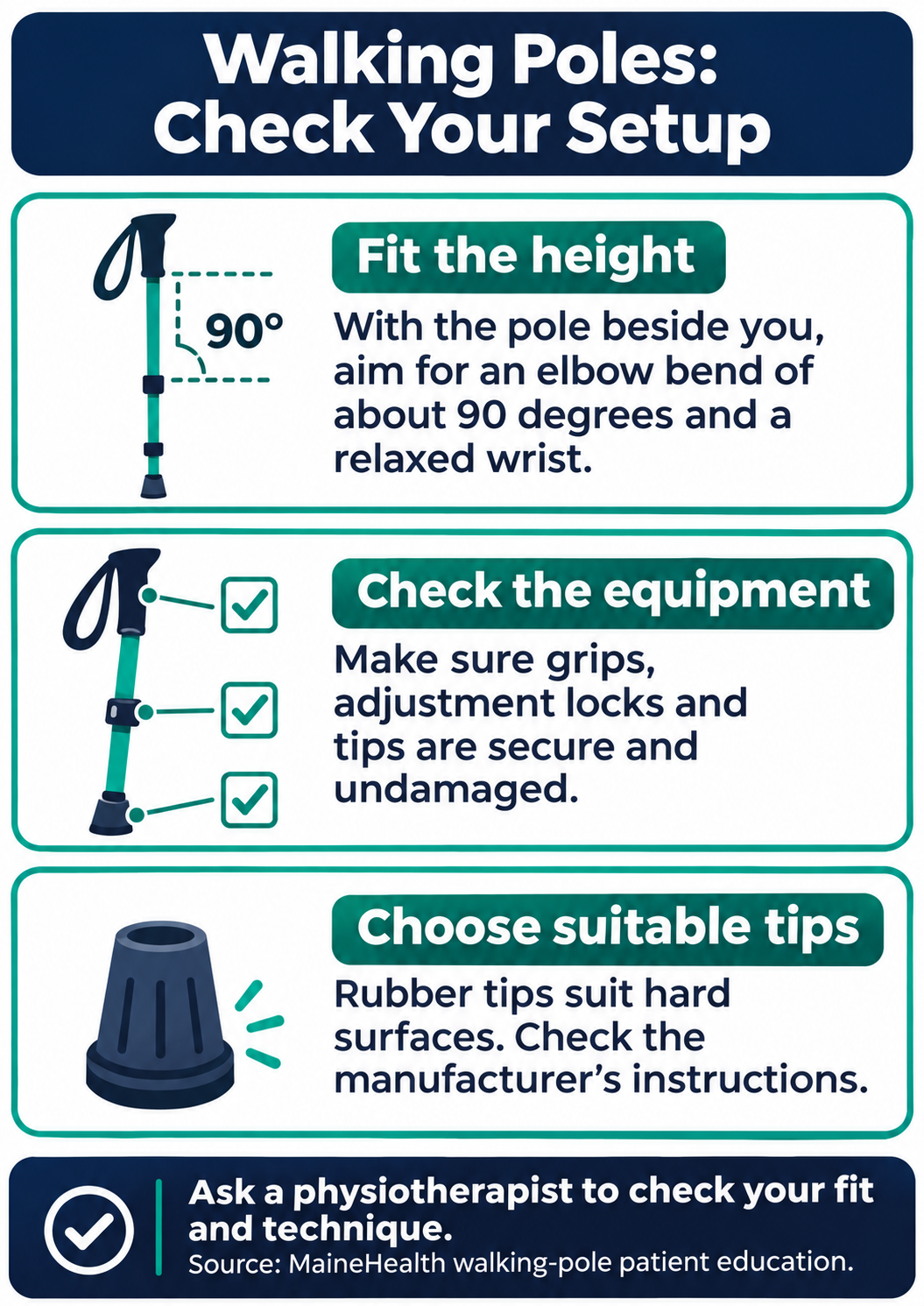
Most walking poles are adjustable aluminium or carbon models with a wrist strap and a rubber or carbide tip. For joint offloading on pavement, rubber tips are the practical choice.
- Adjustable length: essential for correct fit and for adjusting on hills.
- Wrist strap: transfers push force efficiently and reduces grip fatigue.
- Rubber tips: better grip and less jarring on hard surfaces.
- Weight: lighter poles reduce arm fatigue on longer walks.
- Handle shape: choose one that fits your hand comfortably, especially with arthritis.
If you are buying online, check the manufacturer’s sizing guide. A common mistake is buying poles that are too short, which forces a hunched posture and reduces offloading.
How to Set the Correct Pole Height
Stand upright with the pole tip on the ground beside your foot. Your elbow should be bent to roughly 90 degrees when you hold the handle. That is your starting height.
On uphill sections, shorten the poles slightly. On descents, lengthen them so you can plant ahead and control the braking force.
- Check height on flat ground first.
- Re-check after adjusting for hills.
- Keep the wrist strap snug but not tight.
- Test by walking 50 metres and noticing whether your shoulders feel relaxed.
Walking Pole Technique That Actually Offloads Your Joints
Technique is where most people lose the benefit. The pole should plant as the opposite foot lands, creating a natural counter-swing. If you plant the pole on the same side as the forward foot, you get poor offloading and an awkward gait.
- Plant the pole as the opposite heel strikes.
- Push through the handle rather than gripping hard.
- Keep your shoulders down and your trunk upright.
- Let the wrist strap take the push, not your fingers.
- Start on flat, even ground before trying hills.
Practise for five minutes in a corridor or garden before heading out. A physiotherapist can correct your technique in a single session, which is often more useful than watching videos.
Common Mistakes That Reduce the Benefit
The same errors appear repeatedly in clinic. Fixing them usually restores the joint relief people were expecting.
- Poles set too short, causing a stooped posture.
- Planting the pole on the same side as the forward foot.
- Gripping the handle tightly instead of using the strap.
- Dragging the poles rather than pushing through them.
- Using poles only on flat ground and abandoning them on hills, where they help most.
Walking Poles Compared With Other Walking Aids
Choosing between poles, a cane, and a rollator depends on your goals and your joints. The table below summarises the practical differences.
| Aid | Main Purpose | Joint Offloading | Best For |
|---|---|---|---|
| Single cane | Balance and modest offloading | Limited, one side | Mild hip or knee pain, short distances |
| Walking poles (pair) | Balance, posture, and load sharing | Moderate, both sides | Osteoarthritis, longer walks, hills |
| Rollator | Stability with seated rest | Significant, via frame and seat | Poor balance, fatigue, longer outings |
| Crutches | Partial weight-bearing after injury or surgery | High, prescribed | Post-operative or fracture recovery |
If you are unsure which aid suits you, a physiotherapy assessment is the most reliable way to decide. The NHS physiotherapy information page explains how to access physiotherapy services in the UK.
Getting Started Safely
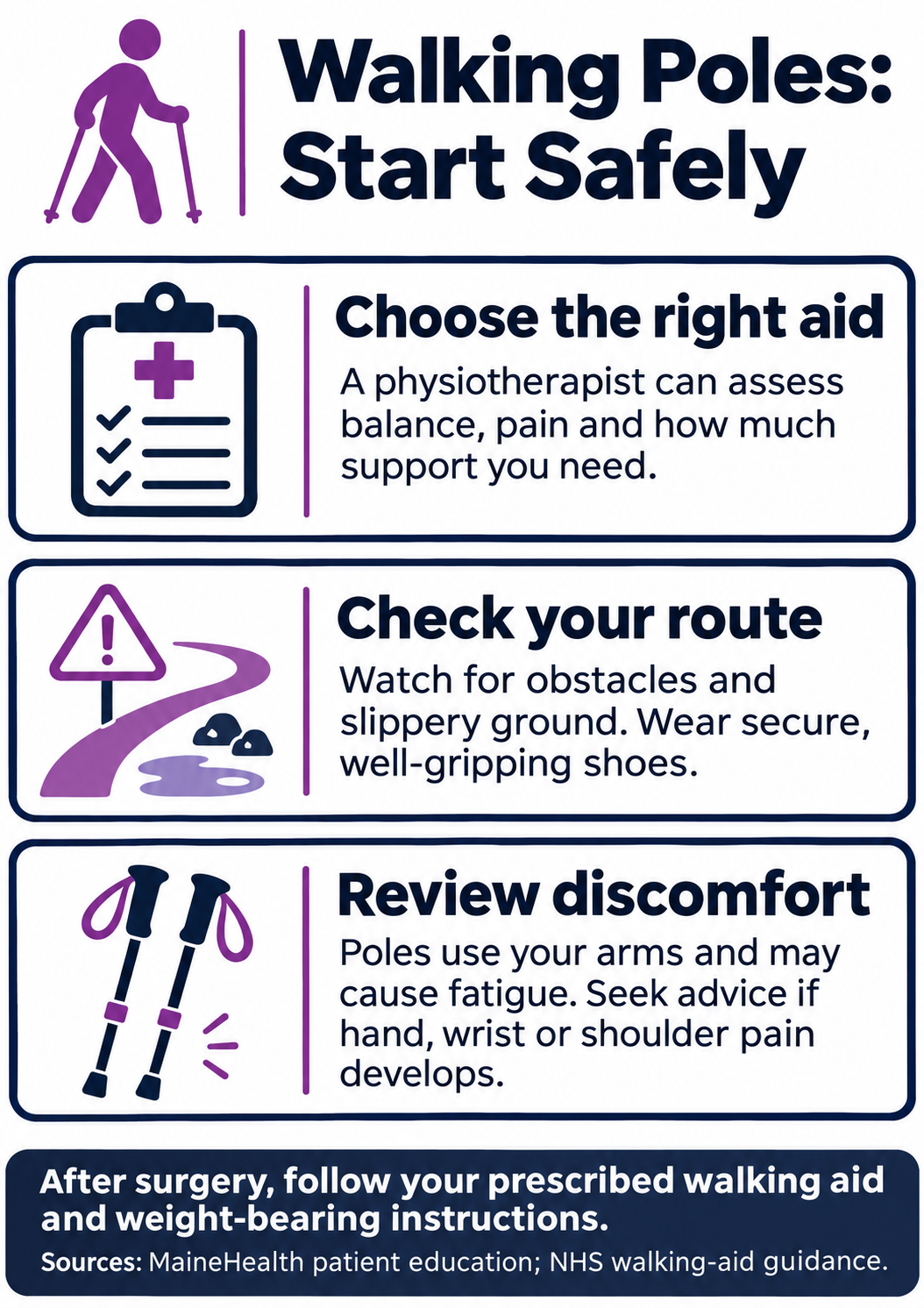
Start with short walks on flat, familiar ground. Build up gradually rather than attempting a long hike on day one. Your upper body needs time to adapt to the extra work.
- Begin with 10 to 15 minutes on flat pavement.
- Increase duration by a few minutes each week.
- Add gentle slopes once flat walking feels comfortable.
- Stop if shoulder or wrist pain develops and reassess technique.
If you have a diagnosed joint condition, ask your physiotherapist to review your pole setup before you increase distance. Small adjustments to height and technique often make a noticeable difference to comfort.
Conclusion
Walking poles take weight off your joints by sharing load between your arms and legs, improving balance, and encouraging better posture. The benefit is real but technique-dependent: correct height, opposite-foot planting, and a deliberate push make the difference. Used well, poles can help you walk further with less pain while you build the strength that protects your joints long term.
Frequently Asked Questions
Do walking poles really reduce knee pain?
Many people with knee osteoarthritis report less pain and longer walking distance when using poles, and biomechanical studies support reduced load through the lower limbs. The effect varies between individuals and depends heavily on technique and correct pole height.
How much weight do walking poles take off my joints?
There is no single reliable percentage that applies to everyone. The amount of offloading depends on how firmly you plant and push, your technique, and the terrain. You will typically feel the difference in your knees and hips within a single walk when using correct technique.
Should I use one pole or two?
Two poles give more balanced offloading and better posture than a single pole. A single pole is sometimes used for mild balance support, but for joint offloading, a matched pair works better.
Can walking poles help after knee replacement surgery?
Poles can be useful during the walking progression phase once your surgeon or physiotherapist clears you for it. They provide balance and load sharing, but they do not replace the prescribed rehabilitation exercises. Always follow your surgical team’s guidance.
How do I know if my poles are the right height?
With the pole tip on the ground beside your foot, your elbow should be bent to about 90 degrees when holding the handle. Adjust shorter for uphill and longer for downhill sections.
Are walking poles better than a cane?
They serve different purposes. A cane offers balance and modest support on one side, while a pair of poles provides bilateral offloading, better posture, and more support on longer walks or hills. The right choice depends on your condition and goals.
Can walking poles make my shoulder pain worse?
They can if you grip too tightly, use poles that are the wrong height, or have significant shoulder arthritis. If shoulder pain develops, stop and have your technique and pole setup reviewed by a physiotherapist.
Do I need special shoes to use walking poles?
No special footwear is required, but supportive, well-fitting walking shoes improve comfort and reduce jarring. Avoid loose slippers or worn-out soles, especially on uneven ground.
Can walking poles help with balance and fear of falling?
Yes. Two extra contact points widen your base of support and can increase confidence, particularly on uneven ground. If you have significant balance problems, a physiotherapy assessment is still advisable before relying on poles.
Where can I get help learning to use walking poles correctly?
A physiotherapist can assess your gait, set your pole height, and correct your technique in a single session. Professional bodies such as the American Physical Therapy Association and the Chartered Society of Physiotherapy provide directories to help you find a qualified clinician.