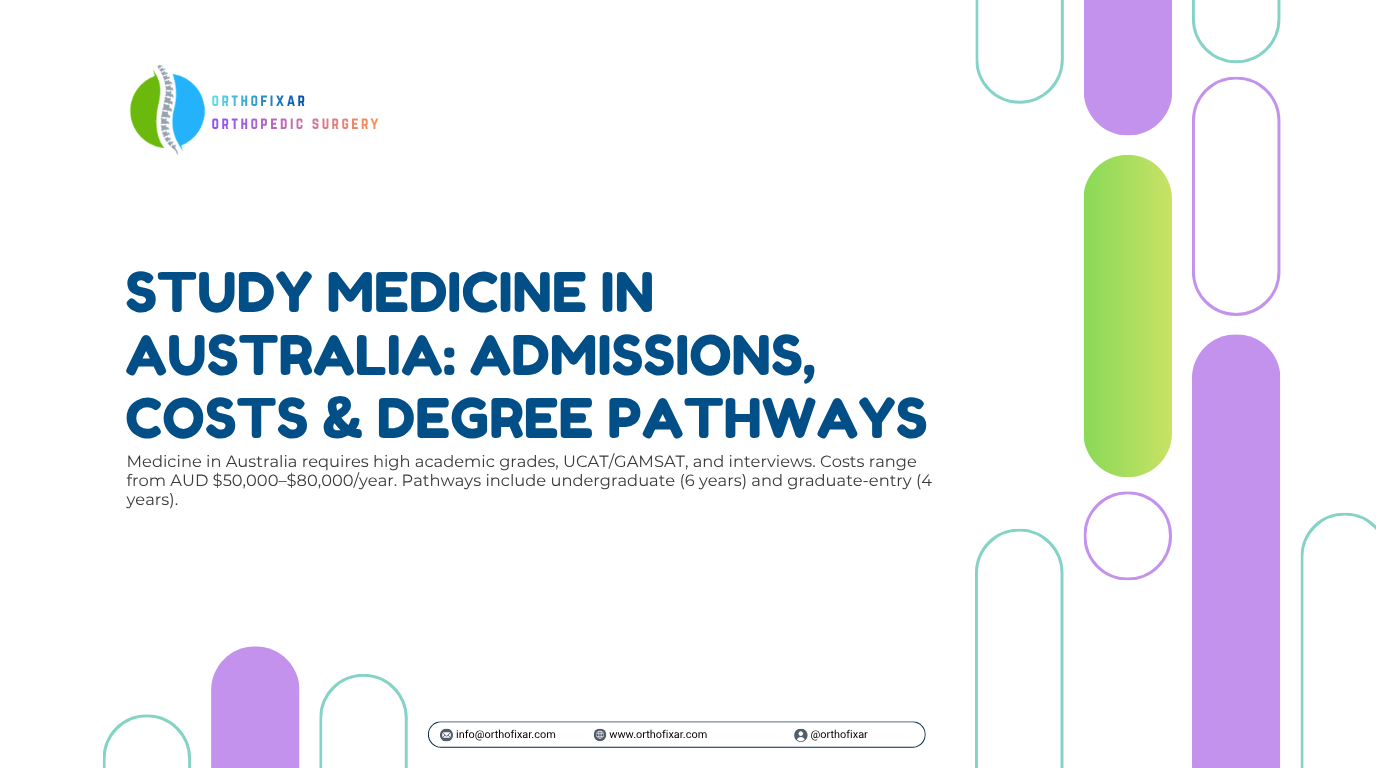
Studying medicine in Australia is one of the most popular routes for international and domestic students who want an internationally recognised degree, early clinical exposure, and a clear path to registration. This guide walks you through the main degree pathways, admission tests and requirements, realistic costs, financial support options, and what happens after graduation. If you want to study medicine in Australia, the key is understanding which entry route fits your background before you start applying.
Why Australia Is a Popular Destination for Medical Studies
Australian medical schools are known for combining strong academic teaching with hands-on clinical training in real hospitals and community clinics. Degrees are taught in English and are widely recognised internationally.
- Medical schools with strong global rankings and active research programs.
- Clinical placements that begin relatively early in the degree.
- English-speaking environment with a multicultural student community.
- A structured internship year that leads toward medical registration.
- Opportunities to gain experience in rural, remote, and metropolitan health settings.
- Clear accreditation standards that make qualifications easier to recognise abroad.
Another practical advantage is that the training model is closely tied to the public health system, so students often rotate through large teaching hospitals, smaller regional facilities, and community practices.
The Main Degree Pathways for Medicine in Australia
There is no single route into medicine. Most students enter through one of two main structures, and the right choice depends on whether you are leaving high school or already hold a university degree.
Undergraduate and Graduate Entry Explained
Undergraduate entry programs accept students directly from high school, usually after strong final-year results and an admissions test. These degrees typically run for five to six years and combine foundational science with clinical training.
Graduate entry programs require a completed bachelor degree in any discipline, provided you meet the prerequisite subjects. These degrees usually run for four years and are popular with students who discovered medicine later or want to change careers.
- Undergraduate entry: best for school leavers with excellent academic results.
- Graduate entry: best for applicants who already hold a degree.
- Provisional or pathway programs: designed for specific groups, such as rural or Indigenous applicants.
- Some universities offer bonded places, where graduates commit to working in areas of need for a set period.
Choosing the right pathway early saves time, money, and stress. Check prerequisites before you commit to a degree.
Admission Requirements and Admission Tests
Admission is competitive, and most schools look at more than just your grades. They want evidence that you can handle a demanding science-heavy curriculum and communicate well with patients.
Academic Results, Tests and Interviews
Academic performance is the foundation. For school leavers, this usually means a strong final secondary result or an equivalent qualification. For graduate applicants, a competitive grade point average in a bachelor degree is normally required, along with specific prerequisite subjects such as chemistry, biology, or mathematics.
Most applicants also sit an admissions test. The UCAT is commonly used for undergraduate entry, while the GAMSAT is used for many graduate entry programs. Some schools accept the ISAT for international applicants. Each test measures different skills, so preparation should start well before the deadline.
- Strong secondary or university academic record.
- Prerequisite subjects in science and mathematics, depending on the school.
- A competitive score in the UCAT, GAMSAT, or ISAT.
- A structured interview, often using multiple mini-interview formats.
- English language proficiency, such as IELTS or an equivalent test, for international applicants.
- A personal statement or portfolio at some institutions.
Interviews matter more than many applicants expect. Schools assess communication, empathy, ethical reasoning, and teamwork, because these skills directly affect how you work with patients later.
High marks alone rarely secure a place. Medical schools are looking for people who can listen, reason, and stay calm under pressure.
What It Costs to Study Medicine in Australia
Cost is one of the biggest factors in planning. Tuition depends on whether you are a domestic or international student, and whether you hold a Commonwealth Supported Place.
Domestic students with a supported place pay a much lower student contribution, while international students pay full fees. Living costs also vary significantly between cities and regional areas.
| Study Route | Typical Length | Indicative Annual Tuition | Who It Suits |
|---|---|---|---|
| Undergraduate direct entry | 5 to 6 years | Approx. AUD 60,000 to 90,000 for international students | School leavers with strong results |
| Graduate entry Doctor of Medicine | 4 years | Approx. AUD 70,000 to 100,000 for international students | Bachelor degree holders |
| Commonwealth Supported Place | Varies by degree | Substantially lower student contribution | Eligible domestic students |
| Bonded or pathway places | Varies | Varies by provider and scheme | Rural, remote, or specific cohorts |
- Tuition is only part of the budget.
- Accommodation, food, transport, and insurance add up quickly.
- Clinical placements in rural or remote areas may involve extra travel or relocation costs.
- Textbooks, equipment, and registration fees should be included in your plan.
- Currency exchange rates affect international students significantly.
A realistic budget should cover the full length of the degree, not just the first year, because medical programs rarely allow heavy part-time work.
Scholarships, Loans and Financial Planning
Funding options exist, but they are competitive. Planning early gives you a much better chance of reducing the financial burden.
- University merit scholarships for high-achieving applicants.
- International student scholarships offered by individual universities.
- Government-supported loan schemes for eligible domestic students.
- Rural and regional health workforce scholarships.
- Research or teaching assistantships in later years.
- Employer sponsorship in some cases, particularly for allied health staff moving into medicine.
It also helps to speak with a financial adviser who understands student loans and long-term budgeting. Medicine is a long commitment, and steady planning beats last-minute scrambling.
Life as a Medical Student in Australia
Medical study is intense, but it is also varied. Most weeks combine lectures, small-group tutorials, laboratory sessions, and clinical skills practice.
- Early years focus on basic sciences, anatomy, and communication skills.
- Later years shift toward hospital and community placements.
- Assessment includes written exams, clinical examinations, and workplace-based evaluation.
- Students often join peer study groups and mentoring programs.
- Balance matters, because burnout is a real risk in medicine.
Many students find that the social side of medical school, including student societies and rural health clubs, makes the workload easier to manage. Support services for wellbeing and academic skills are usually available on campus.
Internship, Registration and Career After Graduation
After finishing the degree, graduates typically complete an internship year in an accredited hospital. This supervised year is a requirement before gaining general registration.
- Internship involves rotations through specialties such as emergency, surgery, and general medicine.
- Provisional registration is granted during the intern year.
- General registration follows successful completion of the internship.
- Specialist training is a separate, competitive process after registration.
- International graduates should check visa and registration requirements well in advance.
Career options are broad, covering general practice, surgery, emergency medicine, psychiatry, paediatrics, and many other specialties. Choosing a direction usually happens during and after the intern year.
To study medicine in Australia successfully, you need to match your background to the right pathway, prepare thoroughly for admissions tests and interviews, and budget for the full length of the program. The process is demanding, but it is well structured, and the training opens doors both in Australia and internationally.
Frequently Asked Questions
How long does it take to study medicine in Australia?
Undergraduate entry programs usually take five to six years, while graduate entry programs generally take four years. After graduation, most doctors complete at least one supervised internship year before gaining general registration.
Can international students study medicine in Australia?
Yes. Many Australian medical schools accept international students, though places are limited and fees are higher. International applicants usually need strong academic results, an admissions test score, an interview, and proof of English proficiency.
What is the UCAT and do I need it?
The UCAT is an admissions test used by many undergraduate medical programs. It assesses reasoning, decision-making, and situational judgement rather than academic knowledge. Whether you need it depends on the specific universities you apply to.
What is the GAMSAT?
The GAMSAT is used mainly for graduate entry medicine. It tests reasoning in humanities, social sciences, and biological and physical sciences. Most applicants prepare for several months before sitting it.
How much does it cost to study medicine in Australia?
International students typically pay full tuition fees, which can range from roughly AUD 60,000 to 100,000 per year depending on the university and program. Domestic students with a Commonwealth Supported Place pay a much lower student contribution.
Can I work while studying medicine in Australia?
Many students work part-time, but medical degrees are demanding and clinical placements can be unpredictable. It is wise to keep work hours modest and prioritise study, especially in the later clinical years.
Can I stay in Australia after graduating from medicine?
Graduates may be eligible for post-study work visas and can apply for internships, but rules change over time. Always check current immigration and registration requirements before relying on any long-term plan.
What subjects should I study in high school to get into medicine?
Chemistry is almost always required or strongly recommended. Biology, mathematics, and physics are also useful. Check each university’s prerequisites, because requirements differ between schools.
Is an interview required for medical school in Australia?
Most medical schools use interviews as part of the selection process. Many use multiple mini-interviews, which assess communication, ethics, empathy, and teamwork rather than academic knowledge.
What is the difference between provisional and general registration?
Provisional registration applies during the supervised internship year. General registration is granted after the internship is completed successfully, allowing doctors to practise without that level of supervision.