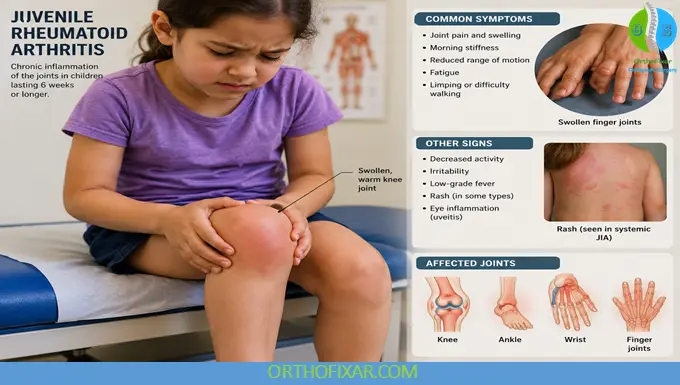
Juvenile rheumatoid arthritis (JRA), now more commonly known as juvenile idiopathic arthritis (JIA), is the most common chronic rheumatic disease affecting children. It is characterized by persistent joint inflammation that begins before the age of 16 years and lasts for at least six weeks. The condition can affect physical function, growth, and quality of life if not diagnosed and treated promptly.
Although the term juvenile idiopathic arthritis has largely replaced juvenile rheumatoid arthritis in modern medical literature, many patients and healthcare professionals still use the traditional term. Understanding juvenile rheumatoid arthritis symptoms, diagnostic approaches, treatment options, and long-term outcomes is essential for both medical professionals and families caring for affected children.
What is Juvenile Rheumatoid Arthritis?
Juvenile rheumatoid arthritis is an autoimmune inflammatory disorder in which the immune system mistakenly attacks healthy tissues, particularly the synovial lining of joints. This leads to chronic inflammation, pain, swelling, stiffness, and potential joint damage.
Unlike adult rheumatoid arthritis, juvenile rheumatoid arthritis encompasses several distinct subtypes with varying clinical presentations and prognoses.
The exact cause remains unknown, but genetic susceptibility combined with environmental triggers is believed to contribute to disease development.
Epidemiology
Juvenile rheumatoid arthritis affects approximately 1–4 per 1,000 children worldwide. It can occur at any age during childhood but most commonly develops between 1 and 3 years or between 8 and 12 years of age.
Girls are affected more frequently than boys, particularly in oligoarticular and polyarticular forms.
Classification of Juvenile Rheumatoid Arthritis
Oligoarticular Juvenile Rheumatoid Arthritis
This subtype affects four or fewer joints during the first six months of disease.
Commonly involved joints include:
- Knees
- Ankles
- Elbows
Characteristics include:
- Asymmetric joint involvement
- Increased risk of chronic uveitis
- Generally favorable prognosis
Polyarticular Juvenile Rheumatoid Arthritis
This form affects five or more joints during the first six months.
Features include:
- Symmetrical joint involvement
- Small joints of hands and feet commonly affected
- May resemble adult rheumatoid arthritis
- Higher risk of persistent disability
Systemic Juvenile Rheumatoid Arthritis
Systemic disease affects both joints and internal organs.
Clinical manifestations include:
- Daily spiking fever
- Arthritis
- Enlarged lymph nodes
- Hepatosplenomegaly
- Serositis
- Systemic inflammation
This subtype is now considered an autoinflammatory disorder rather than a classic autoimmune disease.
Psoriatic Juvenile Arthritis
Associated with:
- Psoriasis
- Nail pitting
- Dactylitis
Enthesitis-Related Arthritis
Characterized by inflammation at tendon and ligament insertion sites.
Commonly affects:
- Hips
- Knees
- Sacroiliac joints
Causes and Risk Factors
The precise etiology remains unclear.
Potential contributing factors include:
Genetic Factors
Several genetic markers increase susceptibility, including:
- HLA-DRB1
- HLA-B27
- HLA-A2
Immune Dysregulation
Abnormal activation of:
- T lymphocytes
- B lymphocytes
- Cytokines such as TNF-α, IL-1, and IL-6
Environmental Triggers
Possible triggers include:
- Viral infections
- Bacterial infections
- Environmental exposures
No single environmental factor has been definitively proven to cause juvenile rheumatoid arthritis.
Juvenile Rheumatoid Arthritis Symptoms
The presentation varies depending on disease subtype.
Common Juvenile Rheumatoid Arthritis Symptoms
- Joint pain
- Joint swelling
- Morning stiffness
- Limping
- Reduced range of motion
- Fatigue
- Decreased physical activity
Children may not complain directly of pain but may avoid activities or demonstrate altered gait patterns.
Musculoskeletal Findings
Physical examination may reveal:
- Warm joints
- Synovial thickening
- Joint effusion
- Muscle wasting
- Flexion contractures
Systemic Symptoms
Particularly in systemic disease:
- Fever
- Weight loss
- Malaise
- Growth delay
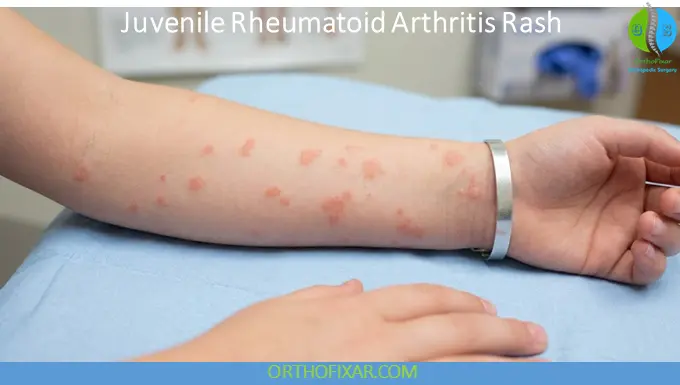
Juvenile Rheumatoid Arthritis Rash
A characteristic juvenile rheumatoid arthritis rash is commonly seen in systemic juvenile arthritis.
Characteristics of the Rash
- Salmon-pink color
- Flat or slightly raised lesions
- Transient appearance
- Often accompanies fever spikes
- Usually located on:
- Trunk
- Upper arms
- Thighs
The rash may disappear completely between fever episodes, making diagnosis challenging.
Eye Complications
One of the most important extra-articular manifestations is chronic anterior uveitis.
Symptoms may include:
- Eye pain
- Redness
- Photophobia
- Blurred vision
However, many children remain asymptomatic.
Regular ophthalmologic screening is therefore essential.
Potential complications include:
- Cataracts
- Glaucoma
- Vision loss
Diagnosis of Juvenile Rheumatoid Arthritis
There is no single diagnostic test.
Diagnosis relies on:
- Clinical assessment
- Laboratory studies
- Imaging findings
- Exclusion of other conditions
Diagnostic Criteria
Key requirements include:
- Onset before age 16
- Arthritis lasting at least six weeks
- No alternative explanation
Laboratory Evaluation
Common investigations include:
Inflammatory Markers
- Erythrocyte sedimentation rate (ESR)
- C-reactive protein (CRP)
Autoantibodies
- Rheumatoid factor (RF)
- Antinuclear antibody (ANA)
- Anti-cyclic citrullinated peptide (Anti-CCP)
Complete Blood Count
May reveal:
- Anemia
- Leukocytosis
- Thrombocytosis
Imaging Studies
Plain Radiographs
Useful for detecting:
- Joint space narrowing
- Growth abnormalities
- Bone erosions
Ultrasound
Can identify:
- Synovitis
- Joint effusion
- Early inflammatory changes
Magnetic Resonance Imaging (MRI)
MRI is highly sensitive for:
- Synovial inflammation
- Cartilage damage
- Bone marrow edema
Differential Diagnosis
Conditions that may mimic juvenile rheumatoid arthritis include:
- Septic arthritis
- Reactive arthritis
- Systemic lupus erythematosus
- Lyme disease
- Leukemia
- Inflammatory bowel disease-associated arthritis
- Vasculitis
Juvenile Rheumatoid Arthritis Treatment
The primary goals of juvenile rheumatoid arthritis treatment are:
- Control inflammation
- Relieve pain
- Prevent joint damage
- Maintain function
- Preserve growth and development
Nonsteroidal Anti-Inflammatory Drugs (NSAIDs)
Common medications include:
- Naproxen
- Ibuprofen
- Meloxicam
NSAIDs help reduce pain and stiffness but rarely induce complete remission.
Corticosteroids
Used for:
- Severe disease flares
- Systemic manifestations
- Intra-articular injections
Long-term systemic use is minimized because of adverse effects on growth and bone health.
Disease-Modifying Antirheumatic Drugs (DMARDs)
Methotrexate
Methotrexate remains the cornerstone of therapy for many patients.
Benefits include:
- Reduction of inflammation
- Prevention of joint damage
- Improved long-term outcomes
Biologic Therapies
Biologic agents target specific inflammatory pathways.
Examples include:
TNF Inhibitors
- Etanercept
- Adalimumab
- Infliximab
IL-6 Inhibitors
- Tocilizumab
IL-1 Inhibitors
- Anakinra
- Canakinumab
Biologic therapies have dramatically improved disease control and functional outcomes.
Physical Therapy and Rehabilitation
Comprehensive management includes:
Exercise Programs
Benefits include:
- Improved flexibility
- Enhanced muscle strength
- Better joint mobility
Occupational Therapy
Helps children:
- Maintain independence
- Protect joints
- Improve daily function
Orthotic Devices
May be prescribed to:
- Correct alignment
- Reduce pain
- Prevent deformities
Lifestyle and Supportive Care
Families should be encouraged to:
- Promote regular physical activity
- Maintain healthy nutrition
- Support school participation
- Address psychosocial concerns
A multidisciplinary approach improves long-term outcomes.
Juvenile Rheumatoid Arthritis Prognosis
The juvenile rheumatoid arthritis prognosis varies according to subtype, disease severity, and response to treatment.
Favorable Prognostic Factors
- Early diagnosis
- Rapid treatment initiation
- Oligoarticular disease
- Good response to therapy
Poor Prognostic Factors
- RF-positive disease
- Polyarticular involvement
- Early erosive changes
- Persistent systemic inflammation
Long-Term Outcomes
Modern therapies have significantly improved outcomes.
Many children achieve:
- Clinical remission
- Normal growth
- Full participation in daily activities
However, some patients continue to experience active disease into adulthood and may require lifelong rheumatologic care.
Potential Complications
Untreated or poorly controlled disease can result in:
- Joint deformities
- Growth disturbances
- Limb-length discrepancies
- Osteoporosis
- Chronic pain
- Visual impairment from uveitis
Early intervention substantially reduces these risks.
Prevention
There is currently no known method for preventing juvenile rheumatoid arthritis.
Early recognition and prompt treatment remain the most effective strategies for minimizing complications and improving quality of life.
Key Points
- Juvenile rheumatoid arthritis is the most common chronic inflammatory arthritis in children.
- Persistent arthritis lasting more than six weeks before age 16 is the hallmark feature.
- Common juvenile rheumatoid arthritis symptoms include joint swelling, stiffness, pain, and reduced mobility.
- A salmon-colored juvenile rheumatoid arthritis rash is characteristic of systemic disease.
- Juvenile rheumatoid arthritis treatment includes NSAIDs, methotrexate, biologic agents, physical therapy, and regular monitoring.
- Juvenile rheumatoid arthritis prognosis has improved dramatically with modern therapies.
- Early diagnosis and multidisciplinary management are critical for preventing disability and preserving long-term function.
References
- Petty RE, Southwood TR, Manners P, et al. International League of Associations for Rheumatology classification of juvenile idiopathic arthritis. J Rheumatol. Link
- Ravelli A, Martini A. Juvenile idiopathic arthritis. Lancet. Link
- Onel, Karen B et al. “2021 American College of Rheumatology Guideline for the Treatment of Juvenile Idiopathic Arthritis: Therapeutic Approaches for Oligoarthritis, Temporomandibular Joint Arthritis, and Systemic Juvenile Idiopathic Arthritis.” Arthritis care & research vol. 74,4 (2022): 521-537. doi:10.1002/acr.24853. Link
- Thatayatikom A, Modica R, De Leucio A. Juvenile Idiopathic Arthritis. [Updated 2023 Jan 16]. In: StatPearls [Internet]. Treasure Island (FL): StatPearls Publishing; 2026 Jan-. Available from: https://www.ncbi.nlm.nih.gov/books/NBK554605/