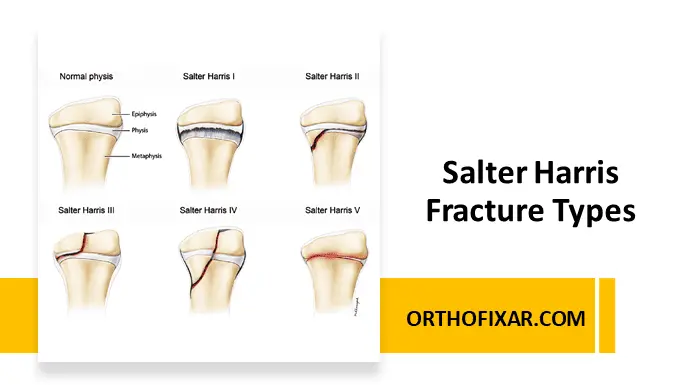
A Salter Harris fracture is a pediatric fracture involving the physis (growth plate) of an immature skeleton. These injuries are among the most important fractures in children because damage to the growth plate may result in premature physeal closure, limb length discrepancy, angular deformity, or permanent growth disturbance.
The classic Salter Harris classification describes five major fracture patterns involving the growth plate. Later, the Peterson classification expanded this system to include additional clinically relevant physeal injuries.
Growth plate fractures account for approximately 15–30% of pediatric fractures, with the distal radius, distal tibia, and phalanges among the most commonly affected locations.
What is the Physis (Growth Plate)?
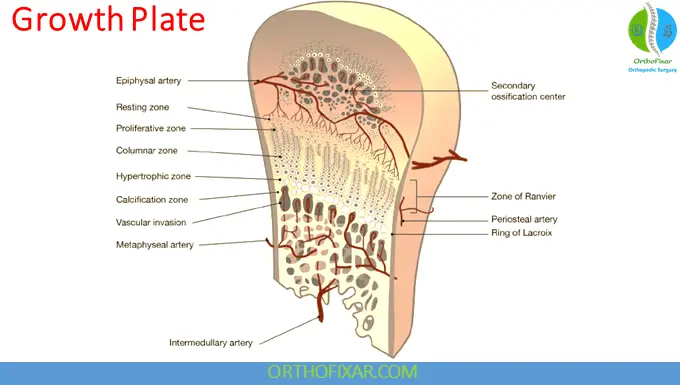
The physis is a cartilaginous structure located between the metaphysis and epiphysis in growing children and adolescents. It is responsible for longitudinal bone growth.
The physis contains several histologic zones:
- Resting (reserve) zone
- Proliferative zone
- Hypertrophic zone
- Calcification zone
Injury severity and long-term prognosis depend on which zones are disrupted.
Salter Harris Classification Overview
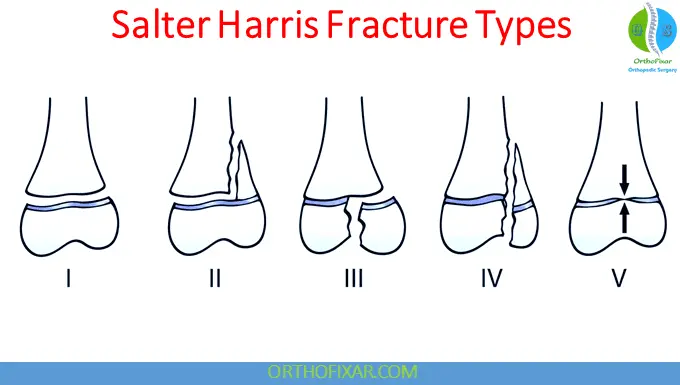
The traditional Salter Harris system classifies physeal fractures into five types (I–V).
| Type | Fracture Pattern | Prognosis |
|---|---|---|
| Type I | Through physis only | Excellent |
| Type II | Through physis and metaphysis | Excellent |
| Type III | Through physis and epiphysis | Guarded |
| Type IV | Through metaphysis, physis, and epiphysis | Guarded |
| Type V | Crush injury to physis | Poor |
A common Salter Harris Fracture mnemonic used in orthopedic education is:
SALTER
- S = Straight across (Type I)
- A = Above (Type II)
- L = Lower (Type III)
- T = Through (Type IV)
- ER = Erasure/crush (Type V)
Salter Harris Fracture Type I
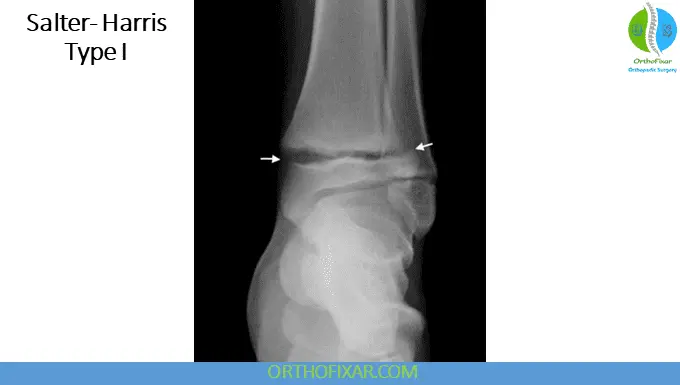
A Salter-Harris fracture type I is a transphyseal fracture entirely within the growth plate.
The fracture traverses the hypertrophic and calcified zones while preserving the reserve and proliferative zones.
Key Features
- Fracture line limited to the physis
- No metaphyseal or epiphyseal involvement
- Common in younger children
- Radiographs may appear normal
Clinical Findings
Diagnosis is often clinical and includes:
- Localized tenderness over the physis
- Swelling
- Pain with weight-bearing or motion
Prognosis
The prognosis is usually excellent because the germinal layer remains intact. However, displaced injuries may still lead to growth arrest.
Salter-Harris Fracture Type II
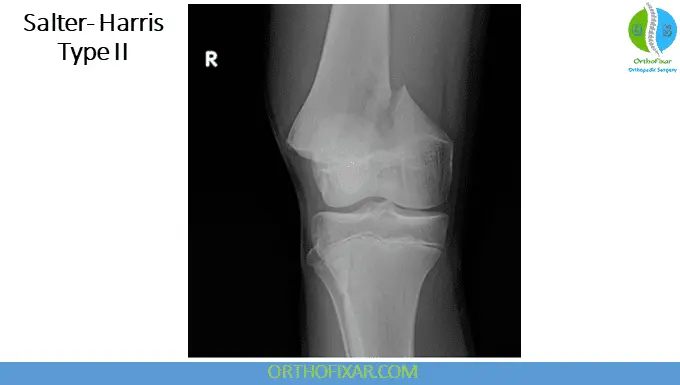
A Salter Harris fracture type II extends through the physis and exits through the metaphysis.
The metaphyseal fragment is called the Thurston-Holland fragment.
Key Features
- Most common Salter-Harris fracture
- Intact periosteal hinge
- Metaphyseal involvement without articular extension
Prognosis
Generally excellent, especially when anatomic alignment is restored early.
Displaced fractures may still cause:
- Partial growth arrest
- Angular deformity
- Limb length discrepancy
Salter Harris Fracture Type III
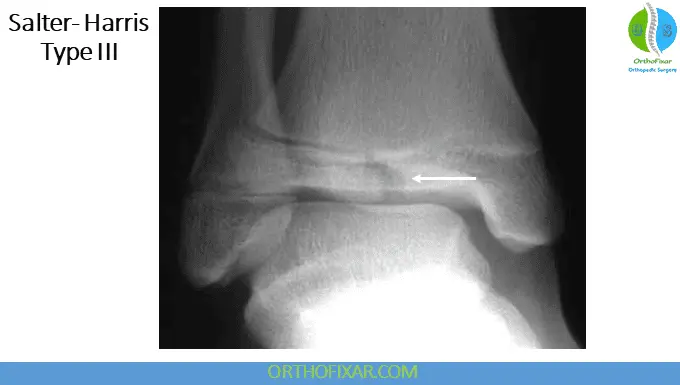
A Salter Harris fracture type III extends from the physis into the epiphysis and usually enters the articular surface.
Key Features
- Intra-articular injury
- Disruption of reserve and proliferative zones
- Requires precise reduction
Treatment Principles
- Anatomic reduction is essential
- Fixation should avoid crossing the physis whenever possible
- CT imaging may help define fracture anatomy
Prognosis
Guarded due to increased risk of:
- Partial growth arrest
- Joint incongruity
- Angular deformity
- Early osteoarthritis
Salter Harris Fracture Type IV
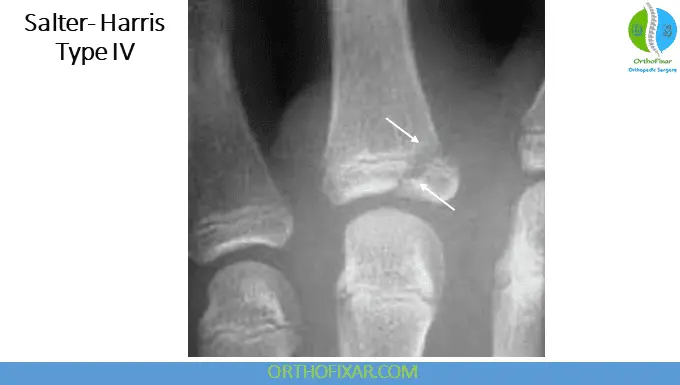
A Salter Harris fracture type IV traverses the epiphysis, physis, and metaphysis.
Key Features
- Crosses all physeal zones
- Intra-articular extension
- High risk for growth disturbance
Treatment
- Accurate reduction mandatory
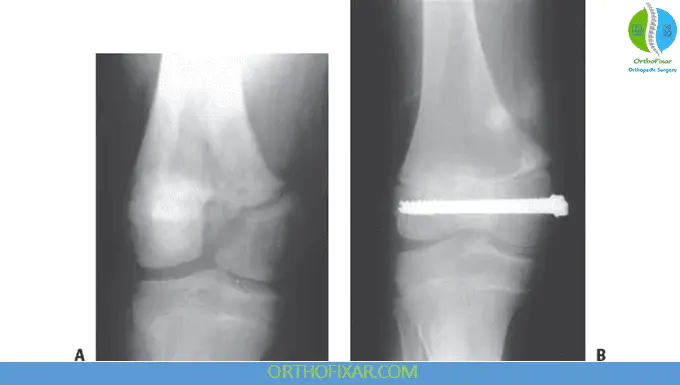
- Often requires surgical fixation
- Restoration of joint congruity is critical
Prognosis
The prognosis is guarded because:
- Growth arrest is common
- Angular deformity may develop
- Articular cartilage injury may cause long-term dysfunction
Salter Harris Fracture Type V
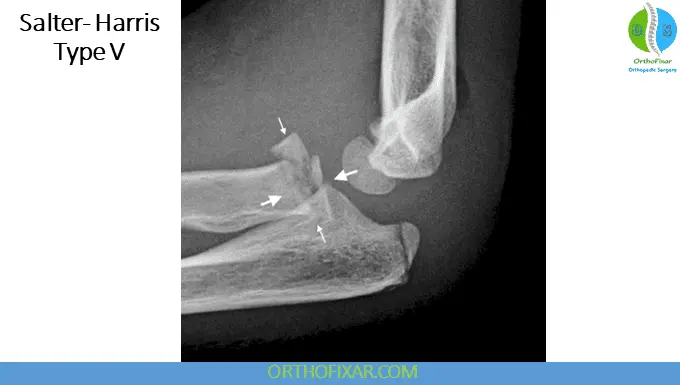
A Salter-Harris fracture type V is a crush injury to the physis.
Key Features
- Compression injury to growth plate
- Often initially radiographically occult
- Diagnosis commonly retrospective
Clinical Importance
Children later present with:
- Premature physeal closure
- Limb deformity
- Limb length discrepancy
Prognosis
Poor, because irreversible damage to the germinal layer frequently occurs.
Peterson Classification of Physeal Fractures
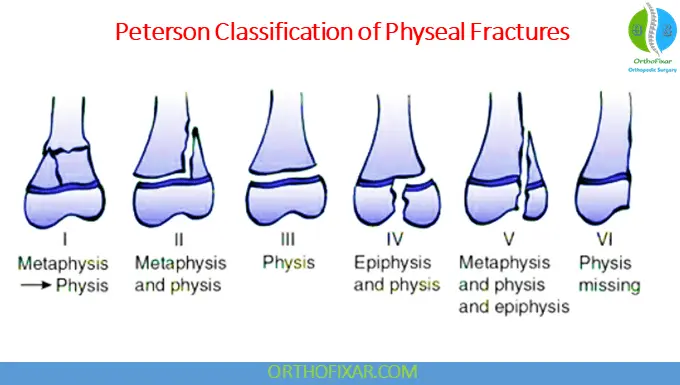
The Peterson classification expanded the Salter Harris system by adding two additional fracture patterns.
Peterson Type I
A transverse metaphyseal fracture with longitudinal extension into the physis.
This injury is subclassified according to:
- Metaphyseal comminution
- Fracture morphology
- Extent of physeal involvement
Peterson Type VI
A partial physeal loss injury.
These devastating injuries are increasingly associated with:
- Lawn mower trauma
- Road-drag injuries
- High-energy open injuries
Associated complications include:
- Soft tissue loss
- Neurovascular injury
- Bone loss
- Epiphyseal destruction
Diagnosis of Salter Harris Fractures
Clinical Evaluation
Important clinical findings include:
- Localized physeal tenderness
- Swelling
- Reduced range of motion
- Inability to bear weight
In children, tenderness directly over a growth plate should be treated as a physeal injury until proven otherwise.
Imaging
Plain Radiographs
Standard evaluation includes:
- AP view
- Lateral view
- Oblique views when necessary
Type I injuries may appear normal radiographically.
CT Scan
Useful for:
- Type III fractures
- Type IV fractures
- Surgical planning
MRI
MRI can identify:
- Occult physeal injury
- Cartilage damage
- Early physeal bar formation
Treatment of Salter Harris Fractures
Nonoperative Management
Indications include:
- Nondisplaced fractures
- Stable injuries
- Most Type I and II fractures
Treatment options:
- Casting
- Splinting
- Activity restriction
Surgical Management
Indications include:
- Displaced Type III and IV fractures
- Irreducible fractures
- Intra-articular incongruity
- Growth plate entrapment
Surgical Goals
- Restore anatomy
- Preserve the physis
- Minimize physeal damage
- Achieve stable fixation
Complications of Growth Plate Fractures
Potential complications include:
- Premature physeal closure
- Partial growth arrest
- Angular deformity
- Limb length discrepancy
- Joint incongruity
- Osteoarthritis
Risk increases with:
- High-grade injuries
- Delayed treatment
- Repeated reduction attempts
- Severe displacement
Prognosis
Prognosis depends on:
- Fracture type
- Degree of displacement
- Patient age
- Accuracy of reduction
- Associated soft tissue injury
Best Prognosis
- Type I
- Type II
Worst Prognosis
- Type V
- Peterson Type VI
Long-term follow-up is essential in pediatric physeal injuries to detect growth disturbance early.
Key Takeaways
- Salter Harris fractures involve the pediatric growth plate.
- Type I and II injuries generally have excellent outcomes.
- Type III and IV fractures are intra-articular and require anatomic reduction.
- Type V injuries are crush injuries with poor prognosis.
- The Peterson classification expands Salter-Harris to include additional clinically important patterns.
- Early diagnosis and appropriate treatment are critical to preventing growth arrest and deformity.
Frequently Asked Questions (FAQs)
What is the most common Salter Harris fracture?
Salter-Harris type II fractures are the most common physeal injuries in children.
Which Salter-Harris fracture has the worst prognosis?
Type V fractures have the worst prognosis because they involve crush injury to the growth plate.
Can Salter-Harris fractures affect bone growth?
Yes. Growth arrest, angular deformity, and limb length discrepancy may occur, particularly in Types III–V injuries.
Are Salter-Harris fractures surgical emergencies?
Not all require surgery, but displaced Type III and IV injuries often need urgent orthopedic evaluation and operative fixation.
References & More
- Levine RH, Thomas A, Nezwek TA, et al. Salter-Harris Fracture. [Updated 2023 Aug 10]. In: StatPearls [Internet]. Treasure Island (FL): StatPearls Publishing; 2026 Jan-. Available from: https://www.ncbi.nlm.nih.gov/books/NBK430688/
- Waseem M, Taqi M, Marquart MJ. Pediatric Physeal Injuries Overview. [Updated 2024 Oct 1]. In: StatPearls [Internet]. Treasure Island (FL): StatPearls Publishing; 2026 Jan-. Available from: https://www.ncbi.nlm.nih.gov/books/NBK560546/
- Cepela DJ, Tartaglione JP, Dooley TP, Patel PN. Classifications In Brief: Salter-Harris Classification of Pediatric Physeal Fractures. Clin Orthop Relat Res. 2016 Nov;474(11):2531-2537. doi: 10.1007/s11999-016-4891-3. Epub 2016 May 20. PMID: 27206505; PMCID: PMC5052189. Pubmed
- Egol KA. Handbook of fractures. 6th ed. Philadelphia: Lippincott Williams & Wilkins; 2019.