The Glasgow Coma Scale (GCS) is a standardized neurological tool used to assess a patient’s level of consciousness, particularly in acute settings such as trauma, emergency medicine, and intensive care. Developed in 1974 by Teasdale and Jennett, it remains one of the most reliable and widely used scoring systems in clinical practice.
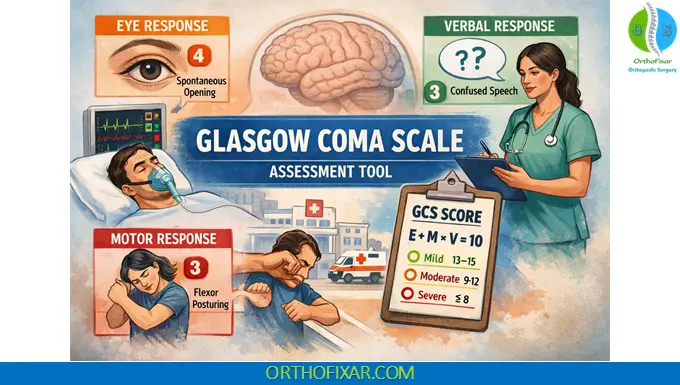
The Glasgow Coma Scale evaluates three key components: eye opening, motor response, and verbal response, providing a reproducible score that helps guide diagnosis, management, and prognosis.
Components of the Glasgow Coma Scale
The total GCS score is calculated as the sum of three individual components:
1. Eye Opening Response (E)
| Response | Score |
|---|---|
| Spontaneous | 4 |
| To speech | 3 |
| To pain | 2 |
| None | 1 |
2. Best Motor Response (M)
| Response | Score |
|---|---|
| Obeys commands | 6 |
| Localizes to stimulus | 5 |
| Withdraws to stimulus | 4 |
| Flexor posturing (decorticate) | 3 |
| Extensor posturing (decerebrate) | 2 |
| None | 1 |
3. Verbal Response (V)
| Response | Score |
|---|---|
| Oriented | 5 |
| Confused conversation | 4 |
| Inappropriate words | 3 |
| Incomprehensible sounds | 2 |
| None | 1 |
Glasgow Coma Scale Score Calculation
GCS = E + M + V
- Minimum score: 3 (deep coma or death)
- Maximum score: 15 (fully alert and oriented)
Interpretation of GCS Scores
| GCS Score | Severity of Brain Injury |
|---|---|
| 13–15 | Mild |
| 9–12 | Moderate |
| ≤8 | Severe (coma) |
A GCS score ≤8 is clinically significant and typically indicates the need for airway protection (intubation) due to impaired consciousness.
Clinical Significance
The Glasgow Coma Scale is essential in:
- Trauma assessment (especially traumatic brain injury)
- Monitoring neurological status over time
- Guiding emergency management decisions
- Predicting outcomes and prognosis
According to evidence from peer-reviewed literature (e.g., PubMed-indexed studies), serial GCS measurements are more valuable than a single score, as trends can indicate neurological deterioration or improvement.
See Also: Skull Fracture Overview & Treatment
Indications for Trauma Center Referral
Patients should be urgently referred to a trauma center if they present with:
- GCS < 13
- Systolic blood pressure < 90 mmHg
- Respiratory rate > 29 or < 10 breaths/min
These findings suggest potentially life-threatening injuries that cannot be adequately evaluated by physical examination alone and require advanced imaging and multidisciplinary care.
Limitations of the GCS
Despite its widespread use, the Glasgow Coma Scale has some limitations:
- Intubated patients cannot be assessed for verbal response
- Sedation or intoxication may alter accuracy
- Language barriers may affect verbal scoring
- Does not assess brainstem reflexes
Clinicians often use modified versions (e.g., “GCS-T” for intubated patients) or combine GCS with other neurological assessments.
Practical Tips for Clinical Use
- Always assess all three components separately
- Document scores in full format (e.g., E3 V4 M5 = GCS 12)
- Repeat assessments regularly for trending
- Correlate findings with clinical context and imaging
Conclusion
The Glasgow Coma Scale is a cornerstone of neurological assessment, offering a simple yet powerful method for evaluating consciousness. Its consistent application improves communication among healthcare providers and supports timely, evidence-based clinical decisions.
Glasgow Coma Scale Online Calculator
Glasgow Coma Scale (GCS) Calculator
References & More
- Egol KA. Handbook of fractures. 6th ed. Philadelphia: Lippincott Williams & Wilkins; 2019.
- Munakomi S, Margetis K, Iverson LM. Glasgow Coma Scale. [Updated 2025 Jun 23]. In: StatPearls [Internet]. Treasure Island (FL): StatPearls Publishing; 2026 Jan-. Available from: Pubmed
- Munakomi S, Margetis K, Iverson LM. Glasgow Coma Scale. 2025 Jun 23. In: StatPearls [Internet]. Treasure Island (FL): StatPearls Publishing; 2026 Jan–. PMID: 30020670. Pubmed