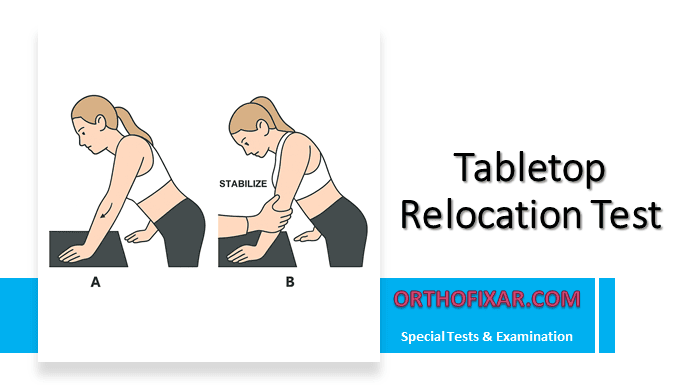
The Tabletop Relocation Test is used to evaluate posterolateral rotary instability (PLRI) of the elbow joint. This test is valuable in assessing patients with lateral elbow pain and suspected instability patterns involving the lateral ulnar collateral ligament complex.
How to perform the Tabletop Relocation Test?
The patient stands facing a standard examination table with their symptomatic arm positioned over the lateral edge of the table. The positioning requirements include:
- Arm placement: The affected arm extends over the table’s lateral border
- Elbow position: Fully extended at the start
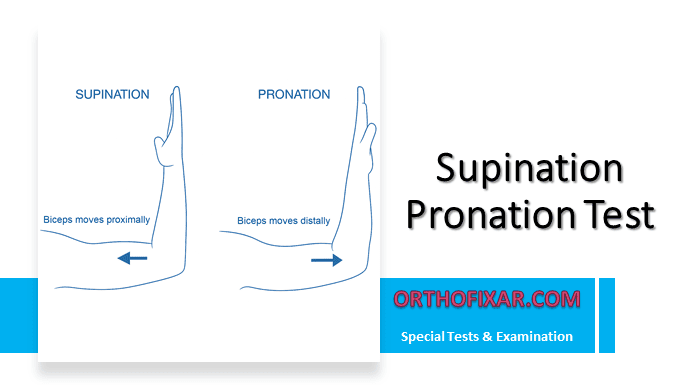
- Forearm orientation: Maintained in supination throughout the test
- Patient stance: Comfortable standing position facing the table
Phase 1: Provocative Maneuver
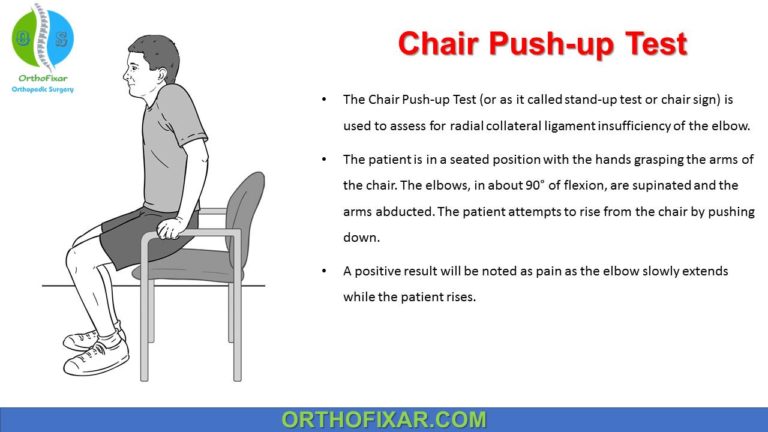
The initial phase the patient performs a controlled push-up motion with specific biomechanical requirements:
- The elbow moves laterally during flexion
- The forearm remains supinated throughout the movement
- The patient slowly flexes the elbow in a controlled “down” phase
- The examiner observes for symptom reproduction
Positive findings in Phase 1 include pain and apprehension occurring at approximately 40 degrees of elbow flexion. This response indicates potential posterolateral rotary instability as the radial head subluxates posterolaterally during the flexion motion.
See Also: Lateral Pivot Shift Test Elbow

Phase 2: Stabilization Maneuver
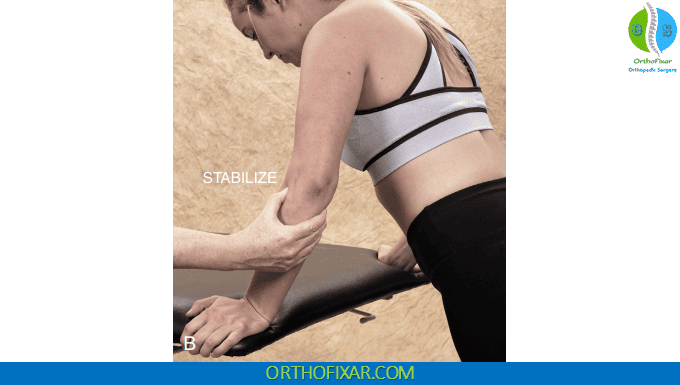
The second phase confirms the diagnosis through manual stabilization of the radial head:
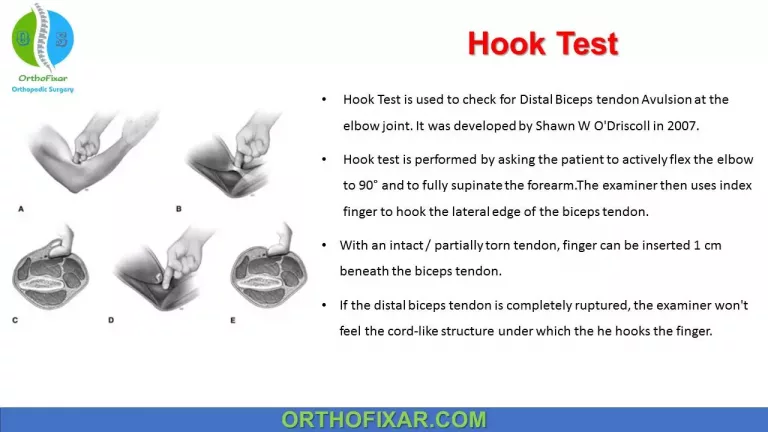
- The examiner places their thumb directly over the patient’s radial head
- Firm pressure is applied to stabilize the radial head position
- The patient repeats the identical push-up movement
- The examiner maintains thumb pressure throughout the flexion arc
Confirmatory findings in Phase 2 demonstrate relief of both pain and apprehension when the radial head is manually stabilized. This improvement occurs because the examiner’s thumb prevents the pathological subluxation of the radial head.
Phase 3: Release Confirmation
To complete the Tabletop Relocation Test, the examiner removes thumb pressure while the patient maintains the elbow position. The return of pain and apprehension upon release provides final confirmation of posterolateral rotary instability.
Positive Tabletop Relocation
A positive Tabletop Relocation Test indicates posterolateral rotary instability of the elbow, suggesting:
- Lateral ulnar collateral ligament insufficiency
- Possible associated capsular laxity
- Potential lateral epicondyle pathology
- Risk for recurrent subluxation episodes
Biomechanical Rationale
The Tabletop Relocation Test exploits the specific mechanics of posterolateral instability. During elbow flexion with the forearm supinated, an unstable elbow allows the radial head to subluxate posterolaterally. Manual stabilization prevents this pathological motion, thereby eliminating symptoms and confirming the diagnosis.
Chinnakonda H V Arvind and David G Hargreaves describe a new clinical test called Tabletop Relocation Test for the assessment of posterolateral rotatory instability. This has been assessed in 8 patients who have been diagnosed with posterolateral rotatory instability. Of these, 6 have undergone surgical reconstruction of the lateral ulnar collateral ligament, and the clinical test has subsequently been negative with resolution of their symptoms.
References & More
- Orthopedic Physical Assessment by David J. Magee, 7th Edition.
- Arvind CH, Hargeaves DG. Tabletop relocationtest: a new clinical test for posterolateral rotaryinstability of the elbow. J Shoulder Elbow Surg.2006;15(6):707–708. Pubmed
- Smith MV, Lamplot JD, Wright RW, Brophy RH. Comprehensive review of the elbow physical examination. J Am Acad Orthop Surg. 2018;26(19):678–687. Pubmed
- Anakwenze OA, Kancherla VK, Iyengar J, et al. Posterolateral rotary instability of the elbow. Am J Sports Med. 2013;42(2):485–491. Pubmed
- Regan W, Lapner PC. Prospective evaluation of two diagnostic apprehension signs for posterolateral instability of the elbow. J Shoulder Elbow Surg. 2006;15(3):344–346. Pubmed