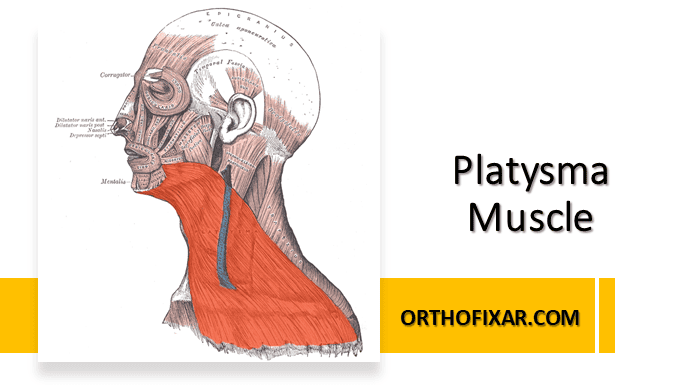
The platysma muscle (G. flat plate) is a broad, thin sheet of muscle in the subcutaneous tissue of the neck. It’s the is the most superficial muscle layer in the face. It covers most of the anterior and lateral aspect of the neck. It is classified as a muscle of facial expression (mimetic muscle) because of its embryological origin (second pharyngeal arch) and its innervation by the facial nerve.
Like other facial and scalp muscles, the platysma develops from a continuous sheet of musculature derived from mesenchyme in the 2nd pharyngeal arch of the embryo and is supplied by branches of the facial nerve, CN VII. The external jugular vein (EJV), descending from the angle of the mandible to the middle of the clavicle, and the main cutaneous nerves of the neck are deep to this muscle.
Platysma Muscle Anatomy
Origin and Insertion
The platysma muscle originates from the skin and fascia of infra- and supraclavicular regions (the fascia that covers the upper segments of the deltoid and pectoralis muscles), its fibers run superiorly and medially from the deltoid and pectoral region in a rostral-caudal direction and inserts on the lower border of mandible, skin of buccal/cheek region, lower lip, modiolus, orbicularis oris muscle.

Innervation
It gets its innervation is via the facial nerve (cranial nerve VII), this confirms its classification as a facial expression muscle rather than a typical neck muscle.
See Also: The 12 Cranial Nerves Anatomy & Function
Blood Supply
The Platysma Muscle gets its blood supply from the submental artery (facial artery) and suprascapular artery (thyrocervical trunk) which are branches of the external carotid artery.
Actions
- Acting from its superior attachment to the mandible, the platysma tenses the skin, producing vertical skin ridges and releasing pressure on the superficial veins. Men commonly use actions of the platysma when shaving their necks and when easing tight collars.
- Acting from its inferior attachment, the platysma helps depress the mandible and draw the corners of the mouth inferiorly, as in a grimace.
- As a muscle of facial expression, the platysma serves to convey tension or stress.
| Origin | Skin and fascia of infra- and supraclavicular regions |
| Insertion | Lower border of mandible, skin of buccal/cheek region, lower lip, modiolus, orbicularis oris muscle |
| Innervation | Facial nerve (cranial nerve VII). |
| Blood Supply | Submental artery (facial artery), suprascapular artery (thyrocervical trunk) |
| Action | Depresses mandible and angle of mouth, tenses skin of lower face and anterior neck |
In 75%, the medial fibers in the submental area interdigitate with the contralateral platysma muscle for up to 1 to 2 cm below the chin. In 15%, the muscle fibers interdigitate all the way down to the thyroid cartilage, and in 10% the medial platysmal fibers do not interdigitate.
Clinical Significance
1. Surgical Importance
- Due to its superficial location, the platysma is encountered early in:
- Neck dissections
- Trauma exploration
- Important landmark for underlying neurovascular structures
2. Facial Nerve Injury
- Damage to the facial nerve (cervical branch) can lead to:
- Loss of lower facial expression
- Asymmetry of the neck and jaw
3. Aging Changes
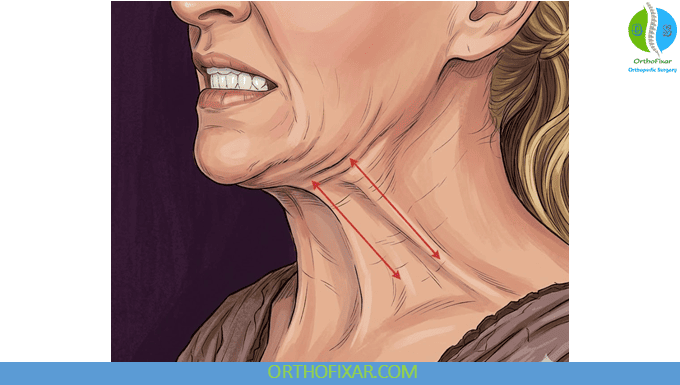
- Platysmal banding:
- Visible vertical bands in the neck with aging
- Common target in cosmetic procedures (e.g., botulinum toxin, platysmaplasty)
Paralysis of the platysma, resulting from injury to the cervical branch of the facial nerve, causes the skin to fall away from the neck in slack folds. Consequently, during surgical dissections of the neck, extra care is necessary to preserve the cervical branch of the facial nerve. When suturing wounds of the neck, surgeons carefully suture the skin and edges of the platysma. If this is not done, the skin wound will be distracted (pulled in different directions) by the contracting platysma muscle fibers, and a disfiguring scar may develop.
References & More
- Gray’s Anatomy: The Anatomical Basis of Clinical Practice
- Clinically Oriented Anatomy – 8th Edition
- Hoerter JE, Patel BC. Anatomy, Head and Neck, Platysma. [Updated 2023 Aug 7]. In: StatPearls [Internet]. Treasure Island (FL): StatPearls Publishing; 2024 Jan-. Available from: Pubmed