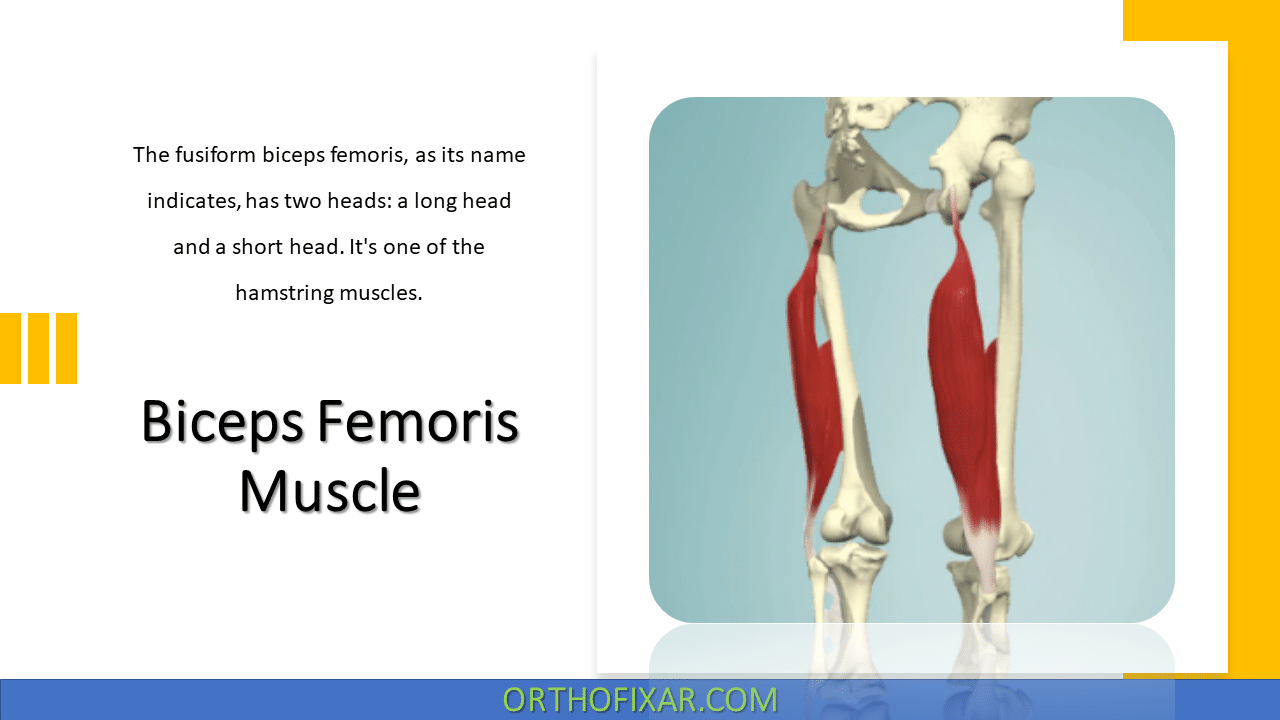
The biceps femoris muscle is a key component of the posterior thigh, belonging to the hamstring muscle group. It plays a central role in knee flexion, hip extension, and lower limb stability. A clear understanding of its anatomy is essential for clinicians, physiotherapists, and medical students.
The fusiform biceps femoris, as its name indicates, has two heads: a long head and a short head.
The hamstring muscles are (1) semitendinosus, (2) semimembranosus, and (3) biceps femoris (long head). The hamstring muscles (“hamstrings” for short) share the following common features:
- Proximal attachment to the ischial tuberosity deep to the gluteus maximus.
- Distal attachment to the bones of the leg.
- Thus, they span and act on two joints, producing extension at the hip joint and flexion at the knee joint.
- Innervation by the tibial division of the sciatic nerve.
The long head of the biceps femoris meets all these conditions, but the short head of the biceps, the fourth muscle of the posterior compartment, fails to meet any of them.
See Also: Hamstring Muscles
Biceps Femoris Muscle Anatomy
Origin
- Long Head
- Originates from the ischial tuberosity of the pelvis
- Shares a common tendon with the semitendinosus muscle
- Short Head
- Originates from:
- Lateral lip of the linea aspera
- Lateral supracondylar line of the femur
- Originates from:
Insertion
- Both heads merge distally to form a common tendon
- Inserts at:
- Head of the fibula
- Lateral condyle of the tibia (via expansions)
Innervation
- Long Head
- Innervated by the tibial division of the sciatic nerve
- Short Head
- Innervated by the common fibular (peroneal) division of the sciatic nerve
Blood Supply
- Primarily supplied by:
- Perforating branches of the profunda femoris artery
- Inferior gluteal artery (contribution to proximal portion)
Function
The biceps femoris contributes to several important lower limb movements:
- Knee Flexion (both heads)
- Hip Extension (long head only)
- Lateral Rotation of the leg (when the knee is flexed)
- Assists in pelvic stabilization during gait
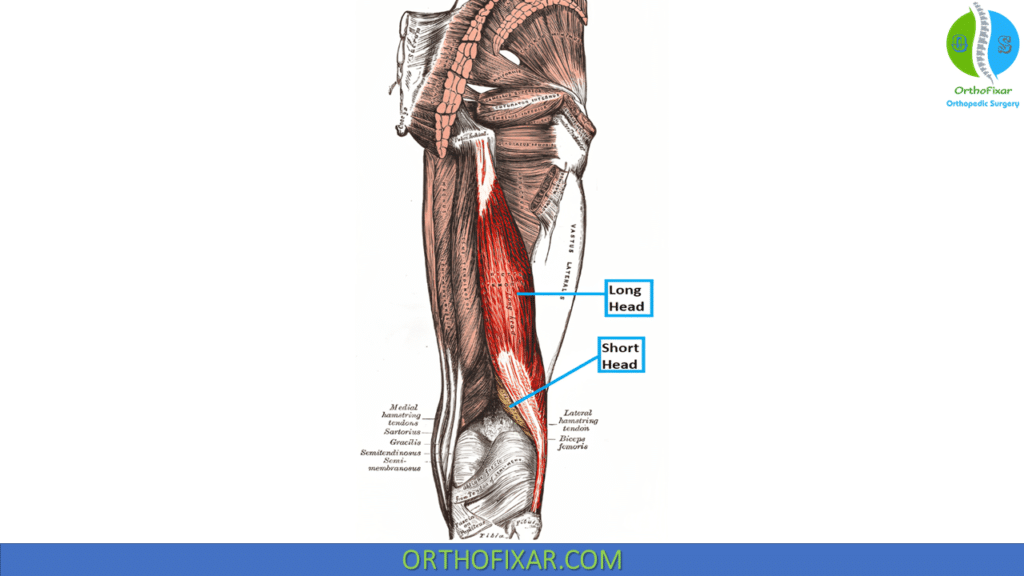
In the inferior part of the thigh, the long head becomes tendinous and is joined by the short head. The rounded common tendon of these heads attaches to the head of the fibula and can easily be seen and felt as it passes the knee, especially when the knee is flexed against resistance.
The long head of the biceps femoris crosses and provides protection for the sciatic nerve after it descends from the gluteal region into the posterior aspect of the thigh. When the sciatic nerve divides into its terminal branches, the lateral branch (common fibular nerve) continues this relationship, running with the biceps femoris tendon.
| Origin | Long Head: Common tendon with semitendinosus from superior medial quadrant of the posterior portion of the ischial tuberosity Short Head: Lateral lip of linea aspera, lateral supracondylar ridge of femur, lateral intermuscular septum of thigh. |
| Insertion | Primarily on fibular head; also on lateral collateral ligament and lateral tibial condyle. |
| Innervation | Long Head: Tibial nerve (L5, S1, S2) Short Head: Common peroneal nerve (L5, S1, S2) |
| Blood Supply | Perforating branches of profunda femoris artery. Inferior gluteal artery. The superior muscular branches of popliteal artery. |
| Action | Flexes the knee, Also rotates the tibia laterally; long head also extends the hip joint. |
Clinical Relevance
Hamstring Injuries
The biceps femoris is the most commonly injured hamstring muscle, especially in athletes involved in sprinting or sudden acceleration.
- Mechanism: Eccentric contraction during terminal swing phase
- Symptoms:
- Sudden posterior thigh pain
- Weakness in knee flexion
- Local tenderness and swelling
See Also: Hamstring Strain
Sciatic Nerve Involvement
Due to its innervation:
- Injury to the sciatic nerve may lead to:
- Weak knee flexion
- Impaired lateral rotation
- Muscle atrophy
Tendinopathy & Avulsion
- Distal tendon injuries can affect fibular head stability
- Proximal avulsion injuries (ischial tuberosity) may occur in high-impact sports
References & More
- Clinically Oriented Anatomy – 8th Edition
- Standring S. Gray’s Anatomy: The Anatomical Basis of Clinical Practice Moore KL, Dalley AF, Agur AMR. Clinically Oriented Anatomy
- Netter FH. Atlas of Human Anatomy
- Rodgers CD, Raja A. Anatomy, Bony Pelvis and Lower Limb, Hamstring Muscle. [Updated 2023 Apr 1]. In: StatPearls [Internet]. Treasure Island (FL): StatPearls Publishing; 2023 Jan-. Available from: Pubmed
- Llurda-Almuzara L, Labata-Lezaun N, López-de-Celis C, Aiguadé-Aiguadé R, Romaní-Sánchez S, Rodríguez-Sanz J, Fernández-de-Las-Peñas C, Pérez-Bellmunt A. Biceps Femoris Activation during Hamstring Strength Exercises: A Systematic Review. Int J Environ Res Public Health. 2021 Aug 18;18(16):8733. doi: 10.3390/ijerph18168733. PMID: 34444481; PMCID: PMC8393607. Pubmed